Climate change made storm that devastated Libya far more likely and intense, scientists say

Advertisement

Advertise with us

The devastating storm that dumped torrential rains along the Libyan coast this month was up to 50 times more likely to occur and 50% more intense because of human-caused climate change, according to an analysis released Tuesday.

Read this article for free:


or

Already have an account? Log in here »

To continue reading, please subscribe:

Subscribe and receive a limited-edition Free Press branded hat or tote.

Digital Subscription

One year of digital access for only $205*

  • Enjoy unlimited reading on winnipegfreepress.com
  • Read the E-Edition, our digital replica newspaper
  • Access News Break, our award-winning app
  • Play interactive puzzles

*First annual payment billed as $205.00 + GST for one year. This annual subscription will automatically renew at $233.00 + GST every 52 weeks (10% off the regular annual price of $259.35). Offer available to new and qualified returning subscribers only. Cancel any time.

To continue reading, please subscribe:

Add Free Press access to your Brandon Sun subscription for only an additional

$1 for the first 4 weeks*

  • Enjoy unlimited reading on winnipegfreepress.com
  • Read the E-Edition, our digital replica newspaper
  • Access News Break, our award-winning app
  • Play interactive puzzles
Start now

*Your next Brandon Sun subscription payment will increase by $1.00 and you will be charged $17.95 plus GST for four weeks. After four weeks, your payment will increase to $24.95 plus GST every four weeks.

Hey there, time traveller!
This article was published 19/09/2023 (1063 days ago), so information in it may no longer be current.

The devastating storm that dumped torrential rains along the Libyan coast this month was up to 50 times more likely to occur and 50% more intense because of human-caused climate change, according to an analysis released Tuesday.

Before crossing the Mediterranean, the storm raged for four days and caused extensive damage in central Greece and parts of Bulgaria and Turkey, a region where such extreme storms are up to 10 times more likely and up to 40% more intense because of climate change, scientists said.

Heavy one-day rains from Mediterranean storm Daniel caused massive flooding across eastern Libya that overwhelmed two dams, sending a wall of water through the coastal city of Derna that destroyed entire neighborhoods and swept bridges, cars and people out to sea. The death toll has varied, with government officials and aid agencies giving tallies ranging from about 4,000 to 11,000 dead.

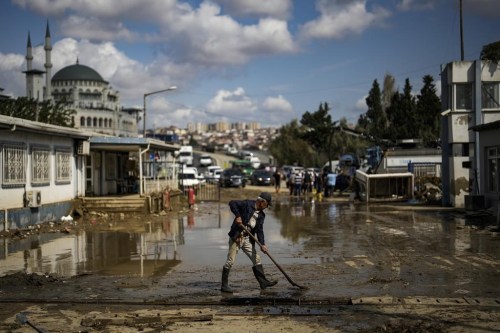
FILE - A man cleans a street on the aftermath of floods caused by heavy rains in Istanbul, Turkey, Sept. 6, 2023. Before crossing the Mediterranean, the devastating storm that dumped torrential rains along the Libyan coast raged for days and caused extensive damage in central Greece and parts of Bulgaria and Turkey, a region where such extreme storms are up to 10 times more likely and up to 40% more intense because of climate change, scientists said. (AP Photo/Khalil Hamra, File)

The analysis was conducted by the World Weather Attribution group, which aims to quickly evaluate the possible role of climate change in extreme weather events.

It also acknowledges that the impacts of the storms were made worse by other factors such as deforestation and urbanization in Greece that changed the landscape and exposed more people to flooding, and by conflicts in Libya that likely led to lack of maintenance on the dams and communications failures. What’s more, the dams might not have been designed to withstand such an extreme rainfall in the first place, they say.

“Through these events, we are already seeing how climate change and human factors can combine to create compounding and cascading impact,” said Maja Vahlberg from the Red Cross Red Crescent Climate Centre in the Netherlands and one of 13 researchers who collaborated on the analysis.

Researchers looked at one-day maximum annual rainfall in a region over Libya, calculating that this month’s storm was a once in 300- to 600-year event in today’s climate. They also looked at four-day maximum rainfall in the summer season over a region that includes Greece, Bulgaria and Turkey, finding the recent deluge would be expected to occur once every five to 10 years.

To assess the role of climate change, researchers then combined observations of rainfall and climate models to determine if there had been changes in the likelihood and intensity of those maximum rainfalls.

Researchers acknowledged that there was high uncertainty in their estimates, and the data includes the possibility that warming played no role because the climate models could not accurately capture the very intense heavy rainfall events.

But they gave equal weight to their observations and the climate models, and said they were confident in their findings because it’s well-established physics that warming causes the atmosphere to retain more water vapor — about 7% more for every 1 degree Celsius of warming — and nothing else occurred to counteract that effect.

“It would be really careless to say there was no change (based on the models),” because of what they know from physics about the effects of warming on the intensity of rainfall in low-pressure systems, said Friederike Otto, a scientist at Imperial College London’s Grantham Institute.

Florida State University climate scientist Michael Diamond, who wasn’t involved in the study, said he doesn’t disagree that a warmer atmosphere probably contributed. But he said the analysis differs from most traditional climate studies that start with the baseline assumption that global warming is not changing extreme precipitation, then determine if that is right or wrong.
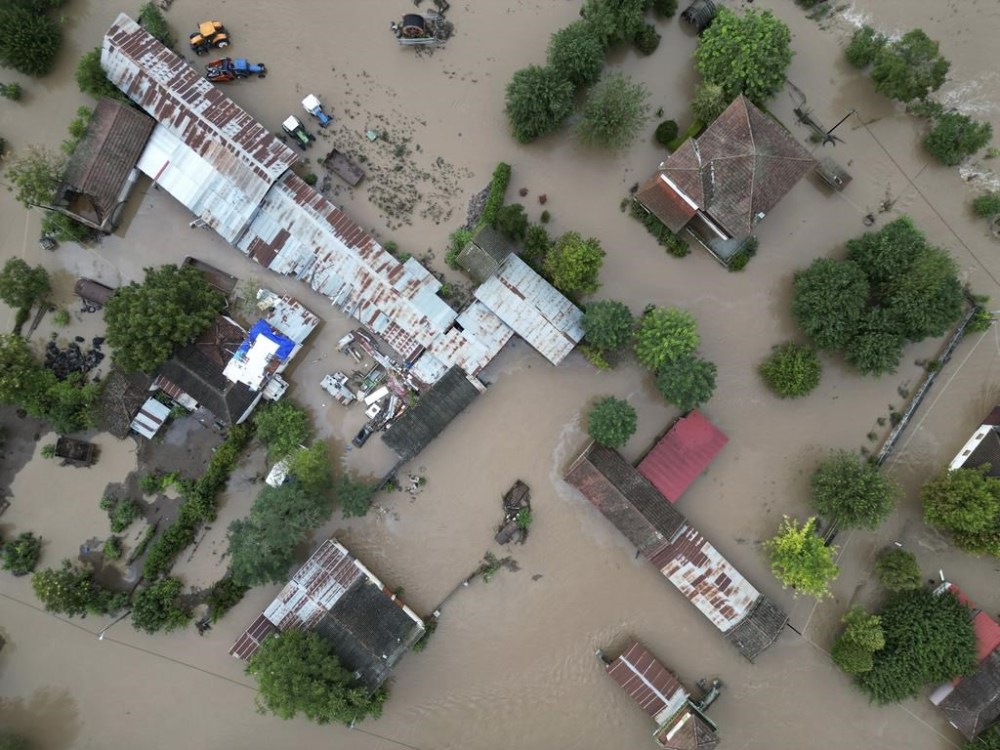
FILE - Floodwaters cover a farm and a house after the country's record rainstorm in the village of Kastro, near Larissa, Thessaly region, central Greece, Sept. 7, 2023. Before crossing the Mediterranean, the devastating storm that dumped torrential rains along the Libyan coast raged for days and caused extensive damage in central Greece and parts of Bulgaria and Turkey, a region where such extreme storms are up to 10 times more likely and up to 40% more intense because of climate change, scientists said. (AP Photo/Vaggelis Kousioras, File)

Even so, the attribution analysis’ approach is useful to those who must act on climate change, including deciding how to build infrastructure that’ll be in place for decades to come, he said. In that case, assuming storms will get worse makes sense, “because that’s probably what’s going to happen just based on the fundamental physics that a warmer atmosphere can hold more water vapor … (and) we have to be prepared for it.”

University of Pennsylvania climate scientist Michael Mann, who was not involved in the analysis, said such weather attribution studies are somewhat useful but don’t capture all the ways that climate change affects weather events. Notably, models used in the analyses don’t account for the fact that, as the poles warm faster than the subtropics, the jet stream is becoming locked into a stationary wavy pattern associated with persistent weather extremes.

“For this reason, my belief is that these attribution studies actually underestimate the impact human-caused climate change is having on these events,” Mann said in an email.

___

Associated Press climate and environmental coverage receives support from several private foundations. See more about AP’s climate initiative here. The AP is solely responsible for all content.

Report Error Submit a Tip

More Stories

‘You vote with your bike’: cyclists celebrate freedoms, call for increased safety

Maggie Macintosh 5 minute read Preview

‘You vote with your bike’: cyclists celebrate freedoms, call for increased safety

Maggie Macintosh 5 minute read Updated: 9:24 AM CDT

Patty Wiens got dressed up in her sparkly, hot pink cowboy boots to pedal and talk politics with more than 100 other people on Sunday.

The founder of Winnipeg’s Fancy Women Bike Ride called on attendees of the 2026 event to ask candidates in the upcoming civic election — a half-dozen of whom were in attendance — about their active transportation platforms.

“We’re here today, in an election year, to remind you that you vote with your bike,” Wiens told a crowd of nearly 120 cyclists gathered on the legislature grounds for the group ride.

“When (city council) candidates come to your door and ask what’s important to you, you’re going to say, ‘I want to ride my bike safely in the city. What are you going to do about it?’”

Read
Updated: 9:24 AM CDT

Climate change made storm that devastated Libya far more likely and intense, scientists say

Tammy Webber, The Associated Press 5 minute read Preview

Climate change made storm that devastated Libya far more likely and intense, scientists say

Tammy Webber, The Associated Press 5 minute read Tuesday, Sep. 19, 2023

The devastating storm that dumped torrential rains along the Libyan coast this month was up to 50 times more likely to occur and 50% more intense because of human-caused climate change, according to an analysis released Tuesday.

Before crossing the Mediterranean, the storm raged for four days and caused extensive damage in central Greece and parts of Bulgaria and Turkey, a region where such extreme storms are up to 10 times more likely and up to 40% more intense because of climate change, scientists said.

Heavy one-day rains from Mediterranean storm Daniel caused massive flooding across eastern Libya that overwhelmed two dams, sending a wall of water through the coastal city of Derna that destroyed entire neighborhoods and swept bridges, cars and people out to sea. The death toll has varied, with government officials and aid agencies giving tallies ranging from about 4,000 to 11,000 dead.

The analysis was conducted by the World Weather Attribution group, which aims to quickly evaluate the possible role of climate change in extreme weather events.

Read
Tuesday, Sep. 19, 2023

Cross-border abduction under investigation

1 minute read Updated: Yesterday at 12:40 PM CDT

A cross-border kidnapping from Winnipeg to Minnesota is under investigation, according to North Dakota state patrol.

A 31-year-old Manitoba man abducted a 37-year-old Manitoba man in Winnipeg and drove across the border into North Dakota, the North Dakota State Highway Patrol said in a Facebook post Sunday. The state patrol said it became aware of the possible abduction Sunday morning and worked with local, federal and Canadian law enforcement to investigate.

Authorities identified a suspect vehicle using cameras at multiple locations and used cell-phone location information and licence-plate reader technology to find the vehicle in Alexandria, Minnesota.

"The victim was able to break free from the suspect and run into a nearby store. The suspect was taken into custody shortly afterward by the Douglas County Sheriff’s Office and Alexandria Police Department. The victim was recovered safely," the North Dakota state patrol's post reads.

Free fix is in: repair café aims to keep items out of landfills

Tiago Resko 3 minute read Preview

Free fix is in: repair café aims to keep items out of landfills

Tiago Resko 3 minute read 6:00 AM CDT

Stephen Kirk wants to give people a chance to fix items they’re not ready to let go of.

The Spence Neighbourhood Association staffer took notice when repair cafés started popping up around the world, and he decided to bring the idea to Winnipeg.

The café invites people to bring broken items like bikes, clothes and small kitchen appliances to the association’s headquarters to get free repairs by a team of skilled volunteers.

“Certainly in our neighbourhood, a lot of people’s motivation is economic, they would rather fix it than have to buy a new one,” said Kirk, the environmental and open spaces coordinator for the Spence Neighbourhood Association.

Read
6:00 AM CDT

Foster mom pleads guilty to assault that left six-year-old-girl paralyzed

Dean Pritchard 4 minute read Preview

Foster mom pleads guilty to assault that left six-year-old-girl paralyzed

Dean Pritchard 4 minute read Friday, Aug. 14, 2026

A Winnipeg foster mother has admitted to violently assaulting her ill foster daughter and leaving her paralyzed after the girl resisted the woman’s efforts to provide her with medication, a court has heard.

Marilyn Keno, 26, pleaded guilty Friday to one count of aggravated assault.

Keno remains in custody and will be sentenced at a later date following the completion of a court-ordered pre-sentence report.

The maximum sentence for aggravated assault is 14 years in prison. Crown attorney Alanna Littman and defence lawyer Jeremy Kostiuk did not disclose what sentences they will be recommending.

Read
Friday, Aug. 14, 2026

Letters, Aug. 17

7 minute read 2:00 AM CDT

Be statesmanlike, Pierre

Re: Canadians have moved on, Poilievre hasn’t (Aug. 7); Poilievre’s trade bluster a desperate bid for attention (Aug. 12)

If I were Pierre Poilievre, I wouldn’t be just thinking about becoming the next prime minister. I’d be thinking about legacy in larger terms — meaning how would I ultimately want to be remembered.

And I would want to be remembered as the politician who, even if not having achieved the ultimate goal of becoming prime minister, left the political world as a respected statesman. As such, with respect to trade and the relationship with the United States, I would be guided by the following maxim found in Tom Brodbeck’s Aug. 12 column: The goal should be to maximize Canada’s leverage while reducing its vulnerability.