Climate change made storm that devastated Libya far more likely and intense, scientists say

Advertisement

Advertise with us

The devastating storm that dumped torrential rains along the Libyan coast this month was up to 50 times more likely to occur and 50% more intense because of human-caused climate change, according to an analysis released Tuesday.

Read this article for free:


or

Already have an account? Log in here »

To continue reading, please subscribe:

Subscribe and receive a limited-edition Free Press branded hat or tote.

Digital Subscription

One year of digital access for only $205*

  • Enjoy unlimited reading on winnipegfreepress.com
  • Read the E-Edition, our digital replica newspaper
  • Access News Break, our award-winning app
  • Play interactive puzzles

*First annual payment billed as $205.00 + GST for one year. This annual subscription will automatically renew at $233.00 + GST every 52 weeks (10% off the regular annual price of $259.35). Offer available to new and qualified returning subscribers only. Cancel any time.

To continue reading, please subscribe:

Add Free Press access to your Brandon Sun subscription for only an additional

$1 for the first 4 weeks*

  • Enjoy unlimited reading on winnipegfreepress.com
  • Read the E-Edition, our digital replica newspaper
  • Access News Break, our award-winning app
  • Play interactive puzzles
Start now

*Your next Brandon Sun subscription payment will increase by $1.00 and you will be charged $17.95 plus GST for four weeks. After four weeks, your payment will increase to $24.95 plus GST every four weeks.

Hey there, time traveller!
This article was published 19/09/2023 (1063 days ago), so information in it may no longer be current.

The devastating storm that dumped torrential rains along the Libyan coast this month was up to 50 times more likely to occur and 50% more intense because of human-caused climate change, according to an analysis released Tuesday.

Before crossing the Mediterranean, the storm raged for four days and caused extensive damage in central Greece and parts of Bulgaria and Turkey, a region where such extreme storms are up to 10 times more likely and up to 40% more intense because of climate change, scientists said.

Heavy one-day rains from Mediterranean storm Daniel caused massive flooding across eastern Libya that overwhelmed two dams, sending a wall of water through the coastal city of Derna that destroyed entire neighborhoods and swept bridges, cars and people out to sea. The death toll has varied, with government officials and aid agencies giving tallies ranging from about 4,000 to 11,000 dead.

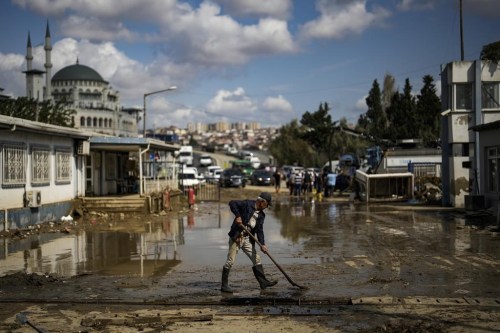
FILE - A man cleans a street on the aftermath of floods caused by heavy rains in Istanbul, Turkey, Sept. 6, 2023. Before crossing the Mediterranean, the devastating storm that dumped torrential rains along the Libyan coast raged for days and caused extensive damage in central Greece and parts of Bulgaria and Turkey, a region where such extreme storms are up to 10 times more likely and up to 40% more intense because of climate change, scientists said. (AP Photo/Khalil Hamra, File)

The analysis was conducted by the World Weather Attribution group, which aims to quickly evaluate the possible role of climate change in extreme weather events.

It also acknowledges that the impacts of the storms were made worse by other factors such as deforestation and urbanization in Greece that changed the landscape and exposed more people to flooding, and by conflicts in Libya that likely led to lack of maintenance on the dams and communications failures. What’s more, the dams might not have been designed to withstand such an extreme rainfall in the first place, they say.

“Through these events, we are already seeing how climate change and human factors can combine to create compounding and cascading impact,” said Maja Vahlberg from the Red Cross Red Crescent Climate Centre in the Netherlands and one of 13 researchers who collaborated on the analysis.

Researchers looked at one-day maximum annual rainfall in a region over Libya, calculating that this month’s storm was a once in 300- to 600-year event in today’s climate. They also looked at four-day maximum rainfall in the summer season over a region that includes Greece, Bulgaria and Turkey, finding the recent deluge would be expected to occur once every five to 10 years.

To assess the role of climate change, researchers then combined observations of rainfall and climate models to determine if there had been changes in the likelihood and intensity of those maximum rainfalls.

Researchers acknowledged that there was high uncertainty in their estimates, and the data includes the possibility that warming played no role because the climate models could not accurately capture the very intense heavy rainfall events.

But they gave equal weight to their observations and the climate models, and said they were confident in their findings because it’s well-established physics that warming causes the atmosphere to retain more water vapor — about 7% more for every 1 degree Celsius of warming — and nothing else occurred to counteract that effect.

“It would be really careless to say there was no change (based on the models),” because of what they know from physics about the effects of warming on the intensity of rainfall in low-pressure systems, said Friederike Otto, a scientist at Imperial College London’s Grantham Institute.

Florida State University climate scientist Michael Diamond, who wasn’t involved in the study, said he doesn’t disagree that a warmer atmosphere probably contributed. But he said the analysis differs from most traditional climate studies that start with the baseline assumption that global warming is not changing extreme precipitation, then determine if that is right or wrong.
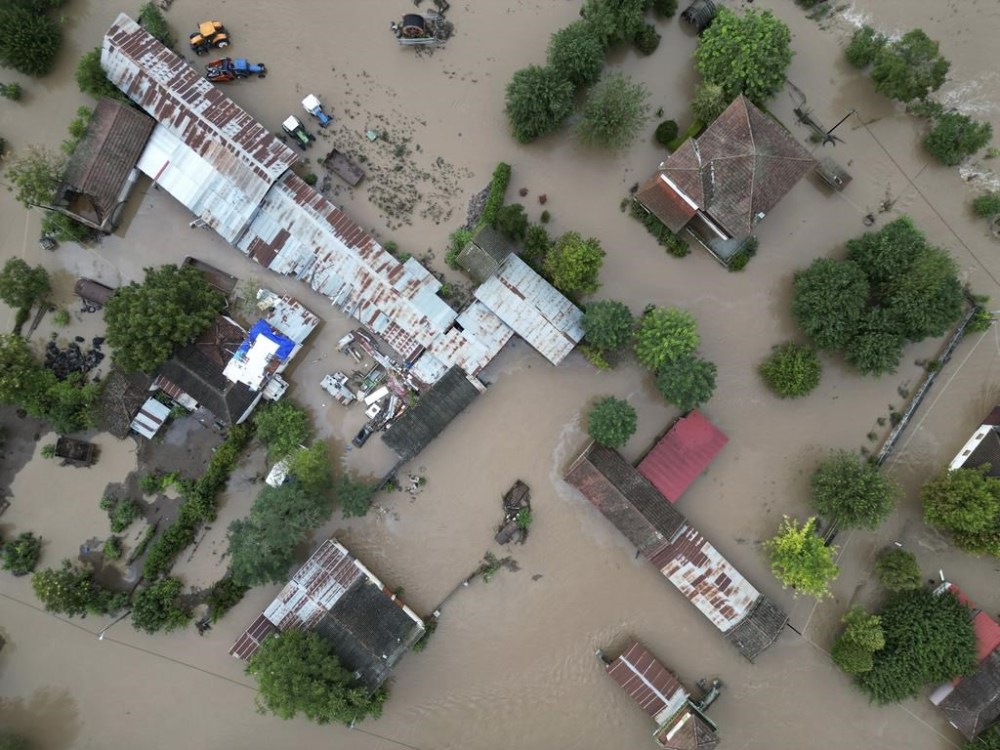
FILE - Floodwaters cover a farm and a house after the country's record rainstorm in the village of Kastro, near Larissa, Thessaly region, central Greece, Sept. 7, 2023. Before crossing the Mediterranean, the devastating storm that dumped torrential rains along the Libyan coast raged for days and caused extensive damage in central Greece and parts of Bulgaria and Turkey, a region where such extreme storms are up to 10 times more likely and up to 40% more intense because of climate change, scientists said. (AP Photo/Vaggelis Kousioras, File)

Even so, the attribution analysis’ approach is useful to those who must act on climate change, including deciding how to build infrastructure that’ll be in place for decades to come, he said. In that case, assuming storms will get worse makes sense, “because that’s probably what’s going to happen just based on the fundamental physics that a warmer atmosphere can hold more water vapor … (and) we have to be prepared for it.”

University of Pennsylvania climate scientist Michael Mann, who was not involved in the analysis, said such weather attribution studies are somewhat useful but don’t capture all the ways that climate change affects weather events. Notably, models used in the analyses don’t account for the fact that, as the poles warm faster than the subtropics, the jet stream is becoming locked into a stationary wavy pattern associated with persistent weather extremes.

“For this reason, my belief is that these attribution studies actually underestimate the impact human-caused climate change is having on these events,” Mann said in an email.

___

Associated Press climate and environmental coverage receives support from several private foundations. See more about AP’s climate initiative here. The AP is solely responsible for all content.

Report Error Submit a Tip

More Stories

Hometown hero hits CEBL championship clinching shot

Taylor Allen 5 minute read Preview

Hometown hero hits CEBL championship clinching shot

Taylor Allen 5 minute read Yesterday at 6:34 PM CDT

Chapter 1 of Winnipeg Sea Bears basketball was capped by hometown hero Chad Posthumus.

It was May 27, 2023, and the late, great centre out of River East Collegiate had a put-back basket off a Teddy Allen miss to give the Sea Bears a 90-85 victory over the Vancouver Bandits in Winnipeg’s inaugural game, in front of what was then a record crowd of 7,303.

So, on Saturday, it was rather poetic that Simon Hildebrandt — another Winnipegger and a player Posthumus used to mentor — was the one to put an exclamation mark on the franchise’s latest and greatest chapter.

Hildebrandt drilled a wide-open three in Target Score Time to crown the Sea Bears as the 2026 CEBL champions.

Read
Yesterday at 6:34 PM CDT

HSC weapons scanners effective, needed at other hospitals: nurses union

Carol Sanders 5 minute read Preview

HSC weapons scanners effective, needed at other hospitals: nurses union

Carol Sanders 5 minute read Saturday, Aug. 15, 2026

The AI weapons scanners at Health Sciences Centre have detected close to 2,000 items since they were installed at Manitoba’s largest hospital.

From March 6, 2025 to the beginning of this month, a total of 1,973 items had been flagged by the scanners and identified for further review, Shared Health said this week.

Knives, Swiss army knives and other multi-tools, drugs, alcohol, box cutters, syringes and other injection devices were detected, it said. The technology set up at entrances to the adult and children’s emergency rooms and the crisis response centre is designed to identify a wide range of objects that may require review under site safety protocols.

But Manitoba Nurses Union president Darlene Jackson said the technology isn’t available everywhere at HSC, and a sawed-off rifle was discovered in the adult ER earlier this month.

Read
Saturday, Aug. 15, 2026

RCMP searching for missing woman from Split Lake

1 minute read Saturday, Aug. 15, 2026

Thompson RCMP are asking for help from the public to find a 37-year-old woman who has not been heard from since late July.

Melanie Beardy, from Split Lake First Nation, was last in contact on July 26, said an RCMP news release Saturday. Beardy, who was in Thompson, was reported missing last Sunday and RCMP said both police and her family are worried for her well-being.

Attempts to find Beardy have been unsuccessful, said RCMP.

She’s described as 5’4 with a large build and long, black hair usually worn in a ponytail, said Mounties. She has a tattoo on her chest that reads: “Elvis,” and has a tattoo of a dreamcatcher on her left forearm.

Murphy helps Goldeyes battle back to beat Explorers

Mike McIntyre 6 minute read Preview

Murphy helps Goldeyes battle back to beat Explorers

Mike McIntyre 6 minute read Yesterday at 5:55 PM CDT

Max Murphy didn’t hesitate when asked to describe his season so far.

“It’s been terrible,” the veteran Winnipeg Goldeyes outfielder told the Free Press.

Murphy is admittedly critical of himself, the product of a high standard he’s set during a pro baseball career that began in 2014 and has included the past six years with the Fish, where he’s established new franchise records for home runs and RBIs.

So you can imagine the relief felt on Sunday when he looked a lot more like the Murphy of old in leading his team to a 6-2 comeback victory over the Sioux City Explorers to close out a six-game homestand at Blue Cross Park in front of a season-high crowd of 6,825.

Read
Yesterday at 5:55 PM CDT

Cross-border abduction under investigation

1 minute read Updated: Yesterday at 12:40 PM CDT

A cross-border kidnapping from Winnipeg to Minnesota is under investigation, according to North Dakota state patrol.

A 31-year-old Manitoba man abducted a 37-year-old Manitoba man in Winnipeg and drove across the border into North Dakota, the North Dakota State Highway Patrol said in a Facebook post Sunday. The state patrol said it became aware of the possible abduction Sunday morning and worked with local, federal and Canadian law enforcement to investigate.

Authorities identified a suspect vehicle using cameras at multiple locations and used cell-phone location information and licence-plate reader technology to find the vehicle in Alexandria, Minnesota.

"The victim was able to break free from the suspect and run into a nearby store. The suspect was taken into custody shortly afterward by the Douglas County Sheriff’s Office and Alexandria Police Department. The victim was recovered safely," the North Dakota state patrol's post reads.

Climate change made storm that devastated Libya far more likely and intense, scientists say

Tammy Webber, The Associated Press 5 minute read Preview

Climate change made storm that devastated Libya far more likely and intense, scientists say

Tammy Webber, The Associated Press 5 minute read Tuesday, Sep. 19, 2023

The devastating storm that dumped torrential rains along the Libyan coast this month was up to 50 times more likely to occur and 50% more intense because of human-caused climate change, according to an analysis released Tuesday.

Before crossing the Mediterranean, the storm raged for four days and caused extensive damage in central Greece and parts of Bulgaria and Turkey, a region where such extreme storms are up to 10 times more likely and up to 40% more intense because of climate change, scientists said.

Heavy one-day rains from Mediterranean storm Daniel caused massive flooding across eastern Libya that overwhelmed two dams, sending a wall of water through the coastal city of Derna that destroyed entire neighborhoods and swept bridges, cars and people out to sea. The death toll has varied, with government officials and aid agencies giving tallies ranging from about 4,000 to 11,000 dead.

The analysis was conducted by the World Weather Attribution group, which aims to quickly evaluate the possible role of climate change in extreme weather events.

Read
Tuesday, Sep. 19, 2023