Putting his life in God’s hands
Lung-transplant patient moves into palliative care

Advertisement
Read this article for free:
or
Already have an account? Log in here »
To continue reading, please subscribe:
Digital Subscription
One year of digital access for only $1.44 a week*
- Enjoy unlimited reading on winnipegfreepress.com
- Read the E-Edition, our digital replica newspaper
- Access News Break, our award-winning app
- Play interactive puzzles
*Billed as $5.77 plus GST every four weeks. After 52 weeks, price increases to the regular rate of $19.95 plus GST every four weeks. Offer available to new and qualified returning subscribers only. Cancel any time.
To continue reading, please subscribe:
Add Free Press access to your Brandon Sun subscription for only an additional
$1 for the first 4 weeks*
- Enjoy unlimited reading on winnipegfreepress.com
- Read the E-Edition, our digital replica newspaper
- Access News Break, our award-winning app
- Play interactive puzzles
*Your next Brandon Sun subscription payment will increase by $1.00 and you will be charged $17.95 plus GST for four weeks. After four weeks, your payment will increase to $24.95 plus GST every four weeks.
Read unlimited articles for free today:
or
Already have an account? Log in here »
Hey there, time traveller!
This article was published 02/10/2023 (1120 days ago), so information in it may no longer be current.
The Free Press has been following Rick Schmidt’s lung transplant journey with a series of stories. Upon learning his body was rejecting the transplant, Schmidt recently made the decision to move to palliative care. Schmidt died early Tuesday morning. He spoke with the Free Press just days prior to his passing.
When he started his medical journey, Rick Schmidt knew that one in 10 lung-transplant patients don’t survive the first year.
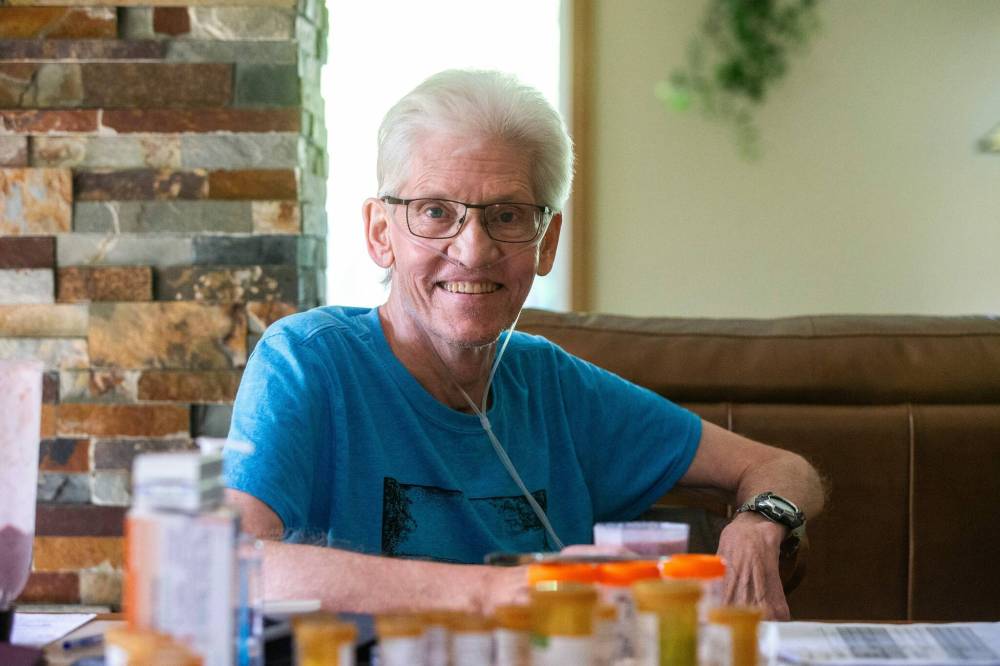
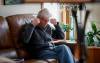
MIKAELA MACKENZIE / WINNIPEG FREE PRESS FILES
Rick Schmidt sits surrounded by medications at his kitchen table back in July, after his lung transplant. Last week he made the decision to move into palliative care.
“It turns out I am that one person,” he says, speaking from his hospital bed at Health Sciences Centre.
In consultation with his wife, Sara Jane, and medical staff, Schmidt, 68, made the decision last weekend to cease aggressive medical interventions, including anti-rejection drugs, and start the palliative-care process.
“I’m just not going to get better,” he said, noting his new lung just never connected to his airway. “I could keep on trying, maybe get a few more months, but things are so hard right now. I don’t want to keep living this way.”
Schmidt was diagnosed with idiopathic pulmonary fibrosis in 2018, a terminal condition in which the lungs harden and make breathing difficult. In June 2022, he was accepted into the Manitoba lung-transplant program.
In April, this year, he got the call that a lung was available. He flew to Edmonton for the operation.
The first week after transplant went well, he said. But then things started to crash.
“Everything tanked,” he said as infections and other complications set in. “I would get better, then tank again.”
Instead of coming back to Winnipeg after a few weeks, as expected, Schmidt ended up spending three months in hospital in Edmonton, before returning to Winnipeg in July.
He managed to live at home for a short time before being readmitted to the hospital. After stabilizing, he was sent back home — only to have to return again when breathing became difficult.
He’s been at Health Sciences Centre since the start of September.
The couple made the decision for him to go into palliative care after learning from the medical team that the chance of recovery “was more and more remote,” he says.
“The cascade of complications added up to an insurmountable barrier for him,” Sara Jane says, adding his weight has fallen to about 103 pounds. “There was little prospect of a good life.”
Schmidt, who was an insurance broker before becoming a mediator and university instructor at Menno Simons College, says, “The cost-benefit ratio just wasn’t there. The chances of my long-term survival are minimal. I want to keep living, but it’s just not in the cards. It’s the reasonable choice.”
In place of the anti-rejection drugs and other medications, the goal now is comfort. This includes regular injections of hydromorphone for the anxiety and panic that comes with breathlessness.
One thing the couple appreciated all along the way was how open and honest the medical staff were about the surgery and the chances for recovery.
“There was never a snow job,” Schmidt says. “They never gave me false hope. They were always upfront with us.”
Looking back, he doesn’t regret having the transplant. “I knew I had to give it a try. Besides, my condition was terminal. What did I have to lose?”
And yet, after all the challenges, he isn’t sure he would do it again. “Maybe not, knowing what I know now,” he says. “But I made the best decision based on the information I had at the time.”
Sara Jane agrees. “He had already declined a lot before the surgery,” she says. “His life was already limited.”
One thing the couple wondered was how the transplant team felt about his failure to recover.
“They told us they learn something from every transplant operation, even the ones that don’t turn out like they hope,” Schmidt says. “This failure could help them to help someone else succeed.”
While Schmidt is adjusting to his new reality, so is his wife.
“Up until now my role has been to support him toward living,” says Sara Jane, who lived in Edmonton the whole time he was in hospital there and who is now staying with him at Health Sciences Centre in these final days.
“It’s quite a head shift to start thinking from how I could help him have a good recovery to how I can help him to have a good death.”
One thing they both appreciate is the support of their church community and other friends and family. “We get strength from that,” Schmidt says. “People are pouring love on us.”
Adds Sara Jane: “We feel very well looked-after.”
They also have nothing but praise for everyone they met in the medical system.
“The people in the Manitoba Lung Transplant Program, the transplant team in Edmonton, the doctors, the nurses, the aides, the cleaners and everyone else, they’ve all been great and such a support,” Schmidt says. “They have been empathetic, attentive, supportive. It’s clear that, for them, it’s not just a job.”
As for what the future holds, that’s unclear. He could hold on for a week yet, maybe more.

All they know is they are at peace about the decision to begin palliative care. For Schmidt, that includes his faith.
“I’ve put my life and death in God’s hands,” said Schmidt. “The same God who loves me in life will love me after I’m gone.”
God’s love, he added, “is not predicated on me having a certain set of beliefs. God is love, full stop.”
To become an organ donor, visit www.signupforlife.ca.
faith@freepress.mb.ca
The Free Press is committed to covering faith in Manitoba through our Religion in the News project. This reporting continues because readers like you step forward to fund it.
Donate now to support our reporting on religion.
Your donation is eligible for a charitable tax receipt.
BECOME A FAITH JOURNALISM SUPPORTER
Our newsroom depends on a growing audience of readers to power our journalism. If you are not a paid reader, please consider becoming a subscriber.
Our newsroom depends on its audience of readers to power our journalism. Thank you for your support.
The Free Press is committed to covering faith in Manitoba through our Religion in the News project. This reporting continues because readers like you step forward to fund it.
Donate now to support our reporting on religion.
Your donation is eligible for a charitable tax receipt.
BECOME A FAITH JOURNALISM SUPPORTER
Our newsroom depends on a growing audience of readers to power our journalism. If you are not a paid reader, please consider becoming a subscriber.
Our newsroom depends on its audience of readers to power our journalism. Thank you for your support.
Related Articles
Long road to recovery after lung-transplant odyssey

Advertisement Advertise With Us
Advertisement Advertise With Us
History
Updated on Tuesday, October 3, 2023 10:22 AM CDT: Updates with news of Rick Schmidt's death
Updated on Thursday, October 5, 2023 10:18 AM CDT: Corrects typo
The Free Press acknowledges the financial support it receives from members of the city’s faith community, which makes our coverage of religion possible.