

NATO equips peacekeeping force in Kosovo with heavier armament to have “combat power”
Advertisement
Read this article for free:
or
Already have an account? Log in here »
To continue reading, please subscribe:

Digital Subscription
One year of digital access for only $205*
- Enjoy unlimited reading on winnipegfreepress.com
- Read the E-Edition, our digital replica newspaper
- Access News Break, our award-winning app
- Play interactive puzzles
*First annual payment billed as $205.00 + GST for one year. This annual subscription will automatically renew at $233.00 + GST every 52 weeks (10% off the regular annual price of $259.35). Offer available to new and qualified returning subscribers only. Cancel any time.
To continue reading, please subscribe:
Add Free Press access to your Brandon Sun subscription for only an additional
$1 for the first 4 weeks*
- Enjoy unlimited reading on winnipegfreepress.com
- Read the E-Edition, our digital replica newspaper
- Access News Break, our award-winning app
- Play interactive puzzles
*Your next Brandon Sun subscription payment will increase by $1.00 and you will be charged $17.95 plus GST for four weeks. After four weeks, your payment will increase to $24.95 plus GST every four weeks.
Read unlimited articles for free today:
or
Already have an account? Log in here »
Hey there, time traveller!
This article was published 10/10/2023 (1084 days ago), so information in it may no longer be current.
PRISTINA, Kosovo (AP) — A NATO top commander said Tuesday the alliance equipped its peacekeeping force in Kosovo with weapons of “combat power” following a recent shootout between masked Serb gunmen and Kosovo police that left four people dead and sent tensions soaring in the region.
Adm. Stuart B. Munsch of the Allied Joint Force Command Naples, Italy said that a battalion of some 200 troops from the United Kingdom and 100 others from Romania “is bringing heavier armament in order to have combat power to” the NATO-led Kosovo Force, or KFOR, but didn’t elaborate further.
The KFOR peacekeepers — made up of around 4,500 troops from 27 nations — have been in Kosovo since June 1999, basically with light armament and vehicles. The 1998-1999 war between Serbia and Kosovo ended after a 78-day NATO bombing campaign forced Serbian forces to withdraw from Kosovo. More than 10,000 people died, mostly Kosovo Albanians.
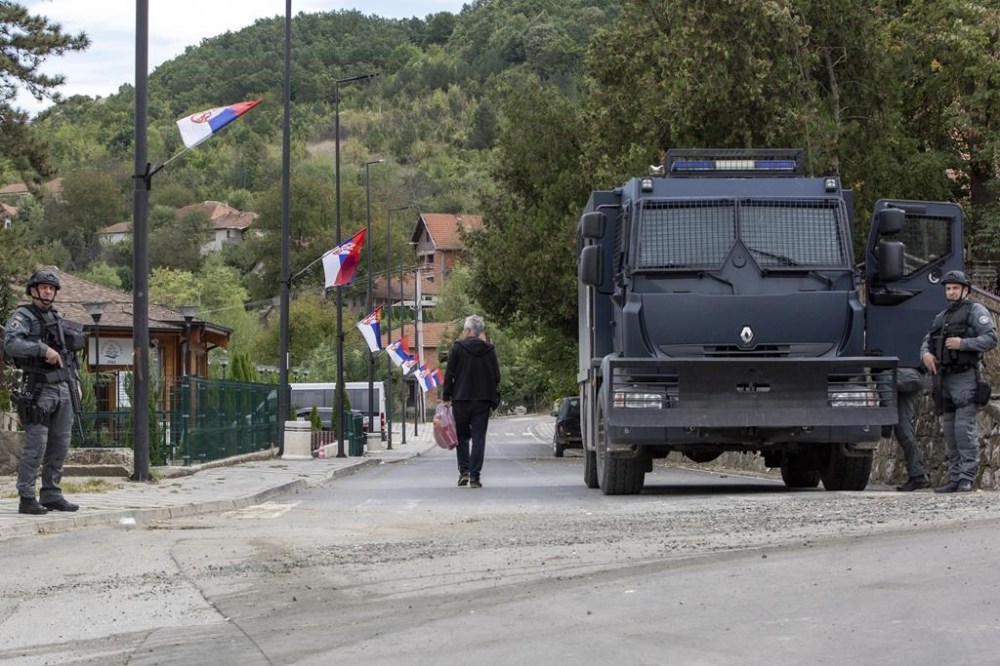
On Sept. 24, around 30 Serb gunmen killed a Kosovar police officer and then set up barricades in northern Kosovo before launching an hours-long gun battle with Kosovo police. Three gunmen were killed.
NATO had first increased its troops with some 600 Turkish ones after the May 29 clashes with ethnic Serbs.
Munsch said the alliance was ready to add more troops and armaments to preserve peace.
“NATO is maintaining further forces equipped with even heavier armament capable of further combat power on a high state of readiness that is deployable should the nations of NATO decide to do so,” he said.
Outgoing KFOR commander Maj. Gen. Angelo Michele Ristuccia said KFOR fully supported the EU-facilitated dialogue between Pristina and Belgrade for the normalization of their ties.
“The situation remains volatile and can easily escalate. Only a political solution can bring a lasting peace and stability in the area,” he said.
In February, the European Union put forward a 10-point plan to end months of political crises. Kosovar Prime Minister Albin Kurti and Serbian President Aleksandar Vucic gave their approval at the time, but with some reservations that haven’t been resolved.
The EU-facilitated dialogue, which began in 2011, has yielded few results.
Kosovo, a former province of Serbia, declared independence in 2008 — a move that Belgrade refuses to recognize.
___
Llazar Semini reported from Tirana, Albania. Follow him at https://twitter.com/lsemini