Cellist strings together masterful performance in Canadian orchestral debut
Advertisement
Read this article for free:
or
Already have an account? Log in here »
To continue reading, please subscribe:

Digital Subscription
One year of digital access for only $205*
- Enjoy unlimited reading on winnipegfreepress.com
- Read the E-Edition, our digital replica newspaper
- Access News Break, our award-winning app
- Play interactive puzzles
*First annual payment billed as $205.00 + GST for one year. This annual subscription will automatically renew at $233.00 + GST every 52 weeks (10% off the regular annual price of $259.35). Offer available to new and qualified returning subscribers only. Cancel any time.
To continue reading, please subscribe:
Add Free Press access to your Brandon Sun subscription for only an additional
$1 for the first 4 weeks*
- Enjoy unlimited reading on winnipegfreepress.com
- Read the E-Edition, our digital replica newspaper
- Access News Break, our award-winning app
- Play interactive puzzles
*Your next Brandon Sun subscription payment will increase by $1.00 and you will be charged $17.95 plus GST for four weeks. After four weeks, your payment will increase to $24.95 plus GST every four weeks.
Read unlimited articles for free today:
or
Already have an account? Log in here »
Hey there, time traveller!
This article was published 14/10/2023 (1071 days ago), so information in it may no longer be current.
In a world aflame with war and political strife, music is one of those enduring balms still able to bring comfort and joy to wounded souls.
But it can also become a vehicle for railing against those same unbridled forces of evil, when composers unleash their full arsenal of creativity as an act of utter defiance.
One such piece is Shostakovich’s Concerto No. 1 for Violoncello and Orchestra, penned in the wake of Stalinism, during which the composer was persecuted and oppressed by the Soviet regime for his daring, often autobiographical works.
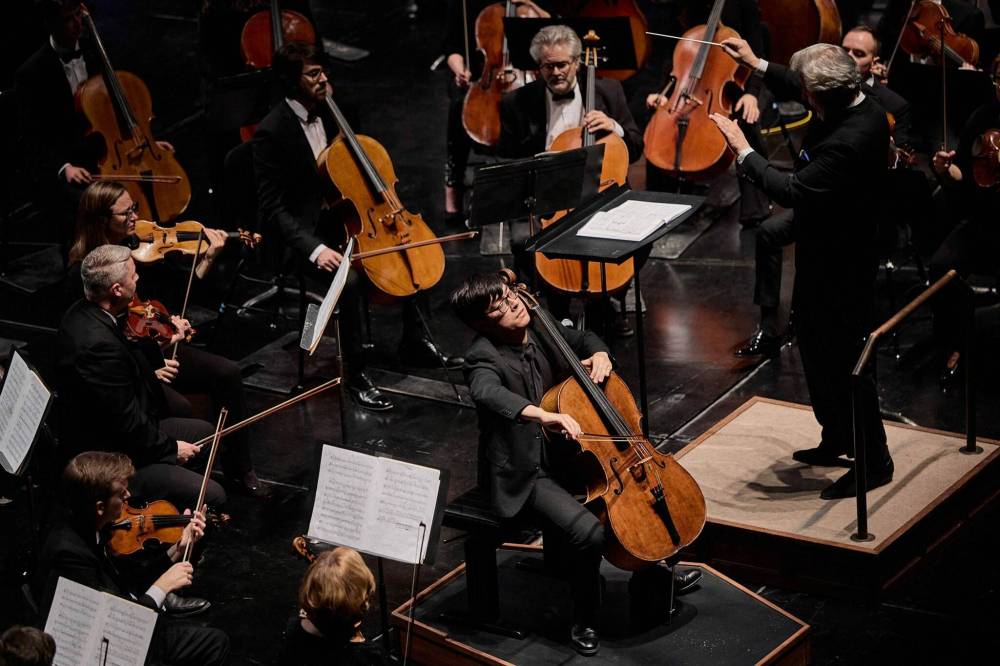
Simeon Rusnak photo
American cellist Zlatomir Fung, 24, performs with the Winnipeg Symphony Orchestra.
Cellist Zlatomir Fung, 24, marked his auspicious Canadian orchestral debut Thursday night with his deeply felt performance of the searing classic, as featured guest artist during the Winnipeg Symphony Orchestra’s latest Thursday Classics program, led by maestro Daniel Raiskin.
The rising international star, who first began cello at the tender age of three, is the first American in four decades — as well the youngest musician — to have won first prize at the International Tchaikovsky Competition Cello Division, among many other accolades and awards, and now regularly performs concerts and recitals around the globe.
It takes nerves of steel and an iron-clad conviction, equally matched by stellar technical facility, to even approach one of this composer’s contemporary masterpieces. Originally written in 1959 for his friend, legendary cellist Mstislav Rostropovich (who famously memorized the entire piece in a mere four days), the four-movement concerto is widely regarded as one of the most fiendishly difficult works in the solo cello canon.
However, it proved no match for Fung, who checked all those boxes and more, as he dazzled the mid-week audience of 881 with his unflinching artistry.
The cellist immediately asserted his compelling stage presence during the opening movement, Allegretto, his bow playfully rendering the four-note main motive — derived from Shostakovich’s musical cryptogram for his name, D-S-C-H — which runs like a unifying thread throughout the work.
Fung’s well-paced performance, propelled by rugged down-bowed accents and double-stop runs, often saw him swaying back and forth with his instrument as though in trance, eyes closed, as he inhabited the music with every cell and fibre.
After Raiskin set a relatively brisk tempo for the elegiac second movement, Moderato, the artist further displayed his unabashed lyricism, as well as a carefully nuanced dynamic palette, with his long-arching thematic lines often barely a whisper.
Kudos to principal horn Patricia Evans for her exposed solo passages, delivered flawlessly. Another highlight was Fung performing his principal melody in artificial harmonics, juxtaposed with a ghostly celesta that elicited goose bumps.
However the evening’s still point proved to be the unusual third movement, an unaccompanied solo cadenza that bleeds out from the prior harmonics section. It’s admittedly rare for an entire hall to remain stone silent — especially during those softer moments, which can inspire nervous coughs. However, Fung held every rapt listener in the palm of his hands. His mesmerizing, highly introspective performance, which will only deepen with each passing year, grew more passionate by the minute. It finally burst, attacca, into the finale, Allegro con moto, now a wild roller-coaster ride, including its embedded musical mockery of Stalin’s favourite song, Georgian folk tune Suliko.
Raiskin and his musicians kept pace with Fung note for note, further driving the work towards its enthralling finish, earning the soloist a rousing standing ovation and demand for four curtain calls, in turn leading to a welcome encore of Prokofiev.
The compact, 82-minute program (no intermission) — with a new, earlier start time of 7 p.m., a pre-show performance featuring local artists and a post-show Q&A session — also featured Carl Nielsen’s Symphony No. 2, Op. 16 (The Four Temperaments), which, remarkably, has not been heard on this stage since 1966, under the baton of the late Victor Feldbrill.

Inspired by the medieval concept of the four temperaments reputed to regulate the human personality, the epic-scaled work’s four movements, firmly rooted in post-romantic tradition, are titled after corresponding humours: Choleric, Phlegmatic, Melancholic and Sanguine.
This performance was somewhat marred by flaws that included balance issues with the brass (including a loud’ n’ proud trombone section) during the opening Allegro collerico, though they were mitigated by the winds’ sensitive solo passages.
Raiskin infused the second movement, Allegro comodo e flemmatico, with lilting grace, before the subsequent Melancholic, underpinned by lush string sonorities. The allegro sanguineo — Marziale oddly saw the horns and strings fighting each other at times, not always in lockstep with the maestro’s crisp direction, but it nonetheless settled before a bright, fiery finish.
Following virtually every concert these days, audience members leap to their feet like coiled springs as a ubiquitous appendix to standard applause. In this case, the mixed crowd awarded the players a relatively tepid, even sluggish partial standing ovation at night’s end, perhaps affected by their own personal humour during these roiling times.
Holly.harris@shaw.ca
Holly Harris writes about music for the Free Press Arts & Life department.
Our newsroom depends on a growing audience of readers to power our journalism. If you are not a paid reader, please consider becoming a subscriber.
Our newsroom depends on its audience of readers to power our journalism. Thank you for your support.