

Feuding Serbia and Kosovo leaders set for talks Thursday on the sidelines of an EU summit
Advertisement
Read this article for free:
or
Already have an account? Log in here »
To continue reading, please subscribe:

Digital Subscription
One year of digital access for only $205*
- Enjoy unlimited reading on winnipegfreepress.com
- Read the E-Edition, our digital replica newspaper
- Access News Break, our award-winning app
- Play interactive puzzles
*First annual payment billed as $205.00 + GST for one year. This annual subscription will automatically renew at $233.00 + GST every 52 weeks (10% off the regular annual price of $259.35). Offer available to new and qualified returning subscribers only. Cancel any time.
To continue reading, please subscribe:
Add Free Press access to your Brandon Sun subscription for only an additional
$1 for the first 4 weeks*
- Enjoy unlimited reading on winnipegfreepress.com
- Read the E-Edition, our digital replica newspaper
- Access News Break, our award-winning app
- Play interactive puzzles
*Your next Brandon Sun subscription payment will increase by $1.00 and you will be charged $17.95 plus GST for four weeks. After four weeks, your payment will increase to $24.95 plus GST every four weeks.
Read unlimited articles for free today:
or
Already have an account? Log in here »
Hey there, time traveller!
This article was published 25/10/2023 (1057 days ago), so information in it may no longer be current.
BRUSSELS (AP) — The leaders of Serbia and Kosovo have been invited to meet with top European Union officials on Thursday to try to breathe life into talks aimed at normalizing their relations, just as the 27-nation bloc’s leaders gather in Brussels for a two-day summit.
Serbian President Aleksandar Vucic and Kosovo Prime Minister Albin Kurti are not expected to meet face to face, but the aim is to push forward with new “proposals and ideas” floated in exploratory talks last weekend, said Peter Stano, spokesman for EU foreign policy chief Josep Borrell.
Fears are high of a resumption of the violence that has characterized their ties since Kosovo unilaterally broke away from Serbia in 2008. Belgrade has never recognized the move. The EU, through Borrell, has supervised a “dialogue” between them to get things back on track.
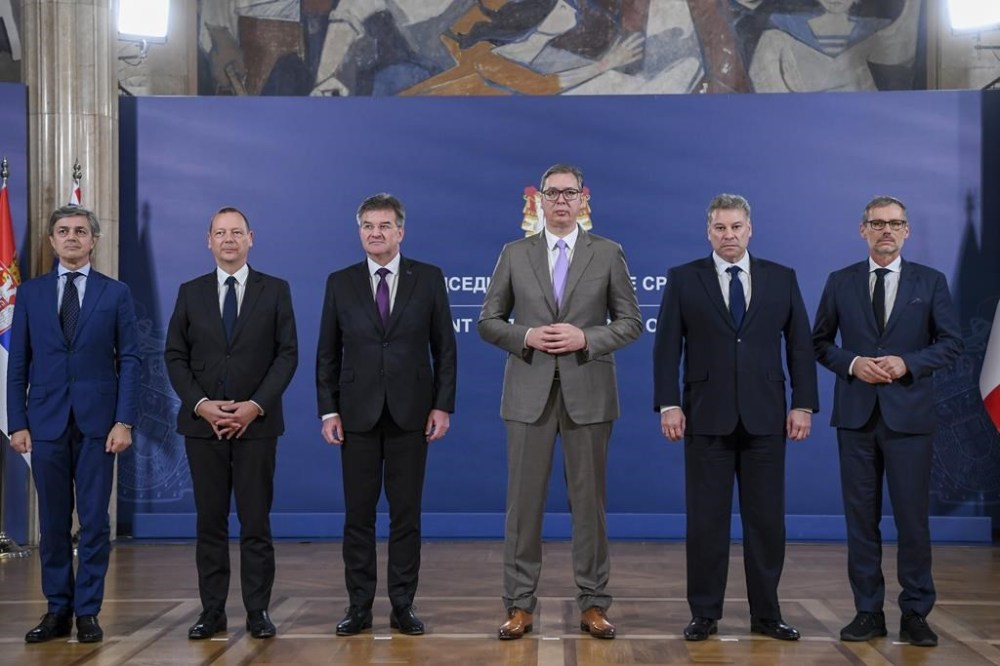
The meetings, if they proceed, could be an important step forward, after about 30 Serb gunmen crossed into northern Kosovo on Sept. 24, killing a police officer and setting up barricades before launching an hours-long gun battle with Kosovo police. Three gunmen were killed.
Apart from discussions with Borrell and the EU’s special envoy to the region, Miroslav Lajcak, Kurti and Vucic might hold talks with the leaders of France, Germany and Italy.
Stano said the EU expects “quick action by the parties to show they are committed to continue to the normalization process – by delivering on their respective dialogue obligations … as well as all past agreements – without preconditions or delays.”
The United States and the EU want Kosovo and Serbia to implement a 10-point plan put forward by Borrell in February to end months of political crises. Kurti and Vucic gave their approval at the time, but with some reservations.
Stano underlined that the exploratory talks in the region over the weekend were aimed solely at finding a way to bring that agreement into effect, and that “there is no intention to replace it.”
Kurti and Vucic do not trust each other. Neither wants to be the first to commit without guarantees that the other will reciprocate.
The EU and U.S. are pressuring Kosovo to allow the creation of an Association of the Serb-Majority Municipalities to coordinate work on education, health care, land planning and economic development in communities of northern Kosovo mostly populated by ethnic Serbs.
Kurti fears that this would be a step toward creating a Serb mini-state with wide autonomy.
In a draft of their summit statement, seen by The Associated Press, EU leaders said that they were “deeply concerned about the security situation in the north of Kosovo” and warned that a “failure to deescalate the tensions will have consequences.” No details were provided about what action might be taken.
The leaders also expressed regret that Serbia and Kosovo have made little progress on putting their agreement into effect or living up to their commitments, and called on the two “to implement them, without delay or preconditions.”
They warned that the normalization dialogue is an essential part of Kosovo and Serbia’s quests to join the EU and that “both risk losing important opportunities in the absence of progress.”