Cutting back on spending and waste, one stitch at a time
Advertisement
Read this article for free:
or
Already have an account? Log in here »
To continue reading, please subscribe:

Digital Subscription
One year of digital access for only $205*
- Enjoy unlimited reading on winnipegfreepress.com
- Read the E-Edition, our digital replica newspaper
- Access News Break, our award-winning app
- Play interactive puzzles
*First annual payment billed as $205.00 + GST for one year. This annual subscription will automatically renew at $233.00 + GST every 52 weeks (10% off the regular annual price of $259.35). Offer available to new and qualified returning subscribers only. Cancel any time.
To continue reading, please subscribe:
Add Free Press access to your Brandon Sun subscription for only an additional
$1 for the first 4 weeks*
- Enjoy unlimited reading on winnipegfreepress.com
- Read the E-Edition, our digital replica newspaper
- Access News Break, our award-winning app
- Play interactive puzzles
*Your next Brandon Sun subscription payment will increase by $1.00 and you will be charged $17.95 plus GST for four weeks. After four weeks, your payment will increase to $24.95 plus GST every four weeks.
Read unlimited articles for free today:
or
Already have an account? Log in here »
Hey there, time traveller!
This article was published 02/11/2023 (1026 days ago), so information in it may no longer be current.
TORONTO – Mending clothes was a regular part of growing up for Anna-Marie Janzen, who started to learn the craft at age three from her grandmother.
“That was just kind of like, of course, that’s what you do, put it in the mending pile,” she said.
“It’s just another part of taking care of your clothes.”
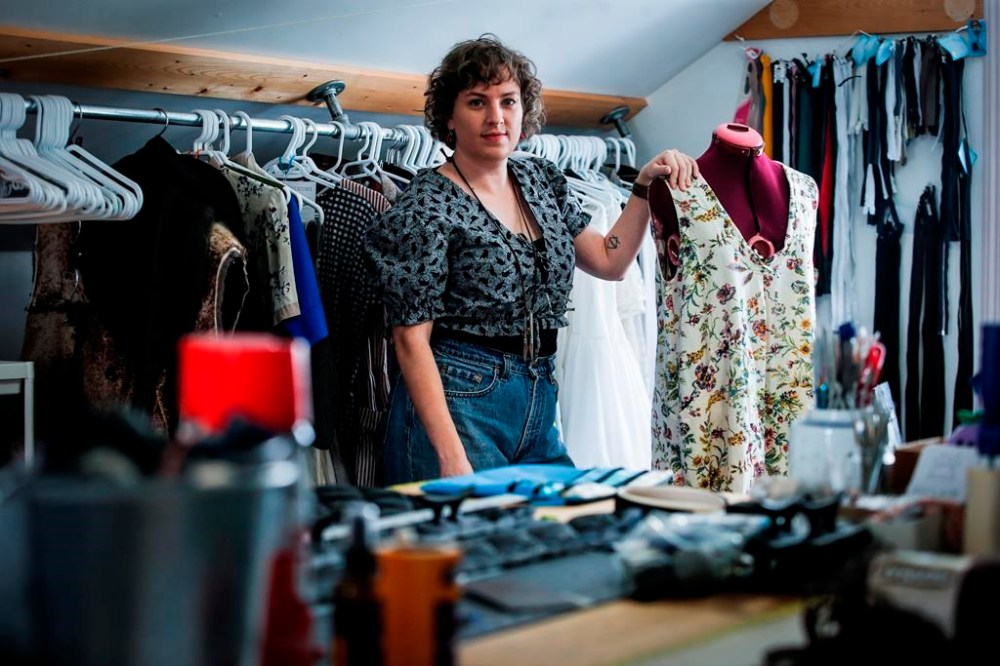
The rise of cheap clothing has made the practice far less common, but people like Janzen are working to revive interest to reduce waste, and potentially save money as well.
She launched her Winnipeg-based repair business Reclaim Mending about seven years ago, retreating from the sometimes-nebulous world of office work to the tangible satisfaction of a repair well done.
“You spent some time on something and now it’s fixed … that is immensely satisfying for me.”
Her many years of practice have made her deft with repairs that are hard to see. She’s helped save everything from T-shirts to winter coats that people don’t want to say goodbye to, whether it’s for sentimental, environmental, or cost reasons.
While mending services have always been around, there’s growing interest, and new approaches, as the costs of fast fashion are better understood.
France, for example, last month started offering between 10 euros and 25 euros in compensation for people to repair their clothes, while in the U.K., app-based clothing repair services like Sojo and The Seam are trying to bring a techie take to the age-old practice.
Given Canadian households spent an average of $3,344 on clothing and accessories in 2019, according to Statistics Canada, the possibility of repairing some items can mean savings and reduced waste.
But while professional repairs can make sense financially for higher-priced items, for those looking to save on everyday clothing, it pays more to learn some of the basics.
Janzen is one of the many across Canada who offer lessons, which she says are regularly sold out.
“It’s great to see that people want to learn how to do it themselves, because really it doesn’t take super long to learn the basics,” said Janzen.
“People can do a lot of these little things themselves, and that definitely saves money in the long run.”
Libraries and community centres often offer lessons too, as do initiatives like Blenderz Garment Recyclers in Edmonton and Repair Café in Toronto.
There’s also, of course, YouTube videos, along with a growing number of books such as “Visible Mending” by Toronto textile artist Arounna Khounnoraj.
In Montreal, repair workshop Les Affutés offers numerous classes in sewing and repairs, including on the increasingly popular trend of visible mending, where the stitches and patches become part of a new design on the garment.
Clara Quintela, who teaches the class, said while the term is only a few years old, the technique can be traced back to much older stiles such as Sashiko mending in Japan, where the mending threads are sometimes sewn into elaborate patterns, or the even older practice of Kantha stitching from South Asia where it’s often done with a simple running stitch.
“With one stitch, you can make wonders,” said Quintela, who studied textiles in a fine arts degree.
Visible mending can be a fairly cheap and doesn’t require much technique as a way to save clothes with rips or holes, she said, while also giving clothing more personality.
Repaired clothing used to be a source of shame, she noted, but she sees increasing acceptance, at least in Quebec. She said that in Brazil, where she’s from, there’s still some resistance.
“This is a particularity of ascending countries, not to show that we are poor. So not everybody understands this is not about being poor or not, is about being eco-responsible, and care about the planet.”
The waste generated by the clothing industry is increasingly being understood, whether it’s the water and resource consumption, or the garbage left over.
Sabine Weber, a professor at Seneca College’s School of Fashion, said she couldn’t find any good public data on how much clothing waste there was in Canada, so she and a team took matters into their own hands, sorting through samplings of trash to figure out how much was textiles.
The findings, which she co-published in the journal Resources, Conservation and Recycling earlier this year, estimated that Canadians throw out on average 12 kilograms of textiles a year. Of the textiles they found, 25 per cent were in good enough condition to re-sell, while 65 per cent could be reused.
While she’s been working to highlight the issues with clothing waste, she’s also aware of how much the practice of repairs has been lost.
When she started teaching, she would ask fashion design students if they had ever made a garment before. Nobody put up their hands.
“I was kind of shocked, even in fashion design,” said Weber.
“Honestly, the majority of Canadians probably are not even able to put on a button.”
For those hesitant to start, Janzen says to just give it a go.
“People are afraid to try because they’re afraid of making it worse, but the thing with something that’s already broken is you can’t really make it worse.”
Even when not perfect, repairing clothes can make them truly your own, she said.
“Because clothes are so cheap and mass produced, when something is unique, it’s kind of automatically cooler. It’s more interesting, and so mending can contribute to that,” said Janzen.
“So I think there’s a lot more space for recognizing, you know, visible repair as something valuable.”
This report by The Canadian Press was first published Nov. 2, 2023.