Determining religiosity a challenge
Survey results vary but it’s clear those with no religion on rise

Advertisement
Read this article for free:
or
Already have an account? Log in here »
To continue reading, please subscribe:
Digital Subscription
One year of digital access for only $1.44 a week*
- Enjoy unlimited reading on winnipegfreepress.com
- Read the E-Edition, our digital replica newspaper
- Access News Break, our award-winning app
- Play interactive puzzles
*Billed as $5.77 plus GST every four weeks. After 52 weeks, price increases to the regular rate of $19.95 plus GST every four weeks. Offer available to new and qualified returning subscribers only. Cancel any time.
To continue reading, please subscribe:
Add Free Press access to your Brandon Sun subscription for only an additional
$1 for the first 4 weeks*
- Enjoy unlimited reading on winnipegfreepress.com
- Read the E-Edition, our digital replica newspaper
- Access News Break, our award-winning app
- Play interactive puzzles
*Your next Brandon Sun subscription payment will increase by $1.00 and you will be charged $17.95 plus GST for four weeks. After four weeks, your payment will increase to $24.95 plus GST every four weeks.
Read unlimited articles for free today:
or
Already have an account? Log in here »
Hey there, time traveller!
This article was published 18/11/2023 (1071 days ago), so information in it may no longer be current.
Is it impossible to know how many people are religious? For American statistician and pastor Ryan Burge, who studies religion in the U.S., the answer is no.
“There’s no objective way to measure religion. There just isn’t,” he said. “There’s no objective measuring stick … everything is just a series of best guesses.”
To make his case, Burge pointed to surveys that ask how many Americans are non-religious, or “nones.” Six different surveys came up with six different answers, ranging from 21 per cent of the population to 36 per cent.
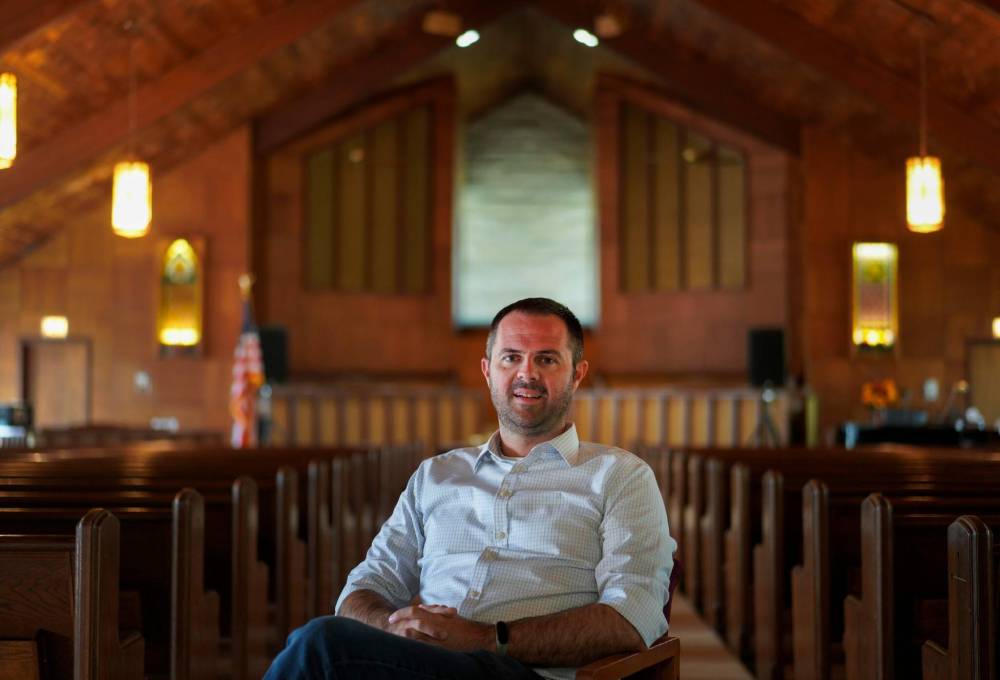
Jessie Wardarski / The Associated Press files
Pastor Ryan Burge, an associate professor of political science at Eastern Illinois University and author says people who do not have a religion, or nones, has risen since 2008 in the United States.
Based on the trend lines, the only thing that can reasonably be concluded is that the number of people with no religion has risen since 2008, he said.
I wondered if the same was true for Canada. Can we really know how many Canadians are religious, or not religious? To help with an answer, I reached out to religion scholars across the country.
For Sam Reimer, who teaches at Crandall University in Moncton, Burge is saying what all scholars of religion know: Different polls and surveys give different results and it’s probably good to find some middle ground.
“What we do know is that these results, though never perfect, are better than our best guess,” he said, adding “what is clear is the percentage of people who have no religious identity is increasing in both countries, and that younger generations are more likely to be nones than older generations.”
Joel Thiessen teaches at Ambrose University College in Calgary. He agreed there are no objective metrics for religiosity. Still, he said, “I’m partial to a relatively objective metric of ‘religious nones’ to simply mean someone who does not identify with a religion or religious group.”
Over time, these surveys, however imperfect, can “still yield useful descriptions and comparisons to track changes over time,” he added.
For John Stackhouse, also of Crandall University, a big problem with surveys about religion is they frequently don’t make sense to the people being researched.
“Definitions of a religious group should be ownable by that group,” he said. “If the observer’s definition materially differs from the participant’s definition, then a yellow flag should go up.”
He noted this can be a particular problem when, for example, non-evangelicals try to determine how many evangelicals there are in Canada.
For example, people who say they only go to church monthly are being counted as evangelicals in some studies. “Mere monthly attendance, outside of special circumstances, is not consistent with a form of religion that emphasizes vitality,” he said, noting that frequent worship service attendance is considered an important marker of evangelicalism.
The same is true for counting Roman Catholics, he said, since that religion’s understanding of the sacraments means going to mass weekly. “You just can’t be a ‘good Catholic’ and not regularly attend mass. That’s just not how that religion works,” he stated.
Sarah Wilkins-LaFlamme of the University of Waterloo agreed that any measurement of a concept, including of religion, will never be perfect.
“There are many dimensions of religiosity to measure,” she said.
For her, a good empirical study of non-religion “with a clearly defined measure and a pretty representative sample is much, much better than just a guess.”
At the same time, it’s important to not rely on only one survey. “This allows us to get a good sense of where trends appear in the various ways we measure religiosity … and where more study is needed.”
Rick Hiemstra is director of research for the Evangelical Fellowship of Canada. He believes that “some measure is better than no measure,” but agreed that good questions need to be asked to get good results.
Asking someone if they are evangelical or Catholic or any other religion isn’t helpful unless there are follow-up questions about adherence to the beliefs and practices of those religions, he said.

He is not a fan of asking people if they are religious or not based on doctrine or beliefs — the most common way of determining religiosity in the U.S.
“Statements of belief are now often performative,” Hiemstra said, noting that many today say they agree with certain statements of belief but fail to live accordingly.
In the meantime, he said, the current ways of determining religiosity are better than nothing since they do “find something, and that’s better than nothing… but I think we can do better.”
The last word goes to Peter Schurmann, who teaches at Redeemer University in Ancaster, Ont. He has a friend who identifies as a “pagan Catholic Jew.” Surveys about religion never work for her; what does she put down? “Polls just can’t capture those layers,” he said.
faith@freepress.mb.ca
The Free Press is committed to covering faith in Manitoba through our Religion in the News project. This reporting continues because readers like you step forward to fund it.
Donate now to support our reporting on religion.
Your donation is eligible for a charitable tax receipt.
BECOME A FAITH JOURNALISM SUPPORTER
Our newsroom depends on a growing audience of readers to power our journalism. If you are not a paid reader, please consider becoming a subscriber.
Our newsroom depends on its audience of readers to power our journalism. Thank you for your support.
The Free Press is committed to covering faith in Manitoba through our Religion in the News project. This reporting continues because readers like you step forward to fund it.
Donate now to support our reporting on religion.
Your donation is eligible for a charitable tax receipt.
BECOME A FAITH JOURNALISM SUPPORTER
Our newsroom depends on a growing audience of readers to power our journalism. If you are not a paid reader, please consider becoming a subscriber.
Our newsroom depends on its audience of readers to power our journalism. Thank you for your support.
Advertisement Advertise With Us
Advertisement Advertise With Us
History
Updated on Saturday, November 18, 2023 9:05 AM CST: Updates hed
The Free Press acknowledges the financial support it receives from members of the city’s faith community, which makes our coverage of religion possible.