

Province says it has plenty of COVID tests

Advertisement
Read this article for free:
or
Already have an account? Log in here »
To continue reading, please subscribe:

Digital Subscription
One year of digital access for only $205*
- Enjoy unlimited reading on winnipegfreepress.com
- Read the E-Edition, our digital replica newspaper
- Access News Break, our award-winning app
- Play interactive puzzles
*First annual payment billed as $205.00 + GST for one year. This annual subscription will automatically renew at $233.00 + GST every 52 weeks (10% off the regular annual price of $259.35). Offer available to new and qualified returning subscribers only. Cancel any time.
To continue reading, please subscribe:
Add Free Press access to your Brandon Sun subscription for only an additional
$1 for the first 4 weeks*
- Enjoy unlimited reading on winnipegfreepress.com
- Read the E-Edition, our digital replica newspaper
- Access News Break, our award-winning app
- Play interactive puzzles
*Your next Brandon Sun subscription payment will increase by $1.00 and you will be charged $17.95 plus GST for four weeks. After four weeks, your payment will increase to $24.95 plus GST every four weeks.
Read unlimited articles for free today:
or
Already have an account? Log in here »
Hey there, time traveller!
This article was published 27/11/2023 (984 days ago), so information in it may no longer be current.
The provincial government has reassured Manitobans it has an abundant supply of rapid tests just as the number of COVID-19 outbreaks at personal care homes has jumped and hospital admissions have increased.
A provincial government spokesman said the inventory sits at almost 8.5 million tests; and the province continues to send retailers tests, which they distribute for free.
Health Minister Uzoma Asagwara said Manitoba is in a good position as cases climb during the fall respiratory virus season.
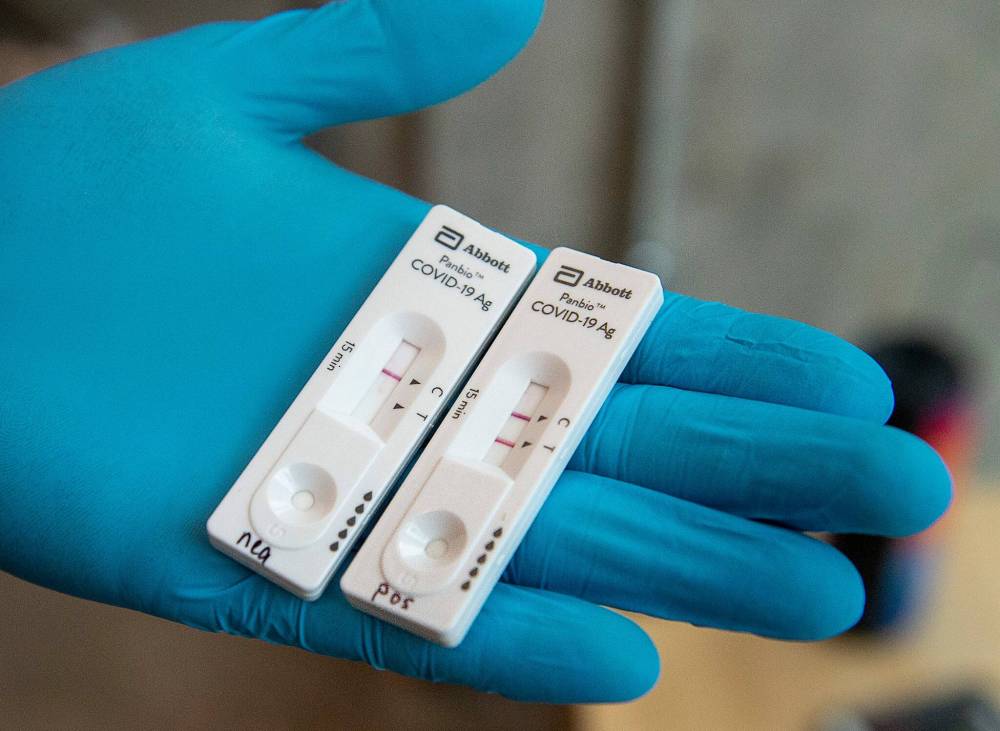
“We have more than enough rapid-test capacity for Manitobans to make sure they are protecting themselves, protecting others and to feel confident in their decision making in terms of if they’re feeling under the weather, what steps they can take in order to help the community stay safe and also to support our hospital capacity,” Asagwara said.
“We have learned a lot of lessons from the pandemic, including the steps that we can all take to better protect ourselves, our neighbours, families, and again our hospitals. That means taking advantage of the fact we do have 8.5 million rapid tests available is important.”
Case numbers related to COVID-19 are going up.
The province’s latest COVID-19 and seasonal influenza report shows that in the week ending Nov. 18, 312 cases of the virus were confirmed by provincial testing. That’s up from 256 cases one week earlier, and 240 two weeks before that.
Dr. Philippe Lagace-Wiens, a medical microbiologist at St. Boniface Hospital and assistant professor in medical microbiology and infectious diseases at the University of Manitoba, said while provincial statistics show the positivity rate is 28.2 per cent, it doesn’t mean that’s the percentage of people in the community with the virus. The number of people who are tested is too low.
(An average of 220 people per day were tested in the week ending Nov. 18.)
“But it does mean there is a high amount of COVID-19 in the community,” Lagace-Wiens said.
“It was 10 per cent at the end of August and it is close to 30 per cent now. Even if it is not super-accurate, it is up.”
The number of Manitobans officially diagnosed with the novel coronavirus stood at 2,604 from July 2 to Nov. 18.
Seventy-eight people were admitted to hospital and 12 were in intensive care during the week ending Nov. 18.
That was up from 59 hospital admissions and three patients in ICU one week earlier.
One person died from COVID-19 in the week ending Nov. 18, the first fatality in a few weeks.
Twenty-three Manitobans have died from COVID-19 since July 2.
At this time, 20 personal care homes and 15 hospital wards in Winnipeg have COVID outbreaks.
Cynthia Carr, a Winnipeg epidemiologist, said people shouldn’t be alarmed by that.
“It’s an outbreak, it’s not an epidemic,” Carr said.
“It’s not the number of cases, but the implementation of the planning to respond to it when it is known.”
Carr said people who feel unwell shouldn’t go to a personal care home.
But Carr said with this number of places having been hit with an outbreaks “it is a message to us that there could be more COVID circulating because you are seeing more than one case in this environment.”
Lagace-Wiens said with the number of hospitalizations up, it means people should get the latest COVID-19 vaccine.
“The best time to get it is before the wave starts and the next best time is now… if you have symptoms, you should wear a mask just to help others.”
Wastewater from Winnipeg’s northern sewage treatment plant is at a high level of COVID-19 and rising; wastewater from the southern treatment plant is high, but hasn’t increased in the past two weeks; and the level of virus in wastewater from the plant in the western end is moderate, but rising, federal government data show.
Asagwara said the new government will rely on health experts to determine whether further public health measures are needed.

“We have got some wonderful public health experts here in Manitoba and it is so important we trust and follow their advice… we continue to encourage people to go out, get their boosters, get their flu vaccines, take the steps they need in order to protect their health in order to mitigate the transmission of viruses in our communities.”
City of Winnipeg spokesman Adam Campbell said since the start of the pandemic the city’s libraries have distributed 35,209 COVID test kits.
“Kits are still available in some branches and public uptake has been popular,” Campbell said. “However, we are nearing the end of our supply. We are discussing the possibility of additional supply with the province.”
In addition, provincial statistics show 70 cases of Influenza A were detected in the week ending Nov. 18, up from 30 a week earlier, and 12 the week before that.
kevin.rollason@freepress.mb.ca
Kevin Rollason
Reporter
Kevin Rollason was a general assignment reporter at the Free Press.
Our newsroom depends on a growing audience of readers to power our journalism. If you are not a paid reader, please consider becoming a subscriber.
Our newsroom depends on its audience of readers to power our journalism. Thank you for your support.
Kevin Rollason
Reporter
Kevin Rollason was a general assignment reporter at the Free Press.
Our newsroom depends on a growing audience of readers to power our journalism. If you are not a paid reader, please consider becoming a subscriber.
Our newsroom depends on its audience of readers to power our journalism. Thank you for your support.
Advertisement Advertise With Us
Advertisement Advertise With Us