

The UN secretary-general invoked ‘Article 99’ to push for a Gaza cease-fire. What exactly is it?
Advertisement
Read this article for free:
or
Already have an account? Log in here »
To continue reading, please subscribe:

Digital Subscription
One year of digital access for only $205*
- Enjoy unlimited reading on winnipegfreepress.com
- Read the E-Edition, our digital replica newspaper
- Access News Break, our award-winning app
- Play interactive puzzles
*First annual payment billed as $205.00 + GST for one year. This annual subscription will automatically renew at $233.00 + GST every 52 weeks (10% off the regular annual price of $259.35). Offer available to new and qualified returning subscribers only. Cancel any time.
To continue reading, please subscribe:
Add Free Press access to your Brandon Sun subscription for only an additional
$1 for the first 4 weeks*
- Enjoy unlimited reading on winnipegfreepress.com
- Read the E-Edition, our digital replica newspaper
- Access News Break, our award-winning app
- Play interactive puzzles
*Your next Brandon Sun subscription payment will increase by $1.00 and you will be charged $17.95 plus GST for four weeks. After four weeks, your payment will increase to $24.95 plus GST every four weeks.
Read unlimited articles for free today:
or
Already have an account? Log in here »
Hey there, time traveller!
This article was published 07/12/2023 (997 days ago), so information in it may no longer be current.
It’s called “Article 99.” And it hasn’t been used for decades. Until this week.
With an intensifying Israeli offensive and escalating civilian casualties, U.N. Secretary-General Antonio Guterres invoked a rarely exercised power this week to warn the Security Council of an impending “humanitarian catastrophe” in Gaza. He urged members to demand an immediate humanitarian cease-fire.
Guterres invoked Article 99 of the U.N. Charter — last used over half a century ago — which says the secretary-general may inform the council of matters he believes threaten international peace and security.
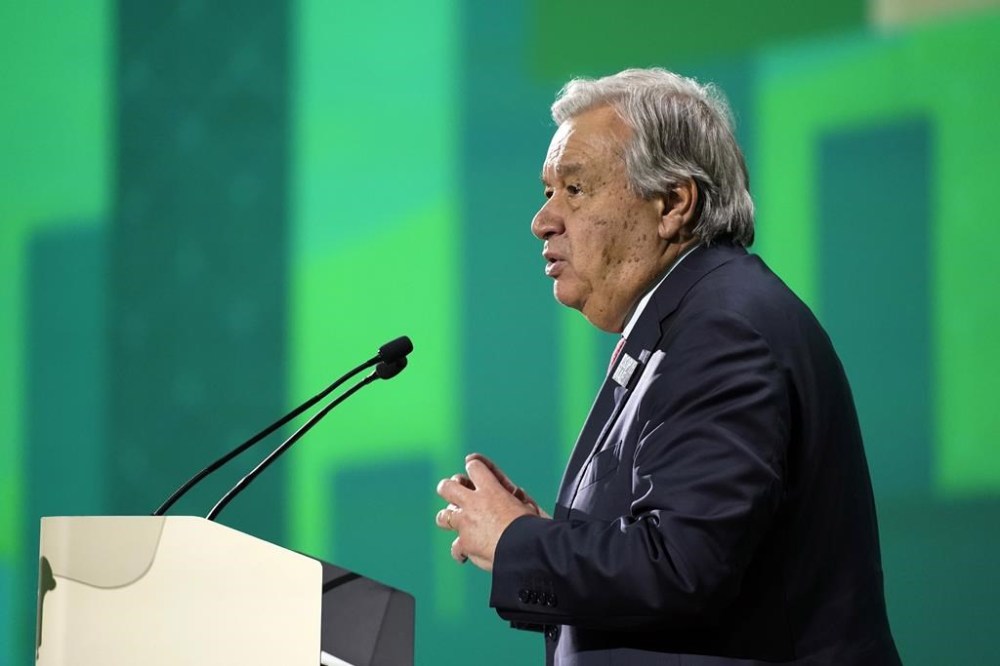
Here, Edith M. Lederer, longtime chief U.N. correspondent for The Associated Press, breaks down what this could mean.
WHAT IS ARTICLE 99 AND WHY IS GUTERRES INVOKING IT?
It’s a provision of the United Nations Charter, the U.N. constitution. It states that the secretary-general — the U.N.’s top diplomat — may bring to the attention of the Security Council “any matter which, in his opinion, may threaten the maintenance of international peace and security.”
This gives an important additional power to the secretary-general, since the real power at the U.N. is held by its 193 member nations and especially the 15 countries that serve on the Security Council.
Article 99 is extremely rarely used. The last time it was invoked was during fighting in 1971 that led to the creation of Bangladesh and its separation from Pakistan.
Guterres invoked Article 99 because he sees the situation in Gaza at risk of a “complete collapse” of the territory’s humanitarian system and civil order. It was something he felt needed to be done.
HOW LIKELY IS THIS TO HAVE AN EFFECT, GIVEN THE U.S. VETO POWER?
Arab and Islamic nations followed up on Guterres’s letter immediately.
The United Arab Emirates, the Arab representative on the Security Council, circulated a short resolution to Security Council members late Wednesday calling for an immediate humanitarian ceasefire. They plan to put that resolution to a vote at a Security Council meeting on Friday morning.
The United States, which is Israel’s closest ally and has veto power on resolutions, has not supported a cease-fire. On Tuesday, U.S. Deputy Ambassador Robert Wood said that the role of the Security Council in the Israel-Gaza war is not to get in the way of important diplomacy that’s taking place. And he said the Security Council resolution at this time “would not be useful.”
This could signal a likely veto, but the U.S. has not said either way.
IN THAT CASE, WHY INVOKE IT?
Because Guterres believes that the humanitarian system and the humanitarian operations in Gaza are collapsing.
He also warns in his letter that in the current situation, “amid constant bombardment by the Israeli Defense Forces and without shelter or essentials to survive, I expect public order to completely break down soon due to the desperate conditions, rendering even limited humanitarian assistance impossible.”
Guterres said the situation could get even worse, pointing to possible epidemics and the mass displacement of Palestinians into neighboring countries. He sees a looming disaster.
Previous secretaries-general have brought threats that they saw to international peace and security to the Security Council without mentioning Article 99. This includes Congo in 1960, the U.S. hostage crisis in Iran that began in November 1979, the Iran-Iraq war in 1980 and more recently Myanmar in 2017.
We don’t know why they didn’t invoke Article 99, and several of the previous secretaries-general are now dead. Guterres has been very outspoken on both the Hamas attacks on Israel and the very high death toll of Palestinian civilians in Gaza.