

A British D-Day veteran celebrates turning 100, but the big event is yet to come
Advertisement
Read this article for free:
or
Already have an account? Log in here »
To continue reading, please subscribe:

Digital Subscription
One year of digital access for only $205*
- Enjoy unlimited reading on winnipegfreepress.com
- Read the E-Edition, our digital replica newspaper
- Access News Break, our award-winning app
- Play interactive puzzles
*First annual payment billed as $205.00 + GST for one year. This annual subscription will automatically renew at $233.00 + GST every 52 weeks (10% off the regular annual price of $259.35). Offer available to new and qualified returning subscribers only. Cancel any time.
To continue reading, please subscribe:
Add Free Press access to your Brandon Sun subscription for only an additional
$1 for the first 4 weeks*
- Enjoy unlimited reading on winnipegfreepress.com
- Read the E-Edition, our digital replica newspaper
- Access News Break, our award-winning app
- Play interactive puzzles
*Your next Brandon Sun subscription payment will increase by $1.00 and you will be charged $17.95 plus GST for four weeks. After four weeks, your payment will increase to $24.95 plus GST every four weeks.
Read unlimited articles for free today:
or
Already have an account? Log in here »
Hey there, time traveller!
This article was published 13/01/2024 (971 days ago), so information in it may no longer be current.
LONDON (AP) — British D-Day veteran Bill Gladden turned 100 on Saturday, a day after his niece threw a surprise birthday party for him. It was a big fuss he didn’t really expect, though the old soldier had tears in his eyes long before he caught sight of a cake decorated with a replica of his uniform and the medals he earned.
But Gladden isn’t focused on his birthday this year, big as it is. He’s looking six months down the road.
That’s because the event he really wants to attend is the 80th anniversary of the D-Day landings on June 6. It may be the last of the big events marking the beginning of the end of World War II in Europe because so few of the 850,000 troops who took part remain. Gladden wants to be there to honor those who are gone — to remind people that victory did not come cheap.

“If I could do that this year, I should be happy,” he told The Associated Press from his home in Haverhill, eastern England, where he still lives on his own. ”Well, I am happy now, but I should be more happy.”
A dispatch rider with the 6th Airborne Reconnaissance Regiment, Gladden landed behind the front lines on D-Day, June 6, 1944, in a wooden glider loaded with six motorcycles and a 17,000-pound (7,700-kilogram) tank. The unit was part of an operation charged with securing bridges over the River Orne and Caen Canal so they could be used by Allied forces moving inland from the Normandy beaches.
Based in an orchard outside the village of Ranville, Gladden spent 12 days making forays into the surrounding countryside to check out reports of enemy activity.
On June 16, he carried two injured soldiers into a barn that was being used as a makeshift field hospital. Two days later, he found himself at the same barn, his right ankle shattered by machine gun fire.
Lying on the grass outside the hospital, he read the treatment label pinned to his tunic:
“Amputation considered. Large deep wound in right ankle. Compound fracture of both tibia and fibula. All extension tendons destroyed. Evacuate.”
Gladden didn’t lose his leg, but he spent the next three years in the hospital as doctors performed a series of surgeries, including tendon transplants, skin and bone grafts.
After the war, Gladden married Marie Warne, an army driver he met in 1943, and spent 40 years working for Siemens and Pearl Insurance. They had a daughter.
These days he’s more likely to talk about how proud he is of his family than he is to reminisce about D-Day. But his wartime story is preserved in a scrapbook that includes a newspaper clipping about “the tanks that were built to fly,” his drawings and other memorabilia.
There’s also a scrap of parachute left behind by one of the paratroopers who landed in the orchard at Ranville. As he lay in the hospital recovering from his wounds, Gladden painstakingly stitched his unit’s shoulder insignia into the fabric.
The edges are frayed and discolored after eight decades, but “Royal Armoured Corps” still stands out in an arc of red lettering on a yellow background. Underneath is a silhouette of Pegasus, the flying horse, over the word “Airborne.”
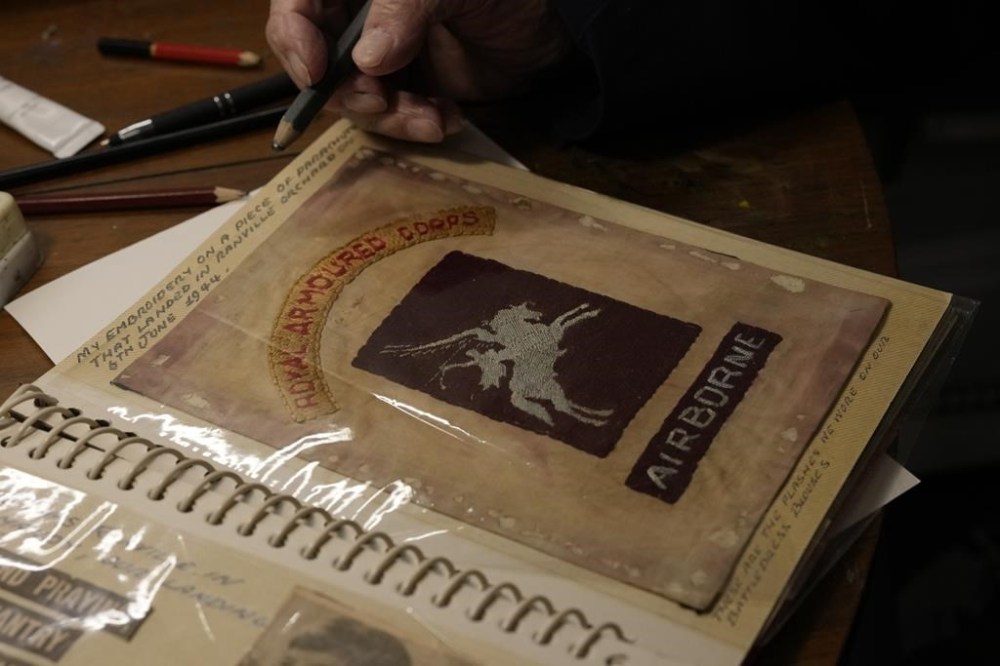
“These are the flashes we wore on our battledress blouses,” says the caption in neat block letters.
Nothing has faded from memory though. At his party, people celebrated his service and offered a booming happy birthday chorus.
“I just think he’s a legend, what he’s been through, what he’s seen, what he’s done,” said his niece, Kaye Thorpe. “He’s just amazing, and he’s still bright as a button on top.”
For men like Bill Gladden, though, there was no I in D-Day. Even as he celebrated his 100th birthday, somehow it wasn’t just about him. Instead, he echoed the words of many who survived the invasion.
“When you think of all those young lives that lay in those cemeteries abroad, the Allies and us won the war but (victory) was a very expensive one, life-wise,” he said. “Because so many youngsters died.”
___
Associated Press writers Mayuko Ono and Alastair Grant contributed