

Tunisia commemorates anniversary of the 2011 revolution. Opposition decries democratic backsliding
Advertisement
Read this article for free:
or
Already have an account? Log in here »
To continue reading, please subscribe:

Digital Subscription
One year of digital access for only $205*
- Enjoy unlimited reading on winnipegfreepress.com
- Read the E-Edition, our digital replica newspaper
- Access News Break, our award-winning app
- Play interactive puzzles
*First annual payment billed as $205.00 + GST for one year. This annual subscription will automatically renew at $233.00 + GST every 52 weeks (10% off the regular annual price of $259.35). Offer available to new and qualified returning subscribers only. Cancel any time.
To continue reading, please subscribe:
Add Free Press access to your Brandon Sun subscription for only an additional
$1 for the first 4 weeks*
- Enjoy unlimited reading on winnipegfreepress.com
- Read the E-Edition, our digital replica newspaper
- Access News Break, our award-winning app
- Play interactive puzzles
*Your next Brandon Sun subscription payment will increase by $1.00 and you will be charged $17.95 plus GST for four weeks. After four weeks, your payment will increase to $24.95 plus GST every four weeks.
Read unlimited articles for free today:
or
Already have an account? Log in here »
Hey there, time traveller!
This article was published 15/01/2024 (972 days ago), so information in it may no longer be current.
TUNIS, Tunisia (AP) — Thirteen years after they toppled the country’s longtime dictator, Tunisians are protesting President Kais Saied for ushering in what they see as democratic backsliding, blaming him for quashing the aims of the revolution that kicked off the Arab Spring in 2011.
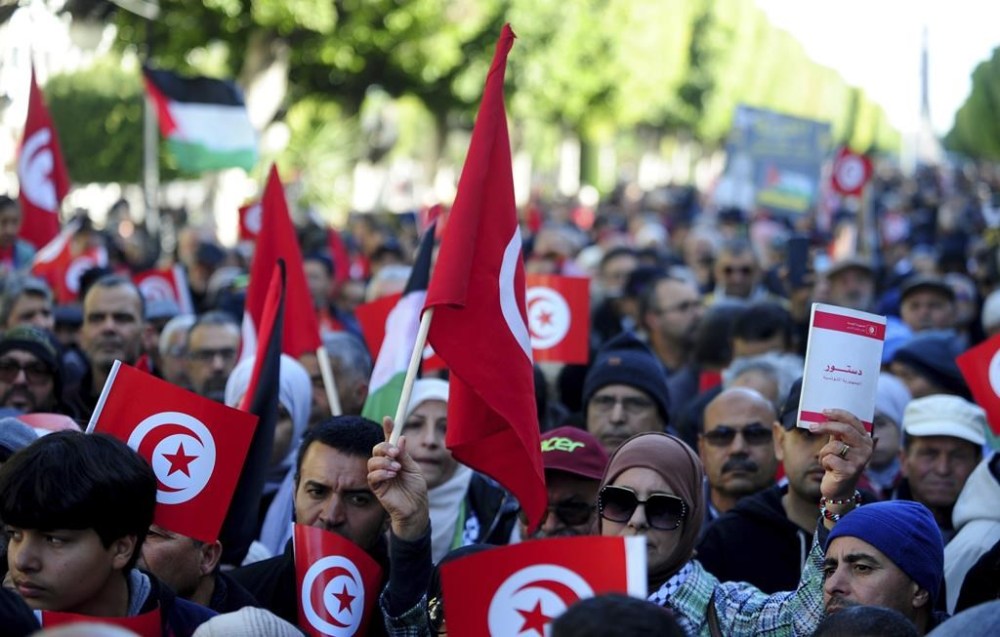
Hundreds of members of opposition parties marched through the streets of the country’s capital on Sunday, commemorating the revolution and expressing outrage at Saied’s rule. They carried Palestinian and Tunisian flags, chanting for freedom, jobs, and dignity, while mourning the state of the current political landscape in Tunisia.
Though many said they were dismayed by the direction that Tunisia’s first-term president has taken the country, the protest was smaller than in years past, reflecting political apathy and an opposition struggling to remain unified as November’s presidential election approaches.
“After a successful start, Tunisia’s democratic transition today has broken down,” Ahmed Chebbi, the president of the National Salvation Front, told The Associated Press. “Saied has exploited the citizens’ disappointment and the divisions that have taken hold among political elites.”
Such criticism has become commonplace over the past two and a half years, throughout which Saied has temporarily suspended Tunisia’s parliament, rewritten the country’s constitution and imprisoned more than 20 political opponents for allegedly undermining state security.
That includes Rached Ghannouchi, the 82-year-old leader of Ennahda, the Islamist movement that rose to power after the revolution. In October, he was sentenced to 15 months behind bars for abetting terrorism and inciting hatred — charges his attorneys have called politically motivated.
“All of the revolution’s gains have suffered setbacks due to (Saied’s) seizure of all powers,” Ennahda spokesperson Imed Khemiri said in a statement. ”Fundamental freedoms have deteriorated, restrictions have been imposed on the activities of political parties, opponents are being prosecuted and the independence of the judiciary has been called into question.”
Sunday’s demonstrations took place weeks after Tunisian journalist Zied El Heni was arrested after criticizing the government. He was later released and received a six-month suspended sentence. Press freedom advocates said the case reflected ongoing concerns about press freedoms in Tunisia 13 years after the revolution.
Journalists have been consistently targeted, with several arrested on state security-related charges in Saied’s Tunisia, even though last decade’s revolution and the constitution written in its aftermath enshrined new protections for press freedoms.
“The situation for the press is worrying and very dangerous”, said Ziad Dabbar, the President of the National Syndicate of Tunisian Journalists.
—
Associated Press writer Mehdi El Arem contributed reporting from Tunis.