

Alabama calls nitrogen execution method painless and humane, but critics are raising doubts
Advertisement
Read this article for free:
or
Already have an account? Log in here »
To continue reading, please subscribe:

Digital Subscription
One year of digital access for only $205*
- Enjoy unlimited reading on winnipegfreepress.com
- Read the E-Edition, our digital replica newspaper
- Access News Break, our award-winning app
- Play interactive puzzles
*First annual payment billed as $205.00 + GST for one year. This annual subscription will automatically renew at $233.00 + GST every 52 weeks (10% off the regular annual price of $259.35). Offer available to new and qualified returning subscribers only. Cancel any time.
To continue reading, please subscribe:
Add Free Press access to your Brandon Sun subscription for only an additional
$1 for the first 4 weeks*
- Enjoy unlimited reading on winnipegfreepress.com
- Read the E-Edition, our digital replica newspaper
- Access News Break, our award-winning app
- Play interactive puzzles
*Your next Brandon Sun subscription payment will increase by $1.00 and you will be charged $17.95 plus GST for four weeks. After four weeks, your payment will increase to $24.95 plus GST every four weeks.
Read unlimited articles for free today:
or
Already have an account? Log in here »
Hey there, time traveller!
This article was published 22/01/2024 (968 days ago), so information in it may no longer be current.
MONTGOMERY, Ala. (AP) — Alabama, unless stopped by the courts, intends to strap Kenneth Eugene Smith to a gurney Thursday and use a gas mask to replace breathable air with nitrogen, depriving him of oxygen, in the nation’s first execution attempt with the method.
The Alabama attorney general’s office told federal appeals court judges last week that nitrogen hypoxia is “the most painless and humane method of execution known to man.” But what exactly Smith, 58, will feel after the warden switches on the gas is unknown, some doctors and critics say.
“What effect the condemned person will feel from the nitrogen gas itself, no one knows,” Dr. Jeffrey Keller, president of the American College of Correctional Physicians, wrote in an email. “This has never been done before. It is an experimental procedure.”

Keller, who was not involved in developing the Alabama protocol, said the plan is to “eliminate all of the oxygen from the air” that Smith is breathing by replacing it with nitrogen.
“Since the condemned person will not be breathing any oxygen, he will die,” Keller said. “It is little different than putting a plastic bag over one’s head.”
The state of Alabama has predicted in federal court filings that the nitrogen gas will “cause unconsciousness within seconds, and cause death within minutes.”
The state plans to place a “full facepiece supplied air respirator” over Smith’s face. The nitrogen would be administered for at least 15 minutes or “five minutes following a flatline indication on the EKG, whichever is longer,” according to the state protocol.
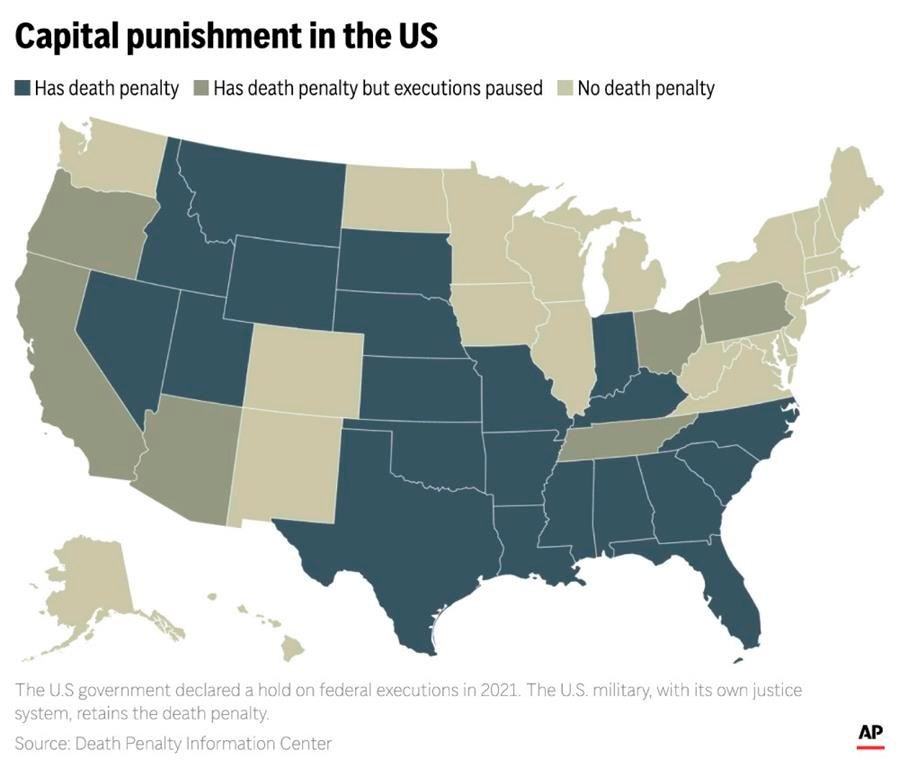
The execution would be the first attempt to use a new method since lethal injection was introduced in 1982. Three states — Alabama, Mississippi and Oklahoma — have authorized nitrogen hypoxia as an execution method. Some states are exploring new methods as lethal injection drugs have been difficult to find.
The American Veterinary Medical Association wrote in 2020 euthanasia guidelines that nitrogen hypoxia is not an acceptable euthanasia method for most mammals because the anoxic environment “is distressing.” And experts appointed by the U.N. Human Rights Council cautioned they believe the execution method could violate the prohibition on torture.
Dr. Joel Zivot, an anesthesiologist who as one of four professionals who filed the U.N. complaint that led to the warning, said Smith is at risk for seizures and choking to death on his own vomit. He said any leak under the mask could prolong the execution.

“A leak will do two things. It will potentially endanger people around. … Air could then get under the mask as well,” Zivot said. “And so the execution could be prolonged or maybe he might never die, he just could get injured.”
Dr. Philip Nitschke, a euthanasia expert who designed a suicide pod using nitrogen gas, said nitrogen can be used to provide a peaceful, hypoxic death. But Nitschke, who testified at a court hearing on behalf of Smith, wrote in a court declaration that he had concerns about Alabama’s specific proposal. including maintaining an air-tight seal in the mask and the potential for vomiting.
Much of what is recorded about death from nitrogen comes from industrial accidents and suicide attempts. The U.S. Chemical Safety and Hazard Investigation Board found 80 people were killed by nitrogen asphyxiation between 1992 and 2002.
Smith was one of two men convicted of the 1988 murder-for-hire of a preacher’s wife. Prosecutors said the men were paid $1,000 to kill Elizabeth Sennett, 45, on behalf of her husband, who wanted to collect on insurance. The coroner testified Sennett was stabbed repeatedly. Her husband killed himself when he became a suspect. John Forrest Parker, the other man convicted, was executed in 2010.
The victim’s son, Charles Sennett Jr., said in an interview with WAAY-TV that Smith “has to pay for what he’s done.” He and other family members plan to witness the execution.
“And some of these people out there say, ‘Well, he doesn’t need to suffer like that.’ Well, he didn’t ask Mama how to suffer?” the son told the station. “They just did it. They stabbed her — multiple times.”
Smith’s initial conviction was overturned. He was convicted again in 1996. The jury recommended a life sentence by 11-1, but a judge sentenced Smith to death. Alabama no longer allows a judge to override a jury’s sentencing decision in death penalty cases.

Smith is one of few people to survive a prior execution attempt. The state attempted a lethal injection in 2022, but the prison system called it off before the drugs were administered because the staff had difficulty connecting the two required intravenous lines.
Smith’s attorneys are asking courts to block the nitrogen execution, arguing that it is unconstitutional for the state to make a second attempt to execute him and that its plan violates the ban on cruel and unusual punishment and at least merits more scrutiny before it is used. The question of whether the execution can proceed is headed to the U.S. Supreme Court, which has never found a proposed execution method to be unconstitutional.
“It’s indefensible for Alabama officials to simply dismiss the very real risks this untested method presents and experiment on a man who has already survived one execution attempt,” Robin M. Maher, executive director of the Death Penalty Information Center, said.
Sant’Egidio Community, a Vatican-affiliated Catholic charity based in Rome, urged Alabama on Tuesday not to go through with the execution, saying the chosen method is “barbarous” and “uncivilized” and would bring “indelible shame” to the state.
The Alabama attorney general’s office noted that Smith, when previously fighting lethal injection, had suggested nitrogen as an alternative execution method. Courts require inmates challenging their execution method to suggest an alternative method.
“Now that the State is prepared to give Smith what he asked for, he objects,” the attorney general’s office said in a Monday statement.
The inmate’s spiritual adviser said Smith is afraid of what is about to happen to him.
“Presently, Kenny is sickened, deeply pained and horrified at the nitrogen hypoxia experiment that is to come,” the Rev. Jeff Hood, a death penalty opponent, said. “Despite the darkness that has descended, he tries very hard to fill every second he might have left with as much love as he can muster.”
Demonstrators gathered outside the Alabama Capitol on Monday and Tuesday, asking the governor to halt the execution.
Alabama Gov. Kay Ivey told The Associated Press last week that the state was ready to proceed.
“Execution by that method was passed in 2018,” Ivey said. “The attorney general’s office and the Department of Corrections has assured us that all the protocols are in place, and we will carry out that law.”