A landslide of contaminated soil threatens environmental disaster in Denmark. Who pays to stop it?

Advertisement

Advertise with us

COPENHAGEN, Denmark (AP) — Authorities in Denmark are working against the clock to stop a slow-moving landslide of contaminated soil from reaching a nearby water source as public officials and the company that operated the site argue over who should pay for the massive cleanup.

Read this article for free:


By clicking the button above, an account will be created and you will begin to receive some of our recommended newsletters. You may opt out of any newsletter by visiting your Email and Communication Preferences page or by clicking "unsubscribe" at the bottom of any email.

or

Already have an account? Log in here »

To continue reading, please subscribe:

Digital Subscription

One year of digital access for only $1.44 a week*

  • Enjoy unlimited reading on winnipegfreepress.com
  • Read the E-Edition, our digital replica newspaper
  • Access News Break, our award-winning app
  • Play interactive puzzles

*Billed as $5.77 plus GST every four weeks. After 52 weeks, price increases to the regular rate of $19.95 plus GST every four weeks. Offer available to new and qualified returning subscribers only. Cancel any time.

To continue reading, please subscribe:

Add Free Press access to your Brandon Sun subscription for only an additional

$1 for the first 4 weeks*

  • Enjoy unlimited reading on winnipegfreepress.com
  • Read the E-Edition, our digital replica newspaper
  • Access News Break, our award-winning app
  • Play interactive puzzles
Start now

*Your next Brandon Sun subscription payment will increase by $1.00 and you will be charged $17.95 plus GST for four weeks. After four weeks, your payment will increase to $24.95 plus GST every four weeks.

Hey there, time traveller!
This article was published 26/01/2024 (1002 days ago), so information in it may no longer be current.

COPENHAGEN, Denmark (AP) — Authorities in Denmark are working against the clock to stop a slow-moving landslide of contaminated soil from reaching a nearby water source as public officials and the company that operated the site argue over who should pay for the massive cleanup.

The 75-meter (250-foot) -tall heap of dirt at the Nordic Waste reprocessing plant south of the town of Randers in northwestern Denmark contains some 3 million cubic meters (100 million cubic feet) of soil contaminated with heavy metals and oil products. It is moving at a pace of up to 40 centimeters (16 inches) per hour toward a stream connected to the Baltic Sea via the Randers Fjord.

The landslide started Dec. 10. Nine days later, Nordic Waste gave up on getting it under control, leaving the task up to the Randers Municipality, which has been rerouting the stream by laying pipes allowing it to pass the site safely.
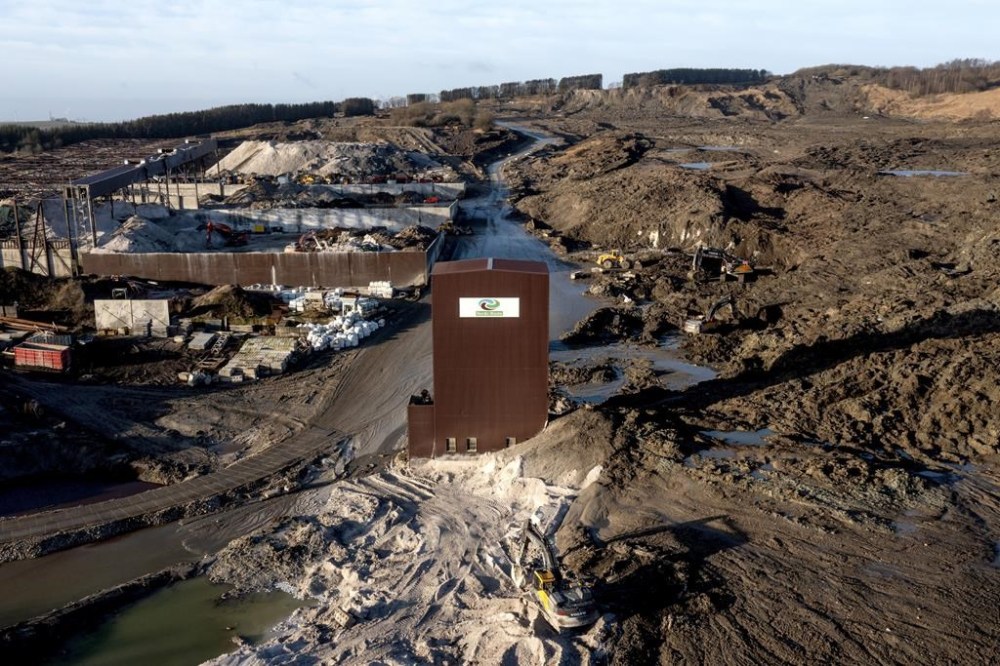
The area affected by a landslide of several million tonnes contaminated soil is pictured, near the village of Oelst, near Randers, Denmark, Thursday Jan. 25, 2024. On Monday, Prime Minister Mette Frederiksen said that
The area affected by a landslide of several million tonnes contaminated soil is pictured, near the village of Oelst, near Randers, Denmark, Thursday Jan. 25, 2024. On Monday, Prime Minister Mette Frederiksen said that "of course, it would be totally unfair if the children in Randers or elderly have to pay this bill,” after visiting the site with a 75-meter (82-yard) tall heap of dirt at the Nordic Waste reprocessing plant site with 3 million cubic meters (3,923,852 cubic yard) of contaminated soil. (Bo Amstrup/Ritzau Scanpix via AP)

Environment Minister Magnus Heunicke said Friday that authorities are working on extending those pipes and that a sheet pile wall is being constructed, along with several basins for the contaminated water.

Water from rain and melting snow are the biggest problems, Heunicke said. In the past week, western Denmark has seen huge amounts of snow and rain.

“It’s about separating the polluted water from the clean water,” he told a news conference, adding that the work is “enormously difficult.”

On Monday, a report by the Geological Survey of Denmark and Greenland, or GEUS, said the continuous deposit of soil on top of a sloping clay pit at Nordic Waste was the main cause for the landslide. GEUS added that there had been landslides in the region since 2021.

United Shipping and Trading Company, or USTC, which is behind Nordic Waste, earlier blamed the landslide on climatic conditions beyond its control. The area “has been exposed to enormous amounts of rain, as 2023 has been the wettest year ever in Denmark. This has resulted in a natural disaster of a caliber never before seen in Denmark,” it said.

It is still unclear who will have to pay for the cleanup. Nordic Waste was declared bankrupt earlier this week after the Danish Environmental Protection Agency ordered it to provide security of more than 200 million kroner ($29.2 million) to prevent an environmental disaster.
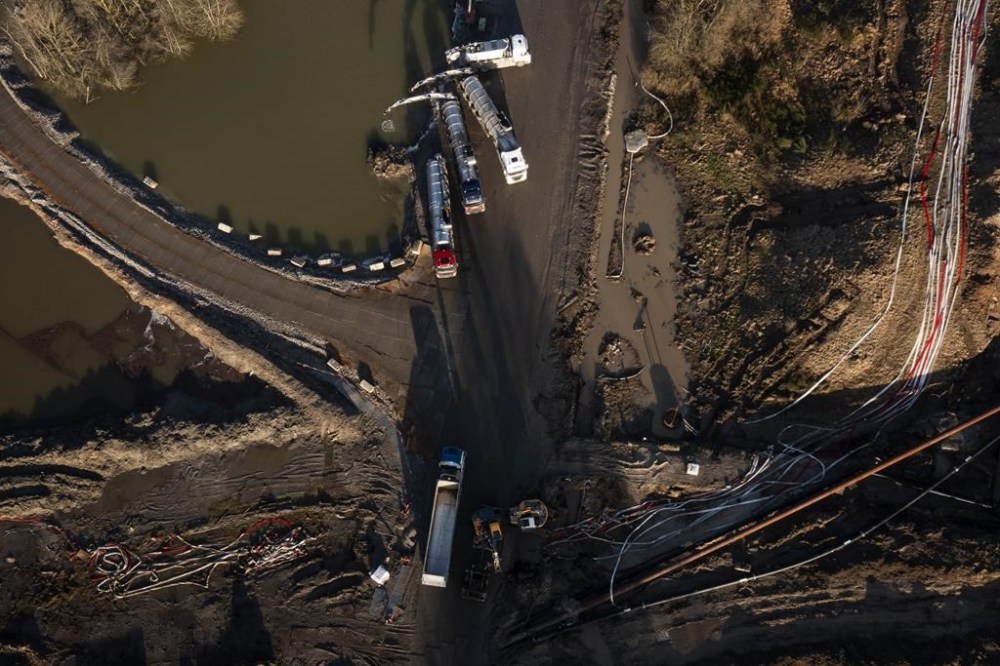
The area affected by a landslide of several million tonnes contaminated soil is pictured, near the village of Oelst, near Randers, Denmark, Thursday Jan. 25, 2024. On Monday, Prime Minister Mette Frederiksen said that
The area affected by a landslide of several million tonnes contaminated soil is pictured, near the village of Oelst, near Randers, Denmark, Thursday Jan. 25, 2024. On Monday, Prime Minister Mette Frederiksen said that "of course, it would be totally unfair if the children in Randers or elderly have to pay this bill,” after visiting the site with a 75-meter (82-yard) tall heap of dirt at the Nordic Waste reprocessing plant site with 3 million cubic meters (3,923,852 cubic yard) of contaminated soil. (Bo Amstrup/Ritzau Scanpix via AP)

Denmark’s Prime Minister Mette Frederiksen, who visited the site Monday, said it would be unfair if Danish taxpayers had to pay.

Nina Østergaard Borris, Nordic Waste’s CEO, said it would take up five years to restore the site, and it could potentially cost billions of kroner. She said the situation “is far more serious than anyone could have imagined, and the task of saving the area is far greater than what Nordic Waste or USTC can handle.”

The case has started a debate about whether Nordic Waste has a moral responsibility to pay. The government has lashed out at Denmark’s sixth-richest man, Torben Østergaard-Nielsen, who is behind USTC, for not paying.

Report Error Submit a Tip

More Stories

Builder beefs up security after string of blazes

Morgan Modjeski 3 minute read Preview

Builder beefs up security after string of blazes

Morgan Modjeski 3 minute read Updated: Yesterday at 9:36 AM CDT

A Winnipeg builder said he’s had to beef up security around his developments after one of his projects sustained significant damage Wednesday in suspected arson cases.

Read
Updated: Yesterday at 9:36 AM CDT

Puzzles Palace

1 minute read Friday, Oct. 16, 2026

To solve our puzzles, please subscribe with this special offer: |

MPI must evolve to ‘best-in-class’

Kyle Ross 5 minute read 2:02 AM CDT

As a Manitoban, you pay the lowest auto insurance rates in Canada in 2026. (That’s the analysis shared in the Saskatchewan Auto Fund’s 2026 Rate Proposal, in case having your good fortune envied by your neighbours sweetens the news.)

You deal directly with one insurance company — your own — after your vehicle gets hit, rather than chasing the other driver’s company. When it comes to fair and transparent customer service, your insurer has a higher bar to jump than in many other provinces. A private insurance company could just hike your rates; before making rate changes, Manitoba Public Insurance must go through an open and transparent public hearing at the Public Utilities Board, a neutral third party.

It’s worth remembering these points as MPI is slammed in opinion columns, social media posts and water-cooler talk. We have rates and an ease of navigating claims that other Canadians envy. We have a crown corporation that is a crown jewel — or could be.

But the criticism is warranted.

Processing potential long way from reality

Laura Rance-Unger 5 minute read Preview

Processing potential long way from reality

Laura Rance-Unger 5 minute read 2:02 AM CDT

There are times in life when you want to be wrong — like when you walk into the doctor’s office believing your ailment will be the death of you.

It’s the same sort of feeling I get wading through the pile of newly released reports extolling the unrealized “potential” for more value-added processing in Canadian agriculture. There’s this little voice inside my head saying: “I’m from Manitoba. Show me.”

There are jaw-dropping numbers bandied about in various reports from Food and Beverage Canada, the Canadian Chambers of Commerce/PwC and the Canadian Agri-Food Policy Institute. For example, more processing could add $75 billion on top of the $188 billion the sector already generates, create hundreds of thousands more jobs and a bigger domestic market for farmers. The list goes on.

Not to discount the solid analysis behind these efforts. Overall, it all sounds great, although notably missing is any mention of the growing concerns over ultra-processed foods and how that might affect future market growth.

Read
2:02 AM CDT

Frustration on menu as St. James construction drags on

Kelly-Anne Riess 4 minute read Preview

Frustration on menu as St. James construction drags on

Kelly-Anne Riess 4 minute read Updated: Yesterday at 11:18 AM CDT

Nearly four months of construction outside the front door of a longtime Portage Avenue restaurant has driven away customers and left its owner struggling to cover operating expenses.

Read
Updated: Yesterday at 11:18 AM CDT

What $4 pumpkin can teach us about workplace culture

Tory McNally 7 minute read Preview

What $4 pumpkin can teach us about workplace culture

Tory McNally 7 minute read 2:02 AM CDT

There are few things more revealing about a workplace than what happens when someone suggests a little fun.

Put a pumpkin on the reception desk, announce a Halloween costume day or suggest that everyone take 20 minutes to enjoy some candy and you may discover that your organization falls into one of two camps.

There are those who embrace the opportunity to do something different and those who immediately begin calculating the cost of lost productivity.

Somewhere, a manager is currently wondering whether the employee who spent 15 minutes decorating their office door could have used that time to answer three emails. Another is worried allowing costumes will somehow lead to a complete collapse of professional standards. A third is quietly trying to figure out whether a bowl of miniature chocolate bars can be claimed as a business expense.

Read
2:02 AM CDT