

Argentinian court overturns Milei’s labor rules, in a blow to his reform plans
Advertisement
Read this article for free:
or
Already have an account? Log in here »
To continue reading, please subscribe:

Digital Subscription
One year of digital access for only $205*
- Enjoy unlimited reading on winnipegfreepress.com
- Read the E-Edition, our digital replica newspaper
- Access News Break, our award-winning app
- Play interactive puzzles
*First annual payment billed as $205.00 + GST for one year. This annual subscription will automatically renew at $233.00 + GST every 52 weeks (10% off the regular annual price of $259.35). Offer available to new and qualified returning subscribers only. Cancel any time.
To continue reading, please subscribe:
Add Free Press access to your Brandon Sun subscription for only an additional
$1 for the first 4 weeks*
- Enjoy unlimited reading on winnipegfreepress.com
- Read the E-Edition, our digital replica newspaper
- Access News Break, our award-winning app
- Play interactive puzzles
*Your next Brandon Sun subscription payment will increase by $1.00 and you will be charged $17.95 plus GST for four weeks. After four weeks, your payment will increase to $24.95 plus GST every four weeks.
Read unlimited articles for free today:
or
Already have an account? Log in here »
Hey there, time traveller!
This article was published 30/01/2024 (972 days ago), so information in it may no longer be current.
BUENOS AIRES, Argentina (AP) — An Argentine court on Tuesday overturned labor rules proposed by President Javier Milei that would make it easier to fire workers, in a new blow to the leader’s efforts to shake up regulations that he says have hampered the country’s struggling economy.
The appeals court already temporarily suspended the incoming president’s new regulations in early January after a legal challenge brought by the main union group, the General Labor Confederation.
The three-judge panel ruled Tuesday that the regulations were unconstitutional, saying that Milei’s government went beyond its authority to decree them and that they first need to be approved by Congress.

The latest ruling can be appealed before the Supreme Court. Milei’s administration did not immediately say whether it would do so.
Milei in December announced a decree that would make several changes to labor rules, like increasing job probation from three to eight months, reducing severance compensation and allowing the dismissal of workers who take part in blockades during protests.
Argentina’s president, who describes himself as a libertarian and anarcho-capitalist, has promised to drastically reduce state spending to shore up a government budget deficit that he says is fueling inflation, which finished 2023 at 211%.
Since his inauguration Dec. 10, Milei has devalued the country’s currency by 50%, cut transport and energy subsidies, and said his government won’t renew contracts for more than 5,000 state employees hired before he took office.
The measures and proposals have stirred protests in Buenos Aires, Argentina’s capital.
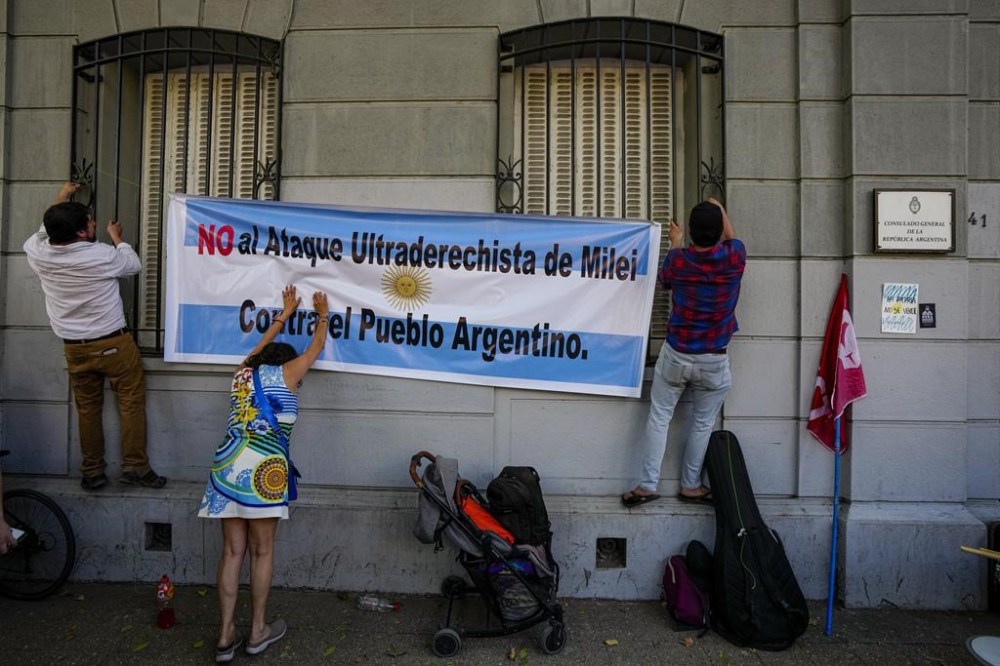
Last week, the president faced a one-day general strike, organized by the biggest union, but some government officials downplayed the effects of the protest.