

Residents scatter as they fear Congo rebel group will again seize key eastern city of Goma
Advertisement
Read this article for free:
or
Already have an account? Log in here »
To continue reading, please subscribe:

Digital Subscription
One year of digital access for only $205*
- Enjoy unlimited reading on winnipegfreepress.com
- Read the E-Edition, our digital replica newspaper
- Access News Break, our award-winning app
- Play interactive puzzles
*First annual payment billed as $205.00 + GST for one year. This annual subscription will automatically renew at $233.00 + GST every 52 weeks (10% off the regular annual price of $259.35). Offer available to new and qualified returning subscribers only. Cancel any time.
To continue reading, please subscribe:
Add Free Press access to your Brandon Sun subscription for only an additional
$1 for the first 4 weeks*
- Enjoy unlimited reading on winnipegfreepress.com
- Read the E-Edition, our digital replica newspaper
- Access News Break, our award-winning app
- Play interactive puzzles
*Your next Brandon Sun subscription payment will increase by $1.00 and you will be charged $17.95 plus GST for four weeks. After four weeks, your payment will increase to $24.95 plus GST every four weeks.
Read unlimited articles for free today:
or
Already have an account? Log in here »
Hey there, time traveller!
This article was published 07/02/2024 (964 days ago), so information in it may no longer be current.
GOMA, Congo (AP) — One of eastern Congo’s most active rebel groups is attacking a community considered the last line of defense before the region’s largest city of Goma, fleeing residents said Wednesday, even as the rebels claimed they had no intention to seize it again.
The M23 rebels in a statement, however, warned that “attacks targeting our forces and/or indiscriminate shelling of civilian population will be dealt with at their source.” The group rose to prominence a decade ago by seizing Goma, an important base for Congolese forces and for humanitarian workers.
The M23, with alleged ties to Rwanda, detonated explosives in North Kivu’s Sake city 27 kilometers (16 miles) from Goma, residents said as they hurried from fighting between the rebels and security forces.
“Bombs are being dropped in the city,” said a resident, Alain Bauma. “We are fleeing but we don’t know where we are going to live.”
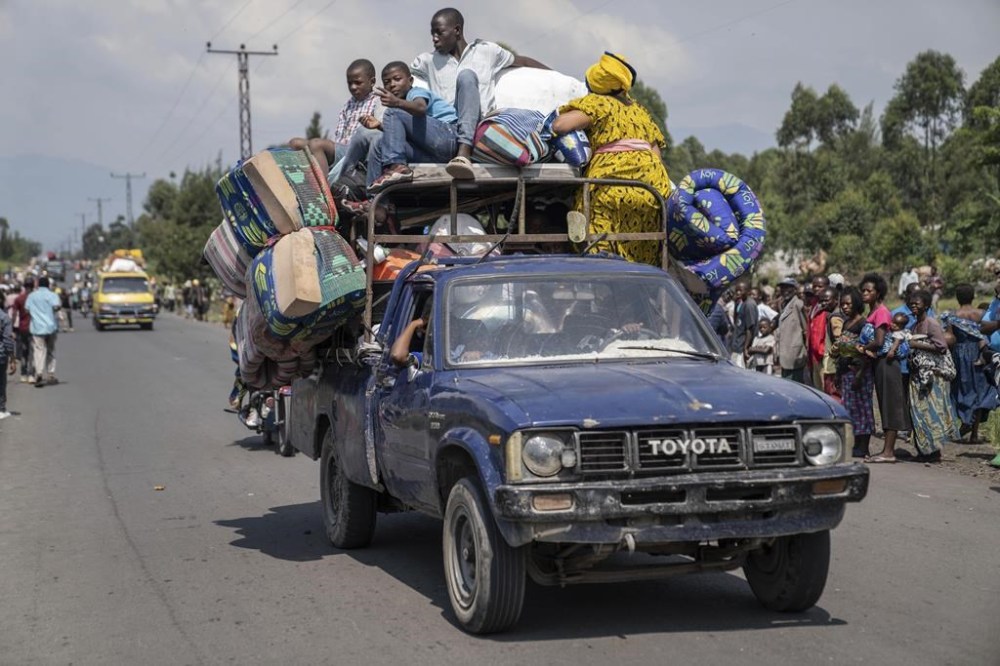
Carrying bedrolls, babies and other belongings, hundreds of people marched in the heat along a narrow roadway clogged with banged-up trucks and vans, in flight once again from the unrest that has gripped eastern Congo for decades.
An aid worker in Sake, Marc Sere, said another aid worker was killed in Wednesday’s bombing and called for urgent support.
“Humanitarians had to stop actions in this city for security reasons because bombs were falling at any time,” Sere said.
At least 70% of Sake residents have fled to Goma as rebels continue to advance, said civil society leader Leopold Muisha, who reported four deaths and 25 people injured in recent days.
“The rebels are getting closer and closer to Sake (and) the population no longer feels safe,” Muisha said. “We are in real danger.”
Far from Congo’s capital of Kinshasa, eastern Congo has long been overrun by more than 120 armed groups seeking a share of the region’s gold and other resources as they carry out mass killings.
Locals say the deadly unrest has worsened in recent weeks. Several armed groups have intensified attacks on civilians and tried to seize more territory as the United Nations and regional peacekeepers begin to withdraw at the government’s request. Peacekeepers have been accused of failing to stop attacks on civilians.
Congolese President Felix Tshisekedi, who was reelected in December, has struggled to end the violence despite promises to do so. He accuses neighboring Rwanda of providing military support to the M23 rebels, a claim supported by the United Nations experts but denied by Rwanda.
Meanwhile, to the north in Ituri province, Islamic State-linked Allied Democratic Forces rebels attacked Manziya and Banzunzuwa villages late Tuesday, killing at least 13 people with several others missing, according to Kitsa Masikini, leader of the Ituri civil society group.
The vast unrest has created one of the world’s largest humanitarian crises, with at least 6.9 million people displaced as of October. Many of those displaced are beyond the reach of aid in remote areas of North Kivu and Ituri provinces.
___
Kamale reported from Kinshasa, Congo. Associated Press journalists Baba Ahmed in Bamako, Mali, and Chinedu Asadu in Abuja, Nigeria, contributed.