Countdown begins for April’s total solar eclipse. What to know about watch parties and safe viewing
Advertisement
Read this article for free:
or
Already have an account? Log in here »
To continue reading, please subscribe:

Digital Subscription
One year of digital access for only $205*
- Enjoy unlimited reading on winnipegfreepress.com
- Read the E-Edition, our digital replica newspaper
- Access News Break, our award-winning app
- Play interactive puzzles
*First annual payment billed as $205.00 + GST for one year. This annual subscription will automatically renew at $233.00 + GST every 52 weeks (10% off the regular annual price of $259.35). Offer available to new and qualified returning subscribers only. Cancel any time.
To continue reading, please subscribe:
Add Free Press access to your Brandon Sun subscription for only an additional
$1 for the first 4 weeks*
- Enjoy unlimited reading on winnipegfreepress.com
- Read the E-Edition, our digital replica newspaper
- Access News Break, our award-winning app
- Play interactive puzzles
*Your next Brandon Sun subscription payment will increase by $1.00 and you will be charged $17.95 plus GST for four weeks. After four weeks, your payment will increase to $24.95 plus GST every four weeks.
Read unlimited articles for free today:
or
Already have an account? Log in here »
Hey there, time traveller!
This article was published 08/02/2024 (953 days ago), so information in it may no longer be current.
The sun is about to pull another disappearing act across North America, turning day into night during a total solar eclipse.
The peak spectacle on April 8 will last up to 4 minutes, 28 seconds in the path of total darkness — twice as long as the total solar eclipse that dimmed U.S. skies in 2017.
This eclipse will take a different and more populated route, entering over Mexico’s Pacific coast, dashing up through Texas and Oklahoma, and crisscrossing the Midwest, Mid-Atlantic and New England, before exiting over eastern Canada into the Atlantic.

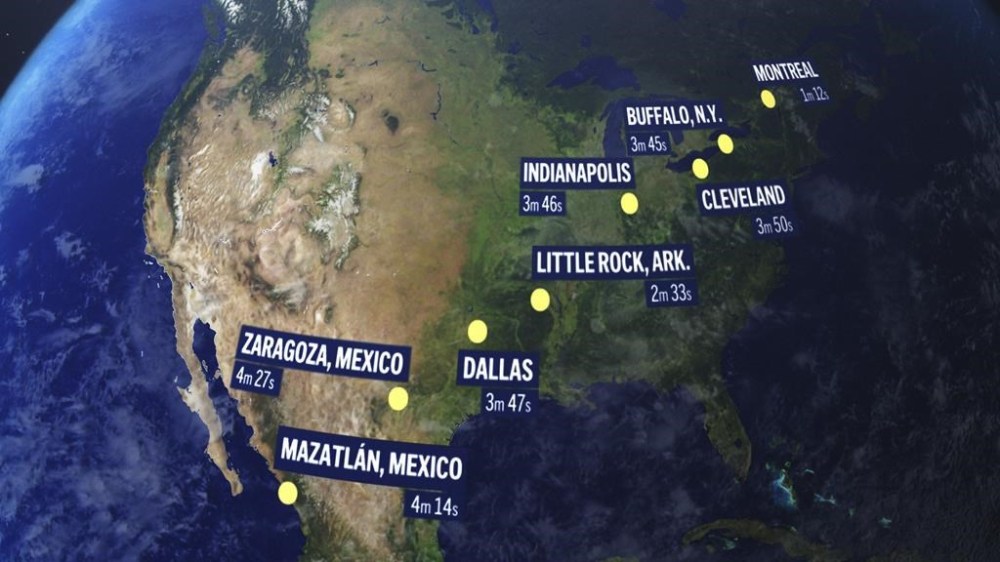
An estimated 44 million people live inside the 115-mile-wide (185-kilometer-wide) path of totality stretching from Mazatlán, Mexico to Newfoundland; about 32 million of them are in the U.S., guaranteeing jammed roads for the must-see celestial sensation.
The eclipse will allow many to share in the “wonder of the universe without going very far,” said NASA’s eclipse program manager Kelly Korreck.
Here’s what to know about April’s extravaganza and how to prepare:
WHAT HAPPENS DURING THE TOTAL SOLAR ECLIPSE?
The moon will line up perfectly between the Earth and the sun, blotting out the sunlight. It will take just a couple hours for the moon’s shadow to slice a diagonal line from the southwest to the northeast across North America, briefly plunging communities along the track into darkness.
Fifteen U.S. states will get a piece of the action, albeit two of them — Tennessee and Michigan — just barely.
Among the cities smack dab in the action: Dallas; Little Rock, Arkansas; Indianapolis, Cleveland, Ohio; Buffalo, New York; and Montreal — making for the continent’s biggest eclipse crowd.
Don’t fret if you don’t have front-row seats. Practically everyone on the continent can catch at least a partial eclipse. The farther from the path of totality, the smaller the moon’s bite will be out of the sun. In Seattle and Portland, Oregon, about as far away as you can get in the continental U.S., one-third of the sun will be swallowed.
WHY IS TOTALITY LONGER?
By a cosmic stroke of luck, the moon will make the month’s closest approach to Earth the day before the total solar eclipse. That puts the moon just 223,000 miles (360,000 kilometers) away on eclipse day.
The moon will appear slightly bigger in the sky thanks to that proximity, resulting in an especially long period of sun-blocked darkness.
What’s more, the Earth and moon will be 93 million miles (150 million kilometers) from the sun that day, the average distance.
When a closer moon pairs up with a more distant sun, totality can last as long as an astounding 7 1/2 minutes. The last time the world saw more than seven minutes of totality was in 1973 over Africa. That won’t happen again until 2150 over the Pacific.
HOW DO I SAFELY WATCH THE ECLIPSE?
Sunglasses won’t cut it. Special eclipse glasses are crucial for safely observing the sun as the moon marches across the late morning and afternoon sky, covering more and more and then less and less of our star.
During totality when the sun is completely shrouded, it’s fine to remove your glasses and look with your naked eyes. But before and after, certified eclipse glasses are essential to avoid eye damage. Just make sure they’re not scratched or torn.
Cameras, binoculars and telescopes must be outfitted with special solar filters for safe viewing. Bottom line: Never look at an exposed sun without proper protection any day of the year.
WHERE ARE SOME ECLIPSE WATCH PARTIES?
Towns up and down the path of totality are throwing star parties. Festivals, races, yoga retreats, drum circles and more will unfold at museums, fairgrounds, parks, stadiums, wineries, breweries and even one of Ohio’s oldest drive-in movie theaters and the Indianapolis Motor Speedway.
Besides looking up, you can attend a “space prom” in Texas Hill Country, get married at eclipse-themed ceremonies in Tiffin, Ohio, and Russellville, Arkansas, or brush up on moonwalking history at the Armstrong Air and Space Museum in Wapakoneta, Ohio — Neil Armstrong’s hometown.
As the eclipse unfolds, NASA will launch small rockets with science instruments into the upper atmosphere from Virginia and chase totality’s shadow from high-altitude planes. Satellites and the International Space Station crew will attempt to capture the show from space.
WHEN IS THE NEXT TOTAL SOLAR ECLIPSE?
Full solar eclipses occur every year or two or three, often in the middle of nowhere like the South Pacific or Antarctic. The next total solar eclipse, in 2026, will grace the northern fringes of Greenland, Iceland and Spain.
North America won’t experience totality again until 2033, with Alaska getting sole dibs. Then that’s it until 2044, when totality will be confined to Western Canada, Montana and North Dakota.
There won’t be another U.S. eclipse, spanning coast to coast, until 2045. That one will stretch from Northern California all the way to Cape Canaveral, Florida.
Aside from Carbondale, Illinois, in the crosshairs of both the 2017 and 2024 eclipses, it usually takes 400 years to 1,000 years before totality returns to the same spot, according to NASA’s Korreck.
___
The Associated Press Health and Science Department receives support from the Howard Hughes Medical Institute’s Science and Educational Media Group. The AP is solely responsible for all content.