Corporate profits must not trump public interest on AI: UN tech envoy
Advertisement
Read this article for free:
or
Already have an account? Log in here »
To continue reading, please subscribe:

Digital Subscription
One year of digital access for only $205*
- Enjoy unlimited reading on winnipegfreepress.com
- Read the E-Edition, our digital replica newspaper
- Access News Break, our award-winning app
- Play interactive puzzles
*First annual payment billed as $205.00 + GST for one year. This annual subscription will automatically renew at $233.00 + GST every 52 weeks (10% off the regular annual price of $259.35). Offer available to new and qualified returning subscribers only. Cancel any time.
To continue reading, please subscribe:
Add Free Press access to your Brandon Sun subscription for only an additional
$1 for the first 4 weeks*
- Enjoy unlimited reading on winnipegfreepress.com
- Read the E-Edition, our digital replica newspaper
- Access News Break, our award-winning app
- Play interactive puzzles
*Your next Brandon Sun subscription payment will increase by $1.00 and you will be charged $17.95 plus GST for four weeks. After four weeks, your payment will increase to $24.95 plus GST every four weeks.
Read unlimited articles for free today:
or
Already have an account? Log in here »
Hey there, time traveller!
This article was published 14/02/2024 (953 days ago), so information in it may no longer be current.
MONTREAL – The United Nations’ top tech official fears that corporate interests may undermine the push to rein in artificial intelligence, exacerbating social divisions and encroaching on human rights.
Countries could feel pressure to accommodate business demands for greater leeway rather than curbing industry excess, said Amandeep Gill in an interview ahead of a global AI conference in Montreal this week.
“I’m quite worried, frankly,” he said.
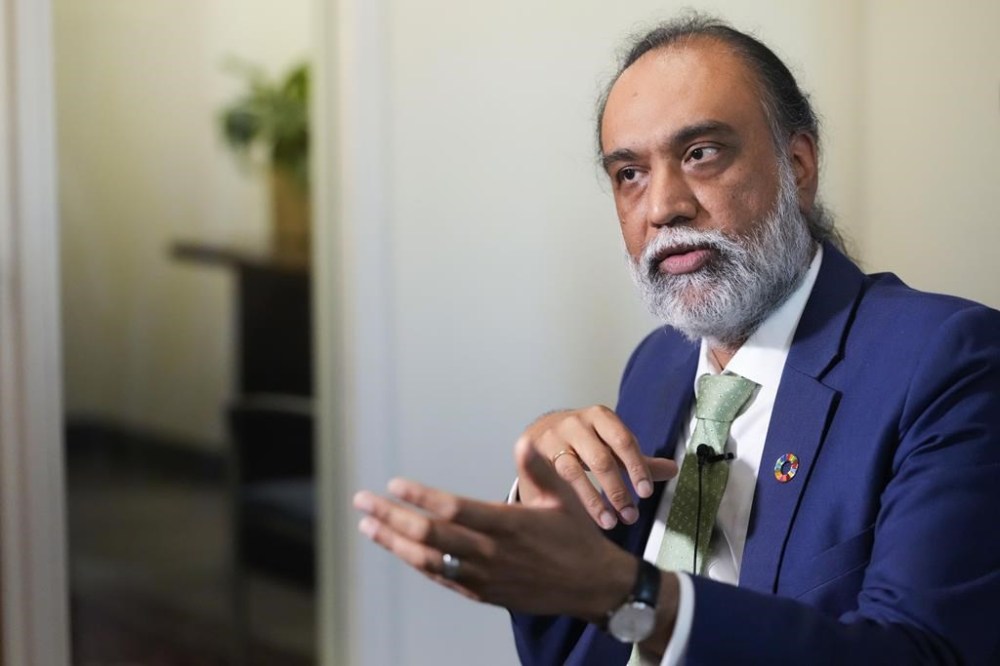
Human rights and democratic values are at stake, according to the UN secretary-general’s tech envoy.
Researchers and political leaders have highlighted concerns ranging from biased data sets and widening global inequality to existential threats around sweeping cyber attacks and AI-developed bioweapons. Artificial intelligence pioneer Yoshua Bengio, who founded Quebec’s Mila AI institute, has sounded the alarm bells on immediate dangers such as “counterfeiting humans” using AI-driven bots as well as outsourcing lethal decisions to machines in war.
On Wednesday, academics, advocates, business leaders and policymakers convened in Montreal for a three-day conference titled “Protecting Human Rights in the Age of AI” and hosted by Mila.
Power consolidation, prejudice and privacy are three of its core themes.
“As potentially there is more concentration of wealth and tech power in a few companies, then that has implications for social equity, for our social contract,” said Gill.
The urge to get a leg up in the global technology race could conflict with the need to curtail the risks around rapid AI advances through laws and regulations, he said. Gill also stressed that AI oligopolies or concentration in a handful of countries would disadvantage smaller firms and developing nations.
The sheer scale of corporations such as Microsoft, Google and Amazon means AI could be dominated by an elite group almost from the get-go.
“A handful of Big Tech companies — by exploiting existing monopoly power and aggressively co-opting other actors — have already positioned themselves to control the future of artificial intelligence and magnify many of the worst problems of the digital age,”according to a recent report from the Open Markets Institute andits Center for Journalism and Liberty.
Further polarization within and between states is another possible outcome of AI run amok.
“If AI is leveraged for deep fakes, for misinformation, disinformation at scale, that could undermine the legitimacy of political processes in our society,” Gill said.
Attempts at AI-generated election interference have already begun, such as when AI robocalls that mimicked U.S. President Joe Biden’s voice tried to discourage people from voting in New Hampshire’s primary election last month.
Built-in bias is also an ongoing problem in the sector as algorithms that draw on reams of data sometimes extend existing prejudices rather than sifting them out. “Those could be perpetuated over even worse,” Gill said, “whether it’s decisions being made on housing, on parole, in the judicial system or allocation of social benefits.”
AI is increasingly involved in decisions that have serious consequences for individuals.
Since 2015, police departments in Vancouver, Edmonton, Calgary, Saskatoon and London, Ont., have implemented or piloted predictive policing — automated decision-making based on data that predicts where a crime will occur or who will commit it.
The federal immigration and refugee system relies on algorithmically-driven decisions to help determine factors such as whether a marriage is genuine or someone should be designated as a “risk,” according to a Citizen Lab study, which found the practice threatens to violate human rights law.
In 2014, Apple Inc. unveiled the Apple Health app for its smartwatch, which an executive said would “monitor all of your metrics that you’re most interested in.”
“It looked at your heartbeat, it looked at your quantity of salt,” said Benjamin Prud’homme, Mila’s head of policy. “And yet it was developed only by men, and so they completely forgot to look at menstruation cycles.”
Discriminatory outcomes are not limited to the national level, Gill added, noting that information fed into machine learning models stems largely from North America or Western Europe.
“That means a vast majority of world cultures, languages and contexts are not properly reflected in these data sets.”
Meanwhile, the power to track the online activity of citizens and social media users risks veering into violations of privacy rights.
In spite of the urgency to control cutting-edge AI, Gill said the United Nations must take a “modest” approach to establishing rules to encourage as many states as possible to sign on.
Last month, a UN advisory body released a preliminary report laying out the guiding principles for a framework on AI governance, stressing that no country be “left behind” as the pace of innovation nears light speed.
In Canada, the federal government introduced legislation placing guardrails around AI use in June 2022, but it has languished at the committee stage for nearly 10 months.

Big Tech executives said last week the Artificial Intelligence and Data Act as it stands is too vague, arguing that it fails to adequately distinguish between high- and low-risk AI systems.
The Liberals have said they will amend the act to introduce new rules. Theseinclude requiring companies responsible for generative AI systems — the algorithmic engine behind chatbots such as OpenAI’s ChatGPT, which can spit out anything from math problems to marriage advice — to take steps toward ensuring their content is identifiable as AI-made.
The legislation still aims for a more general, principles-based approach to AI governance that allows for agility amid the technology’s constant evolution, leaving most details to a later date.
Ottawa has said the act known as Bill C-27 will come into force no sooner than 2025.
This report by The Canadian Press was first published Feb. 14, 2024.