

The truth, the hyperbolic truth and nothing but the public accounts truth

Advertisement
Read this article for free:
or
Already have an account? Log in here »
To continue reading, please subscribe:

Digital Subscription
One year of digital access for only $205*
- Enjoy unlimited reading on winnipegfreepress.com
- Read the E-Edition, our digital replica newspaper
- Access News Break, our award-winning app
- Play interactive puzzles
*First annual payment billed as $205.00 + GST for one year. This annual subscription will automatically renew at $233.00 + GST every 52 weeks (10% off the regular annual price of $259.35). Offer available to new and qualified returning subscribers only. Cancel any time.
To continue reading, please subscribe:
Add Free Press access to your Brandon Sun subscription for only an additional
$1 for the first 4 weeks*
- Enjoy unlimited reading on winnipegfreepress.com
- Read the E-Edition, our digital replica newspaper
- Access News Break, our award-winning app
- Play interactive puzzles
*Your next Brandon Sun subscription payment will increase by $1.00 and you will be charged $17.95 plus GST for four weeks. After four weeks, your payment will increase to $24.95 plus GST every four weeks.
Read unlimited articles for free today:
or
Already have an account? Log in here »
The Manitoba public accounts — the final and definitive tabulation of government expenditures and revenues — have always been a difficult story to cover.
Difficult because the public accounts are complex, and explaining what the numbers mean and how they differ (but yet illuminate) the provincial budget is a gargantuan task.
However, the thing that really complicates the job of reporting the public accounts is the hyperbolic claims the government of the day makes about the numbers and what they mean.
MIKE DEAL / FREE PRESS Premier Wab Kinew (left) and Finance Minister Adrien Sala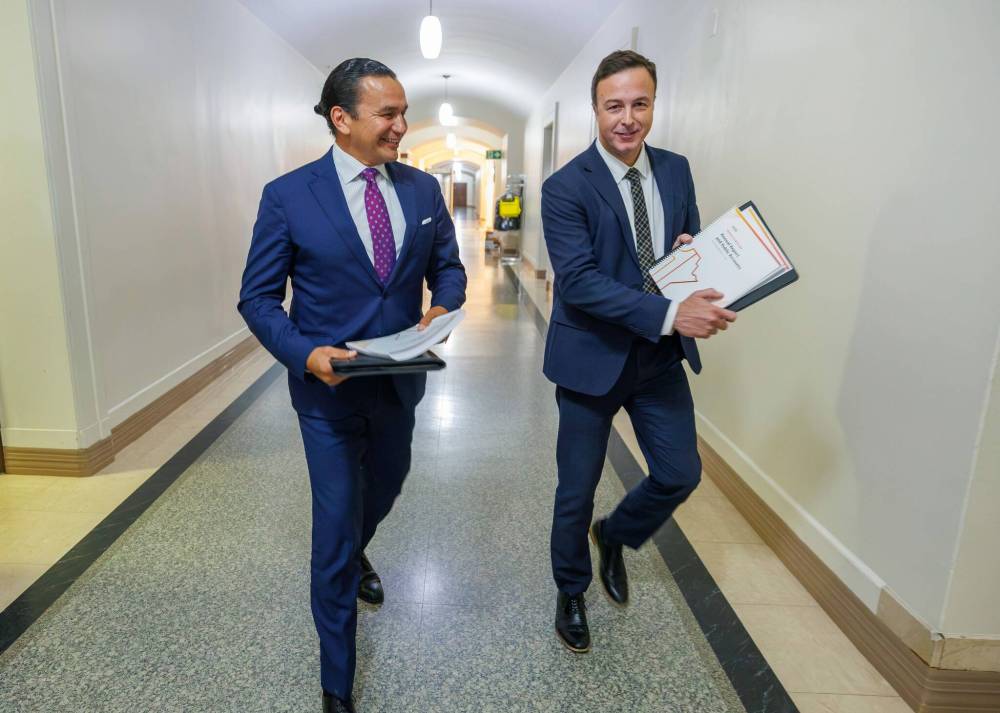
In pursuit of the truth, let’s look at the numbers from the 2025-26 public accounts released this week, and some of the claims made by Premier Wab Kinew and Finance Minister Adrien Sala.
Not in dispute are the main numbers, which track and confirm final revenues and expenditures for the 2025-26 fiscal year, which ended March 31.
The deficit came in at $832 million, only slightly more than the $794 million the NDP forecast in the budget tabled in the spring of 2025. That represents a marked reduction in the deficit from 2023-24, when the treasury was nearly $2 billion in the red.
How did Manitoba move the fiscal needle in the right direction? This is where some of the claims made by Kinew and Sala have to be examined very closely.
First, let’s look at the big pat the NDP gave itself for reducing the deficit:
“I’m particularly proud of this final result, (given the potential) implications of tariffs on our economy, the worst wildfire season in 30 years – which resulted in significant emergency expenditures – and, of course, a significant drought.”
It is fair to give the current government credit for managing its fiscal matters in a relatively responsible way at a time when — to acknowledge Sala’s checklist of challenges — we’re facing fires, floods and profound economic uncertainty brought on by the trade war with the United States.
It’s not that the Kinew government hasn’t done some irresponsible things: hundreds of millions of dollars were given away in gas-tax holidays and by removing the PST on prepared meals and junk food. Kinew claimed these were affordability measures, but they are just populist bribes with little or no impact on affordability.
In the responsible category, the NDP has continued to ratchet up spending in core departments (Health and Seniors Care, Homelessness, Education) while holding the line on other portfolios to keep the overall spending increase at less than 2.0 per cent, which is less than the rate of inflation.
However, holding expenditures below the rate of inflation is not a virtue unto itself. Not when surgical and diagnostic waiting lists remain high, a shortage of provincial judges has led to reductions in sittings and progress in sheltering the homeless is moving at a glacial pace.
“While other provinces are struggling to rein in their deficits, here in Manitoba we’re moving in the right direction.”
This is accurate. Manitoba is one of only three provinces (Alberta and Saskatchewan being the others) that have finished or that have forecasted to finish their current fiscal year with a deficit lower than the previous year. Deficits have exploded in B.C., Ontario, Quebec, New Brunswick and Nova Scotia.
Manitoba’s deficit is now roughly one per cent of GDP, which is quite respectable and, roughly, middle of the provincial pack. However, it’s expenses per capita are still among the highest in the country, which is troubling when you consider some of the sub-optimal outcomes.
“This puts us on track to balance the budget next year, just like we promised.”
Maybe yes, but maybe no.
Manitoba moved the deficit downwards with the help of the aforementioned expenditure restraint but also because of stronger-than-expected revenues.
Income and retail sales taxes went up more than a half-billion dollars above what the NDP forecasted in the 2025-26 budget. Normally, tax revenue growth is accompanied by a parallel growth in the economy. However, at 1.3 per cent growth, Manitoba came in under the 1.7-per-cent average of all provinces.
If not GDP, then what drove tax revenue growth? There are a number of ways to slice this answer, but let’s say that inflation played a significant role.
When prices go up, wages are surely to follow even if the increase in income does not grow as fast as inflation. That means more income tax. And if retail sales stay strong, which they have, then sales tax revenue goes up, as well.
What does all this mean for Kinew’s pledge to balance the budget? In general, it will be difficult for Manitoba to pull off the same trick this fiscal year, which was to grow revenues and shrink the deficit purely on the strength of revenue growth that is disconnected from economic growth.
Never say never, of course. But in this instance, it will be interesting to see if next year’s provincial budget, to be tabled in the spring and in the same year a provincial election is expected, can match the hopeful hyperbole that accompanied the public accounts.
dan.lett@freepress.mb.ca
Dan Lett is a columnist for the Free Press, providing opinion and commentary on politics in Winnipeg and beyond. Born and raised in Toronto, Dan joined the Free Press in 1986. Read more about Dan.
Dan’s columns are built on facts and reactions, but offer his personal views through arguments and analysis. The Free Press’ editing team reviews Dan’s columns before they are posted online or published in print — part of the our tradition, since 1872, of producing reliable independent journalism. Read more about Free Press’s history and mandate, and learn how our newsroom operates.
Our newsroom depends on a growing audience of readers to power our journalism. If you are not a paid reader, please consider becoming a subscriber.
Our newsroom depends on its audience of readers to power our journalism. Thank you for your support.
Dan Lett is a columnist for the Free Press, providing opinion and commentary on politics in Winnipeg and beyond. Born and raised in Toronto, Dan joined the Free Press in 1986. Read more about Dan.
Dan’s columns are built on facts and reactions, but offer his personal views through arguments and analysis. The Free Press’ editing team reviews Dan’s columns before they are posted online or published in print — part of the our tradition, since 1872, of producing reliable independent journalism. Read more about Free Press’s history and mandate, and learn how our newsroom operates.
Our newsroom depends on a growing audience of readers to power our journalism. If you are not a paid reader, please consider becoming a subscriber.
Our newsroom depends on its audience of readers to power our journalism. Thank you for your support.
Related Articles
Manitoba budget reveals province underspent on crucial departments related to justice, public safety
Advertisement Advertise With Us
Advertisement Advertise With Us