

Nigeria’s defense chief accuses nations withholding arms sales over abuses of ‘double standards’
Advertisement
Read this article for free:
or
Already have an account? Log in here »
To continue reading, please subscribe:
Digital Subscription
One year of digital access for only $1.44 a week*
- Enjoy unlimited reading on winnipegfreepress.com
- Read the E-Edition, our digital replica newspaper
- Access News Break, our award-winning app
- Play interactive puzzles
*Billed as $5.77 plus GST every four weeks. After 52 weeks, price increases to the regular rate of $19.95 plus GST every four weeks. Offer available to new and qualified returning subscribers only. Cancel any time.
To continue reading, please subscribe:
Add Free Press access to your Brandon Sun subscription for only an additional
$1 for the first 4 weeks*
- Enjoy unlimited reading on winnipegfreepress.com
- Read the E-Edition, our digital replica newspaper
- Access News Break, our award-winning app
- Play interactive puzzles
*Your next Brandon Sun subscription payment will increase by $1.00 and you will be charged $17.95 plus GST for four weeks. After four weeks, your payment will increase to $24.95 plus GST every four weeks.
Read unlimited articles for free today:
or
Already have an account? Log in here »
Hey there, time traveller!
This article was published 20/02/2024 (969 days ago), so information in it may no longer be current.
ABUJA, Nigeria (AP) — Nigeria’s defense chief expressed frustration Tuesday with what he called the “double standards” of some countries that won’t sell his military weapons because of human rights concerns.
Gen. Christopher Musa’s comment underscores one of the biggest challenges for Africa’s most populous nation in combating a deadly and complex security crisis, from the Islamic militant insurgency in northeast to the dozens of armed groups targeting travelers and communities in the northwest and central regions.
“Even with our money, it is difficult getting equipment,” Musa told reporters in Nigeria’s capital of Abuja, acknowledging a huge need for items such as helicopters, drones and Mine Resistant Ambush Protected (MRAP) vehicles.
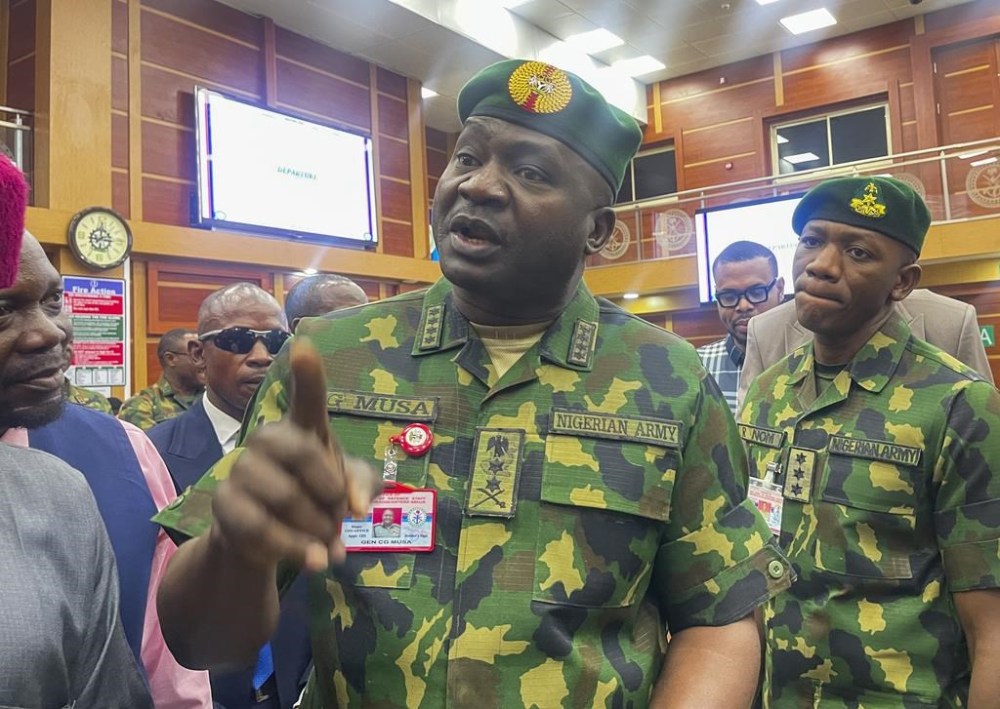
“Some say human rights, some say ‘You have killed’ … but again, sometimes, people pointing fingers at you have done worse and yet nobody is holding them to account. It is these double standards that (are) making the world more dangerous,” Musa said.
He declined to name the countries in question when asked by The Associated Press.
Nigeria’s security forces for many years have faced allegations of extrajudicial killings and illegal arrests. The United States and other major arms suppliers at one point or another have withheld the sale of weapons over those accusations.
In December, at least 85 civilians were killed when a Nigerian army drone erroneously targeted a religious gathering in northwest Kaduna state, the latest of several such incidents.
Musa said Nigeria’s military has continued to improve on its human rights record and is holding its personnel to account. Alleged abuses are often investigated, and a report on the December incident will be released soon, he said.
“The Nigerian Armed Forces have the capacity to secure Nigeria (and) the entire region,” Musa said, but added that the lack of needed weapons will continue to limit that capacity.
However, there is little evidence to show that Nigeria’s military has improved on its human rights record, according to Isa Sanusi, Amnesty International’s director in Nigeria.
“Protecting civilians should be their priority (and) they should look at all human rights violations they have committed to ensure accountability,” Sanusi said.
U.S. military support to Nigeria has at times included training on how to mitigate risks to civilians, according to a State Department statement in January on security cooperation. It said that in August, Nigeria delivered the first payment for 12 attack helicopters worth a total of $997 million.