Union raises issue of weapons scanner at HSC Technology called ‘game changer’ at Ontario hospital that struggled with safety
Read this article for free:
or
Already have an account? Log in here »
To continue reading, please subscribe:

Digital Subscription
One year of digital access for only $205*
- Enjoy unlimited reading on winnipegfreepress.com
- Read the E-Edition, our digital replica newspaper
- Access News Break, our award-winning app
- Play interactive puzzles
*First annual payment billed as $205.00 + GST for one year. This annual subscription will automatically renew at $233.00 + GST every 52 weeks (10% off the regular annual price of $259.35). Offer available to new and qualified returning subscribers only. Cancel any time.
To continue reading, please subscribe:
Add Free Press access to your Brandon Sun subscription for only an additional
$1 for the first 4 weeks*
- Enjoy unlimited reading on winnipegfreepress.com
- Read the E-Edition, our digital replica newspaper
- Access News Break, our award-winning app
- Play interactive puzzles
*Your next Brandon Sun subscription payment will increase by $1.00 and you will be charged $17.95 plus GST for four weeks. After four weeks, your payment will increase to $24.95 plus GST every four weeks.
Read unlimited articles for free today:
or
Already have an account? Log in here »
Hey there, time traveller!
This article was published 27/02/2024 (887 days ago), so information in it may no longer be current.
The union for Manitoba nurses, who are subjected to violence while on the job, is asking the province to explore the use of weapon scanners at Health Sciences Centre — equipment one Ontario hospital calls “a game changer” for safety.
“They’ve got to do something to make our facilities safer,” said Darlene Jackson, president of the Manitoba Nurses’ Union, which posts its concerns about violence occurring in the workplace daily.
In a recent example, an unarmed security guard at Health Sciences Centre tried to calm down an agitated ER patient who had a pen knife. The guard was stabbed and the patient has been charged with assault with a weapon for the Feb. 22 incident, Winnipeg Police Service Const. Dani McKinnon said Tuesday.
Related Articles
Nurses union renews calls for safety action at HSC after security guard stabbed in ER








Jackson wonders whether weapon-scanning technology should be brought in to make it safer for staff and patients.
“If it’s not a metal detector, then for goodness sake, put institutional safety officers in there who can actually manage this type of behaviour,” said Jackson, who questioned why there are no armed and trained institutional safety officers in Manitoba hospitals nearly five years after legislation was passed to give them power to detain and restrain violent people.
In response, Shared Health spokesman Kevin Engstrom said the officers could be on the job at the HSC as early as this spring, Their training and hiring “is well under way,” he said.
An overseer of protective and security services at all sites is expected to start work in early March, he said.
As for a weapon detector, Engstrom wouldn’t say if such a system is under consideration.
“They’ve got to do something to make our facilities safer.”–Union president Darlene Jackson
The statement said Shared Health is “committed to further improvements to enhance staff and patient safety.”
Security measures put in place in recent years have reduced the number of incidents in parkades while reducing access points to the facility, he said.
In Ontario, an inner-city hospital has tackled its safety issue by using an inexpensive piece of technology that’s been a “game changer” for staff and patient safety.
The head of the first Canadian hospital to deploy AI weapon-detection scanners at its emergency department entrances in October said it’s getting “rave reviews” from staff and patients.
“This is probably one of the most significant, positive investments we’ve made for staff and patient safety,” said David Musyj, CEO of the Windsor Regional Hospital, who has worked in health care for 30 years.
Like Winnipeg’s HSC, the inner-city hospital with two emergency departments is the region’s main trauma centre. Windsor was looking for ways to address concern about weapons, especially guns, being taken into the emergency departments, Musyj said Tuesday.
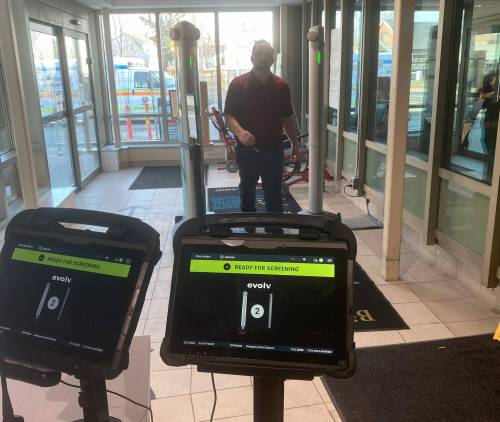
It decided to lease an AI-based screening system, developed by Evolv Technology, that allows staff, patients and visitors to proceed through the emergency department entrance without having to open bags or empty pockets.
Unlike a metal detector, which requires people to remove keys and phones prior to screening, the weapon detector distinguishes between items that might be a threat, such as a gun or knife, and everyday items.
SUPPLIED A demonstration of the Windsor Regional Hospital weapons detector.
The system allows the swift identification of threats without slowing down the entrance of patients, Musyj said.
Members of the hospital’s occupational health and safety committee went to U.S. sites that use the technology, including the Mayo Clinic. The system identifies weapons and illicit items and how they’re being carried on a person. The system doesn’t keep track of anyone’s identity or use facial-recognition technology, Musyj said.
It’s high-tech at a low cost, he said.
“For us, per month, it’s a lease of $8,000 a month for two machines,” the CEO said. “In the grand scheme, it’s nothing.”
As of Tuesday, the system had detected 1,912 items — including 1,052 knives, at least one pair of brass knuckles, illicit drugs and paraphernalia — from when it was installed a little over four months ago.
“The numbers are staggering. It’s unbelievable when you think about it: a lot of people are carrying a lot of knives,” Musyj said.
SUPPLIED The brass knuckles are one of the 1,912 items detected since the weapons detection system was established in late October.
“If it could prevent one incident, it’s well worth the investment. It really is inexpensive to have this layer of protection for our staff and fellow patients. Patients know the person sitting next to them in the emergency department had to go through the same machine,” said Musyj.
The number of weapons intercepted has decreased since word got out that the hospital uses the detection system, he said.
“Nothing is 100 per cent, but it definitely has helped…while not negatively impacting patients’ access to an emergency department.”
For its part, Doctors Manitoba, the body that speaks for physicians in this province, said while weapons are a “major concern,” many of the physical safety incidents confronting staff don’t involve weapons.
“They can include issues such as being pushed or shoved, being spit on, blocking an exit to an exam room, etc,” spokesman Keir Johnson said.
“We found that 34 per cent of physicians reported one or more physical safety incidents in the last 12 months.”–Doctors Manitoba spokesman Keir Johnson
The organization, which represents more than 4,000 physicians, medical students and retirees, isn’t notified about safety incidents at hospitals or clinics, but it recently surveyed doctors to understand the magnitude of the issue, Johnson said.
“We found that 34 per cent of physicians reported one or more physical safety incidents in the last 12 months. Among these physicians, they experienced an average of six physical safety incidents in the past year,” he said in an email.
Physicians also reported an average of 5.6 psychological safety incidents — including verbal abuse, bullying, discrimination, and threats — in the last 12 months.
“Hospitals and clinics are a place for healing and should be safe, inclusive, and comfortable for all patients, staff and physicians. It should offer a calm, caring environment to support treatment and recovery,” Johnson said.

The Progressive Conservatives say the NDP has failed to address community safety.
“The previous PC government put everything in place to train and implement institutional safety officers. Now the NDP needs to explain their next steps, and how they plan to keep patients and healthcare staff safe,” PC spokesman Matt Preprost said in a statement.
carol.sanders@freepress.mb.ca

Carol Sanders
Legislature reporter
Carol Sanders is a reporter at the Free Press legislature bureau. The former general assignment reporter and copy editor joined the paper in 1997. Read more about Carol.
Every piece of reporting Carol produces is reviewed by an editing team before it is posted online or published in print — part of the Free Press‘s tradition, since 1872, of producing reliable independent journalism. Read more about Free Press’s history and mandate, and learn how our newsroom operates.
Our newsroom depends on a growing audience of readers to power our journalism. If you are not a paid reader, please consider becoming a subscriber.
Our newsroom depends on its audience of readers to power our journalism. Thank you for your support.