Some emergency departments installing AI weapons detection amid rising violence
Advertisement
Read this article for free:
or
Already have an account? Log in here »
To continue reading, please subscribe:

Digital Subscription
One year of digital access for only $205*
- Enjoy unlimited reading on winnipegfreepress.com
- Read the E-Edition, our digital replica newspaper
- Access News Break, our award-winning app
- Play interactive puzzles
*First annual payment billed as $205.00 + GST for one year. This annual subscription will automatically renew at $233.00 + GST every 52 weeks (10% off the regular annual price of $259.35). Offer available to new and qualified returning subscribers only. Cancel any time.
To continue reading, please subscribe:
Add Free Press access to your Brandon Sun subscription for only an additional
$1 for the first 4 weeks*
- Enjoy unlimited reading on winnipegfreepress.com
- Read the E-Edition, our digital replica newspaper
- Access News Break, our award-winning app
- Play interactive puzzles
*Your next Brandon Sun subscription payment will increase by $1.00 and you will be charged $17.95 plus GST for four weeks. After four weeks, your payment will increase to $24.95 plus GST every four weeks.
Read unlimited articles for free today:
or
Already have an account? Log in here »
Hey there, time traveller!
This article was published 21/04/2025 (527 days ago), so information in it may no longer be current.
TORONTO – London Health Sciences Centre is the latest Canadian hospital to install a weapons detection system in its emergency department as health-care workers across the country continue to grapple with increasing violence.
The southwestern Ontario health-care network started using one of the artificial intelligence-driven systems at its University Hospital site on April 15 and will install a second one at Victoria Hospital on May 6.
The head of the health sciences centre, David Musyj, said AI weapons detectors were already under discussion when he started last May.
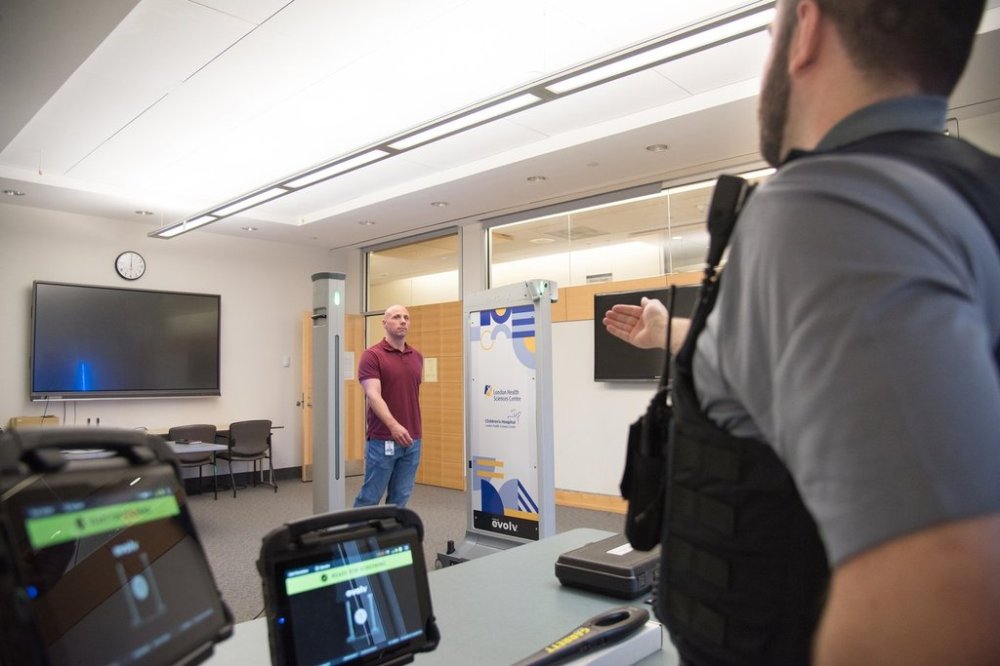
But he said the catalyst to act happened last December, when a gunman chased someone into the hospital.
“We’d be fooling ourselves if we think somehow we’re immune from the violence that’s taking place outside of our four walls,” said Musyj in an interview.
“We have to appreciate that and recognize that is occurring inside the hospital as well.”
Everyone entering the emergency department walks through the detector. Unlike a standard metal detector, the AI is trained to specifically recognize items of concern such as knives and guns.
“You don’t have to take out your cellphone or your keys or take off your belt or take off your shoes. You can walk through with everything on your body,” Musyj said.
“It will identify the look, the size, the metal of a knife and will ignore the cellphone or the keys because it recognizes that’s not (something) to worry about.”
If something concerning is detected, it flags a security guard stationed nearby. The guard takes the person aside and inspects the item. If it’s legal, it’s held in a secure area and the patient can pick it up on their way out. If it’s illegal, police are called.
In the first day and a half the weapons detector was running, it found seven knives, Musyj said.
Most people pulled aside are carrying pocket knives and have no bad intentions, but it’s important for them to know not to bring knives to the hospital, he said.
That’s something people entering Windsor Regional Hospital have learned since it started using AI weapons detectors in Oct. 2023.
When they were first installed, about 20 knives and other sharp-edged items were found on people going into the emergency department every day, said Mike Broderick, the hospital’s manager of safety and security services.
That number is now down to about six a day, he said.
“What we take that to mean is that the word is out and individuals that are coming here will leave those things at home,” Broderick said.
Both Broderick and Musyj emphasized that the AI weapons detectors are just one part of broader strategies to improve security.
The visible presence of security guards, better lighting, more cameras and panic buttons for staff are some of the other measures.
Winnipeg Health Sciences Centre installed AI weapons scanners in February, a spokesperson confirmed by email. The QEII Halifax Infirmary installed metal detectors in its emergency department in February as well, according to a news release.
Canadian physicians and nurses have been calling for improved safety in emergency departments for years, said Dr. Alan Drummond, a family and emergency doctor in Perth, Ont.
“The emergency department is a unique clinical environment and we have people under maximal stress. We also have patients coming in who have substance abuse issues that may lead to violence. We also have, increasingly, an aged population coming in with dementia and … can develop delirium,” said Drummond, who co-authored the Canadian Association of Emergency Physicians’ position statement on ER violence in 2021.
Comprehensive solutions are necessary to protect both staff and patients — while still ensuring that patients dealing with substance use, mental health issues, dementia or delirium get the care they need, he said.
Some hospitals, including University Health Network (UHN) in Toronto, have decided weapons detectors aren’t the best way to make their emergency departments safer and are taking different approaches.
UHN’s data shows that most assaults are verbal or involve slapping, kicking, punching, biting or spitting rather than weapons, said Robert Whiteside, the health network’s director of security operations.
Dr. Christian Schulz-Quach, a staff psychiatrist and the medical director for workplace violence prevention at UHN, said there’s been a 169 per cent jump in physical, emotional or verbal violence toward staff in its Toronto General and Toronto Western emergency departments since the COVID-19 pandemic.
The onslaught of geopolitical crises on top of the pandemic has led to “an age of anxiety that is affecting everyone,” he said.
“If you’re the essential service that’s open 24-7, you will be on the receiving end at your entry gates of that distress,” Schulz-Quach said, noting that substance use and living in situations “that are hard to bear” can also drive violence.
One of UHN’s key strategies for violence prevention is a training program for staff in situational awareness, verbal de-escalation of volatile situations and physical self-protection skills, he said.
Another strategy is using wearable devices, including body cameras for security guards.
“It has been quite significant and impressive to see how the simple activation of a recording device can change the complete dynamic in a room and can de-escalate (the situation),” said Schulz-Quach.
The hospital is also implementing wearable panic buttons, which look like badges, for nurses, physicians and other emergency department staff, he said.
Communication is also key to violence prevention, Whiteside said.

UHN has launched a strategy to communicate “mutual respect”— both through direct interactions with patients and through posters letting them know that staff are there to help them.
“My philosophy for health-care security staff is that we should have an ethos of treating all people with dignity by showing them respect,” said Whiteside.
“That actually produces safer conditions. It’s not simply a way to help people feel better, though it does that as well.”
This report by The Canadian Press was first published April 21, 2025.
Canadian Press health coverage receives support through a partnership with the Canadian Medical Association. CP is solely responsible for this content.
Related Articles
HSC weapons detectors panned by nurse after knives go undetected



Advertisement Advertise With Us
Advertisement Advertise With Us