

South Korean and US troops will begin major exercises next week in response to North Korean threats
Advertisement
Read this article for free:
or
Already have an account? Log in here »
To continue reading, please subscribe:

Digital Subscription
One year of digital access for only $205*
- Enjoy unlimited reading on winnipegfreepress.com
- Read the E-Edition, our digital replica newspaper
- Access News Break, our award-winning app
- Play interactive puzzles
*First annual payment billed as $205.00 + GST for one year. This annual subscription will automatically renew at $233.00 + GST every 52 weeks (10% off the regular annual price of $259.35). Offer available to new and qualified returning subscribers only. Cancel any time.
To continue reading, please subscribe:
Add Free Press access to your Brandon Sun subscription for only an additional
$1 for the first 4 weeks*
- Enjoy unlimited reading on winnipegfreepress.com
- Read the E-Edition, our digital replica newspaper
- Access News Break, our award-winning app
- Play interactive puzzles
*Your next Brandon Sun subscription payment will increase by $1.00 and you will be charged $17.95 plus GST for four weeks. After four weeks, your payment will increase to $24.95 plus GST every four weeks.
Read unlimited articles for free today:
or
Already have an account? Log in here »
Hey there, time traveller!
This article was published 27/02/2024 (910 days ago), so information in it may no longer be current.
SEOUL, South Korea (AP) — South Korean and U.S. troops will begin their expanded annual military drills next week in response to North Korea’s evolving nuclear threats, the two countries said Wednesday, a move that will likely enrage North Korea because it views its rivals’ joint training as an invasion rehearsal.
In recent months, North Korea has inflamed animosities on the Korean Peninsula with fiery rhetoric and continued missile tests. While it’s unlikely for North Korea to launch full-blown attacks against South Korea and the U.S., observers say the North could still stage limited provocations along the tense border with South Korea.
On Wednesday, the South Korea and U.S. militaries jointly announced that the allies will conduct Freedom Shield exercise, a computer-simulated command post training, and a variety of separate field training, from March 4-14.
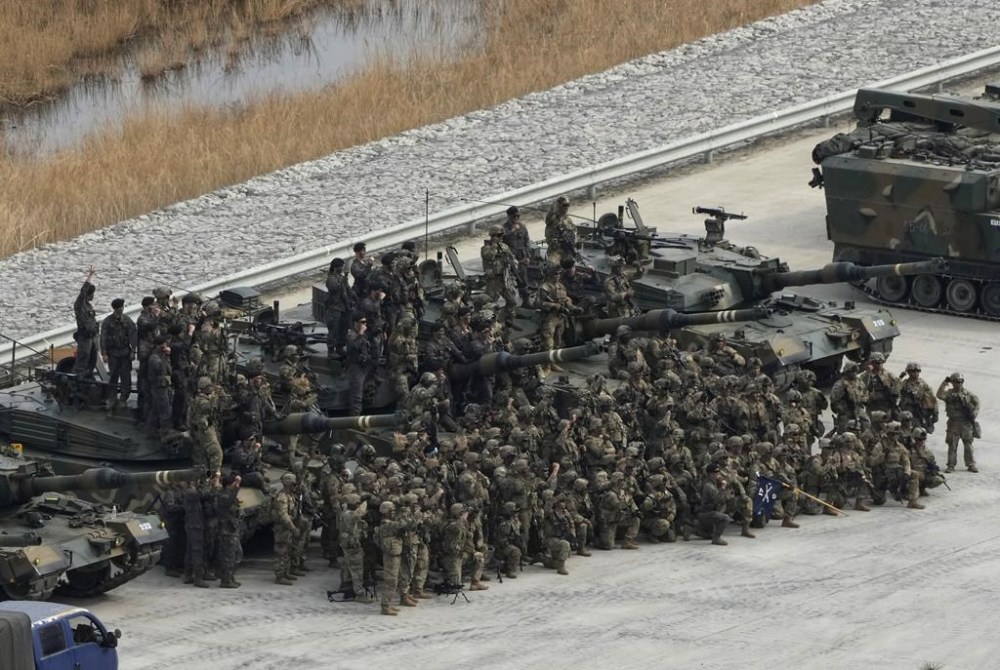
Col. Lee Sung-Jun, a spokesperson for South Korea’s Joint Chiefs of Staff, told reporters that the allies’ drills are designed to bolster their joint capabilities to prevent North Korea from using its nuclear weapons. He said the allies are to carry out 48 field exercises this spring, twice the number conducted last year, and that this year’s drills would involve air assault, live-firing and bombing training.
“Our military is ready to punish North Korea immediately, strongly and to the end in the event of its provocation, and we’ll further strengthen our firm readiness through the upcoming drills,” Lee said.
Col. Isaac L. Taylor, a spokesperson for the U.S. military, said the allies’ exercises have been defensive in nature and that there is solid evidence that “a high readiness rate” helps ensure deterrence.
North Korea didn’t immediately respond to the drills’ announcement. North Korea has reacted to previous major South Korea-U.S. military drills with its own missile tests.
North Korea has sharply intensified its weapons testing activities since 2022 in part of its efforts to expand its nuclear and missile arsenals. This year, the North already conducted six rounds of missile tests — five of them reportedly involving cruise missiles — and other weapons launches.
Lee, the South Korean military spokesperson, said that the upcoming South Korea-U.S. drills would involve training to detect and shoot down North Korean cruise missiles. Analysts say North Korea would likely use cruise missiles to attack incoming U.S. warships in the event of a conflict, as well as U.S. military installations in Japan. The North’s weapons tests in 2022 and 2023 largely focused on ballistic weapons systems.
Experts say North Korea believes a bigger weapons arsenal would allow it to pressure the U.S. and South Korea more effectively to make concessions like sanctions relief when diplomacy resumes. They expect North Korea to ramp up its testing activities and other provocations this year as both the U.S. and South Korea head into major elections.

South Korea and the U.S. have responded to the North’s testing spree with expansions of their bilateral military drills and trilateral exercises involving Japan. U.S. and South Korean officials have repeatedly warned that any nuclear attack by North Korea against them would spell the end of the North’s government led by Kim Jong Un.
In a telephone call earlier Wednesday, South Korean Defense Minister Shin Wonsik and U.S. Defense Secretary Lloyd Austin condemned North Korea’s missile tests and reaffirmed the need to maintain an overwhelming joint defense posture, according to the South Korean Defense Ministry. The Pentagon said Austin reaffirmed the ironclad U.S. extended deterrence commitment to the defense of South Korea.
___
Follow AP’s Asia-Pacific coverage at https://apnews.com/hub/asia-pacific