Our ancient animal ancestors had tails. Why don’t we?

Advertisement

Advertise with us

WASHINGTON (AP) — Our very ancient animal ancestors had tails. Why don't we?

Read this article for free:


or

Already have an account? Log in here »

To continue reading, please subscribe:

Subscribe and receive a limited-edition Free Press branded hat or tote.

Digital Subscription

One year of digital access for only $205*

  • Enjoy unlimited reading on winnipegfreepress.com
  • Read the E-Edition, our digital replica newspaper
  • Access News Break, our award-winning app
  • Play interactive puzzles

*First annual payment billed as $205.00 + GST for one year. This annual subscription will automatically renew at $233.00 + GST every 52 weeks (10% off the regular annual price of $259.35). Offer available to new and qualified returning subscribers only. Cancel any time.

To continue reading, please subscribe:

Add Free Press access to your Brandon Sun subscription for only an additional

$1 for the first 4 weeks*

  • Enjoy unlimited reading on winnipegfreepress.com
  • Read the E-Edition, our digital replica newspaper
  • Access News Break, our award-winning app
  • Play interactive puzzles
Start now

*Your next Brandon Sun subscription payment will increase by $1.00 and you will be charged $17.95 plus GST for four weeks. After four weeks, your payment will increase to $24.95 plus GST every four weeks.

Hey there, time traveller!
This article was published 28/02/2024 (906 days ago), so information in it may no longer be current.

WASHINGTON (AP) — Our very ancient animal ancestors had tails. Why don’t we?

Somewhere around 20 million or 25 million years ago, when apes diverged from monkeys, our branch of the tree of life shed its tail. From Darwin’s time, scientists have wondered why — and how — this happened.

Now, researchers have identified at least one of the key genetic tweaks that led to this change.
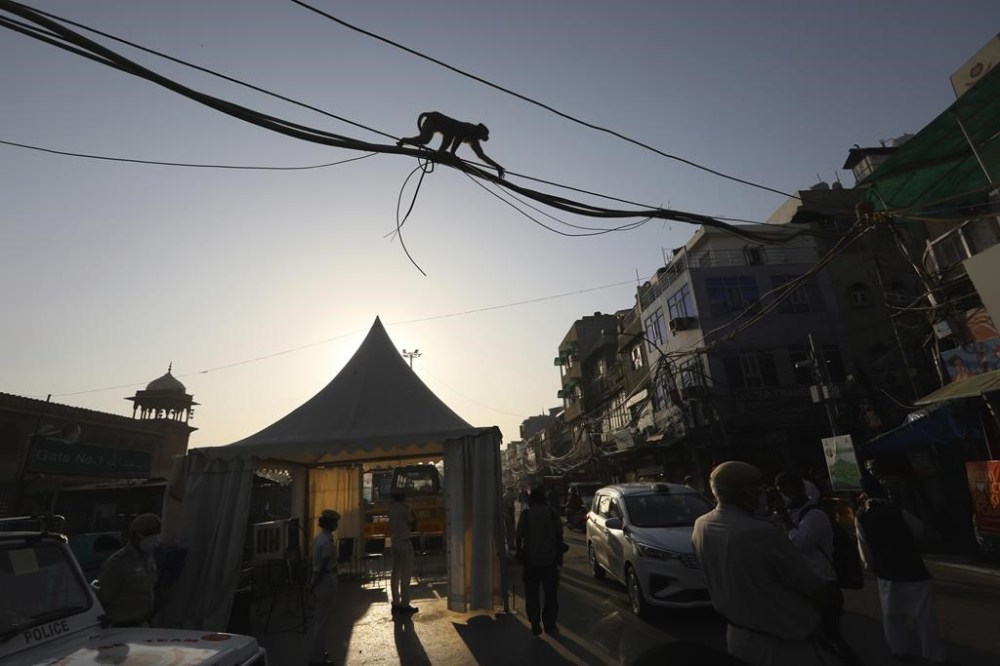
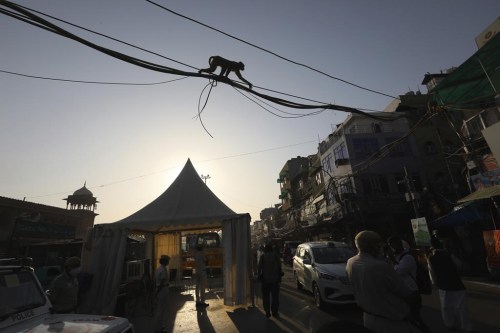
FILE - A monkey walks across power cables near the Jama Mosque in the old quarters of New Delhi, India, Monday, May 25, 2020. Humans’ ancient ancestors had tails, as most vertebrates still do. But somewhere around 20 or 25 million years ago, when apes diverged from monkeys, our branch of the tree of life shed its back appendage. In a paper published in the journal Nature on Wednesday, Feb. 28, 2024, researchers identify at least one of the key genetic tweaks that led to this change. (AP Photo/Manish Swarup, File)

“We found a single mutation in a very important gene,” said Bo Xia, a geneticist at the Broad Institute and co-author of a study published Wednesday in the journal Nature.

The researchers compared the genomes of six species of apes, including humans, and 15 species of monkeys with tails to pinpoint key differences between the groups. Once they identified a significant mutation, they tested their theory by using the gene-editing tool CRISPR to tweak the same spot in mouse embryos. Those mice were born without tails.

Xia cautioned that other genetic changes may also play a role in losing tails.

Another mystery: Did having no tails actually help these ape ancestors — and eventually, humans — survive? Or was it just a chance mutation in a population that thrived for other reasons?

“It could be random chance, but it could have brought a big evolutionary advantage,” said Miriam Konkel, an evolutionary geneticist at Clemson University, who was not involved in the study.

As to why having no tails may have helped, there are many tantalizing theories — including some that link being tailless to humans eventually learning to walk upright.

Rick Potts, who directs the Smithsonian Institution’s Human Origins Project and was not involved in the research, suggests being tailless may have been a first step toward some apes adopting a vertical body posture, even before they left the trees.

Not all apes live on the ground today. Orangutans and gibbons are tailless apes that still live in trees. But Potts notes that they move very differently than monkeys, who scamper along the tops of branches, using their tails for balance. Those apes hang below branches, swinging between them while hanging largely upright.

New York University biologist Itai Yanai, a co-author of the study, said that losing our tails was clearly a major transition. But the only way to certainly know the reason “would be to invent a time machine,” he said.

___

The Associated Press Health and Science Department receives support from the Howard Hughes Medical Institute’s Science and Educational Media Group. The AP is solely responsible for all content.

Report Error Submit a Tip

More Stories

Gun found after police spot masked taxi riders

1 minute read Yesterday at 10:17 AM CDT

Winnipeg police officers seized a sawed-off rifle and arrested a 13-year-old boy after spotting people wearing ski masks inside a taxi Monday afternoon.

North district community support officers were on patrol at about 3:45 p.m. when they noticed the taxi’s masked occupants, who weren’t wearing seatbelts, near McPhillips Street and Pritchard Avenue, police said.

While speaking to one of the passengers, the officers noticed what appeared to be the outline of a gun inside a satchel.

After arresting the passengers, police seized a sawed-off .22-calibre rifle and ammunition, a shotgun shell and about half a gram of methamphetamine, which has a street value of about $30, a news release said.

Residents fear mailbox crime sprees

Morgan Modjeski 4 minute read Preview

Residents fear mailbox crime sprees

Morgan Modjeski 4 minute read 2:01 AM CDT

Some North End residents are concerned new community mailboxes will become a target for vandalism and crime after the base of one was recently lit ablaze — before it was even installed.

The community mailboxes started to show up on Andrews Street within the last two weeks. Some have been installed, while at other locations, only the concrete foundation is in place.

“They just dumped them on the boulevard,” said Stephen Giesbrecht, who lives beside one of the boxes in the St. John’s neighbourhood. “They dumped them on the corner and then they were gone.”

One of the concrete slabs has already played host to a fire and some of the hardware needed to install the mailbox melted.

Read
2:01 AM CDT

Letters, Aug. 22

7 minute read 2:01 AM CDT

Foster system must be better

Re: Paralyzed foster girl has system under a microscope (Aug. 18)

Families Minister Nahanni Fontaine’s assertion that “you can’t train people not to be violent” should concern everyone who cares about the safety of children in Manitoba’s child welfare system.

Of course, no training program can guarantee that an individual will never harm a child. But framing these tragedies as the actions of a few “abominable” people risks absolving the system of its responsibility to prevent harm.

City inundated with thousands of complaints after launch of new transit system

Morgan Modjeski 11 minute read Preview

City inundated with thousands of complaints after launch of new transit system

Morgan Modjeski 11 minute read Yesterday at 12:25 PM CDT

Despite complaints from thousands of dissatisfied users, Winnipeg hasn't hit the brakes on the rollout of its new primary transit network. And it appears that ignoring the public response cost Winnipeg Transit millions of dollars in lost revenue and ridership.

Read
Yesterday at 12:25 PM CDT

Executive exodus continues at Shared Health with three recent departures

Chris Kitching 5 minute read Preview

Executive exodus continues at Shared Health with three recent departures

Chris Kitching 5 minute read Updated: Yesterday at 4:18 PM CDT

Manitoba’s provincial health authority is looking for its fourth chief financial officer since 2023 and additional replacements after the recent departures of three executives.

Read
Updated: Yesterday at 4:18 PM CDT

Free Press literary editor picks noteworthy Canadian fiction and non-fiction titles to watch for this fall

Ben Sigurdson 8 minute read Preview

Free Press literary editor picks noteworthy Canadian fiction and non-fiction titles to watch for this fall

Ben Sigurdson 8 minute read 6:00 AM CDT

For many book lovers, summer means relaxing at the beach, in the backyard or at the cottage with fun, warm-weather page-turners — easy-going romance novels, gripping thrillers or even a dishy biography.

And some may long for the summer months to slow down, fall books season always offers up some of the most compelling reads for bookworms.

Here are 10 works of fiction and 10 non-fiction titles from Canadian authors slated to be published in the coming months — from Olympians to separatists, draft dodgers, plutocrats, prime ministers, bird-men and beyond, the characters in these forthcoming titles run the gamut.

FICTIONEliza Sunshine

Read
6:00 AM CDT