

Three former Department of Education employees charged with defrauding Arizona voucher program
Advertisement
Read this article for free:
or
Already have an account? Log in here »
To continue reading, please subscribe:

Digital Subscription
One year of digital access for only $205*
- Enjoy unlimited reading on winnipegfreepress.com
- Read the E-Edition, our digital replica newspaper
- Access News Break, our award-winning app
- Play interactive puzzles
*First annual payment billed as $205.00 + GST for one year. This annual subscription will automatically renew at $233.00 + GST every 52 weeks (10% off the regular annual price of $259.35). Offer available to new and qualified returning subscribers only. Cancel any time.
To continue reading, please subscribe:
Add Free Press access to your Brandon Sun subscription for only an additional
$1 for the first 4 weeks*
- Enjoy unlimited reading on winnipegfreepress.com
- Read the E-Edition, our digital replica newspaper
- Access News Break, our award-winning app
- Play interactive puzzles
*Your next Brandon Sun subscription payment will increase by $1.00 and you will be charged $17.95 plus GST for four weeks. After four weeks, your payment will increase to $24.95 plus GST every four weeks.
Read unlimited articles for free today:
or
Already have an account? Log in here »
Hey there, time traveller!
This article was published 29/02/2024 (952 days ago), so information in it may no longer be current.
Three former Arizona Department of Education employees were indicted on conspiracy and money laundering charges in what prosecutors say was a scheme to defraud more than $600,000 from an education voucher program that has drawn criticism for its skyrocketing costs and lax regulation by the state.
Prosecutors said Thursday that the three employees approved applications for 17 students -– five of which were fictitious — that admitted them into the voucher program using forged birth certificates and special education evaluations.
Delores Lashay Sweet, Dorrian Lamarr Jones and Jennifer Lopez, who were fired last year from the Department of Education, are accused of using the money for their own benefit, such as luxury purchases. Two of Sweet’s adult children, Jadakah Celeste Johnson and Raymond Lamont Johnson Jr., also were charged with conspiracy and money laundering.
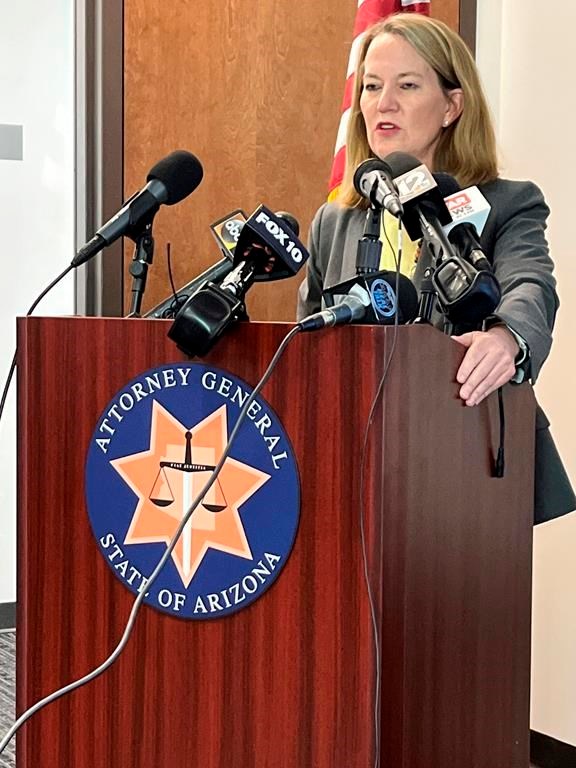
“They created ghost students with forged birth certificates – children that didn’t exist –- and gave them fake disability diagnoses that would make them eligible for larger funding amounts,” said Arizona Attorney General Kris Mayes, whose office is examining other suspected abuses of the voucher program.
No attorneys for the former Department of Education employees and Sweet’s two adult children could found in court records.
Phone messages left late Thursday afternoon for Sweet and Jones, as well as a number listed for both Jadakah and Raymond Johnson, weren’t immediately returned. Efforts to get Lopez’s phone number were unsuccessful.
The Democratic attorney general said the case shows the voucher program is an easy target for fraud and that the Republican-majority Legislature should take steps to lessen the opportunity for fraud within the voucher program.
Sen. John Kavanagh, a Republican who supports the vouchers, said he doesn’t see the problem as fraud within the Empowerment Scholarships Account program, but rather fraud in the agency that runs it.
“I don’t think that it’s anymore damning of the ESA than when a bank teller steals money from the banking system,” Kavanagh said. “It (the problem) is about the people, not the program.”
Mayes said investigators were tipped off to the alleged fraud not by the education department, which runs the voucher program, but rather a credit union that noticed unusually large cash withdrawals.
In a statement, Superintendent of Public Instruction Tom Horne disputed that his office didn’t tell the Attorney General’s Office about the fraud, saying his office had alerted Mayes’ office about concerns about two of the three employees. He also said he has placed more controls on the program and reported other instances of suspected abuse of the voucher program to Mayes’ office.
“Our discovery of the activities of the two former staffers is consistent with my determination to root out potential fraud and abuse,” Horne said.
The voucher program lets parents use public money for private-school tuition and other education costs. It started in 2011 as a small program for disabled children. But it was expanded repeatedly over the next decade until it became available to all students in 2022.
Originally estimated to cost $64 million for the current fiscal year, budget analysts now say it could top $900 million.
The changes in Arizona’s voucher program led to a sharp increase in the number of participants. Before the expansion, nearly 12,000 students — including disabled children, those living on Native American reservations and children in low-performing schools — took part in the program. Now that all students can apply for the vouchers, more than 75,000 students participate.
Critics say the expansion is a drain on the state’s coffers, while backers say the expansion lets parents choose the best school for their children.
About 75% of the students who got vouchers immediately after the program was expanded had no prior record of attending an Arizona public school, according to Department of Education data reported in 2022. That suggests the state subsidies went largely to students whose families already were paying private school tuition. ____ Associated Press writer Rio Yamat in Las Vegas contributed to this report.