Russian disinformation is about immigration. The real aim is to undercut Ukraine aid
Advertisement
Read this article for free:
or
Already have an account? Log in here »
To continue reading, please subscribe:

Digital Subscription
One year of digital access for only $205*
- Enjoy unlimited reading on winnipegfreepress.com
- Read the E-Edition, our digital replica newspaper
- Access News Break, our award-winning app
- Play interactive puzzles
*First annual payment billed as $205.00 + GST for one year. This annual subscription will automatically renew at $233.00 + GST every 52 weeks (10% off the regular annual price of $259.35). Offer available to new and qualified returning subscribers only. Cancel any time.
To continue reading, please subscribe:
Add Free Press access to your Brandon Sun subscription for only an additional
$1 for the first 4 weeks*
- Enjoy unlimited reading on winnipegfreepress.com
- Read the E-Edition, our digital replica newspaper
- Access News Break, our award-winning app
- Play interactive puzzles
*Your next Brandon Sun subscription payment will increase by $1.00 and you will be charged $17.95 plus GST for four weeks. After four weeks, your payment will increase to $24.95 plus GST every four weeks.
Read unlimited articles for free today:
or
Already have an account? Log in here »
Hey there, time traveller!
This article was published 01/03/2024 (939 days ago), so information in it may no longer be current.
WASHINGTON (AP) — For Vladimir Putin, victory in Ukraine may run through Texas’ Rio Grande Valley.
In recent weeks, Russian state media and online accounts tied to the Kremlin have spread and amplified misleading and incendiary content about U.S. immigration and border security. The campaign seems crafted to stoke outrage and polarization before the 2024 election for the White House, and experts who study Russian disinformation say Americans can expect more to come as Putin looks to weaken support for Ukraine and cut off a vital supply of aid.
In social media posts, online videos and stories on websites, these accounts misstate the impact of immigration, highlight stories about crimes committed by immigrants, and warn of dire consequences if the U.S. doesn’t crack down at its border with Mexico. Many are misleading, filled with cherry-picked data or debunked rumors.

The pivot toward the United States comes after two years in which Russia’s vast disinformation apparatus was busy pushing propaganda and disinformation about its invasion of Ukraine. Experts who study how authoritarian states use the internet to spread disinformation say eroding support for Ukraine remains Russia’s top priority — and that the Kremlin is just finding new ways to do it.
“Things have shifted, even in the last few days,” said Kyle Walter, head of research at Logically, a tech company that tracks disinformation campaigns. While experts and government officials have long warned of Russia’s intentions, Walter said the content spotted so far this year “is the first indication that I’ve seen that Russia is actually going to focus on U.S. elections.”
This month Logically identified dozens of pro-Russian accounts posting about immigration in the U.S., with a particular interest in promoting recent anti-immigration rallies in Texas. A recent Logically assessment concluded that after two years spent largely dedicated to the war in Ukraine, Russia’s disinformation apparatus has “started 2024 with a focus on the U.S.”
Many posts highlight crimes allegedly committed by recent immigrants or suggest migrants are a burden on local communities. Some claims were posted by accounts with tiny audiences; others were made by state media sites with millions of followers.
This week the accounts seized on the recent death of a Georgia nursing student and the arrest of a Venezuelan man who had entered the U.S. illegally and was allowed to stay to pursue his immigration case. The killing quickly became a rallying cry for former President Donald Trump and other Republicans who suggest that migrants commit crimes more often than do U.S. citizens. The evidence does not support those claims.
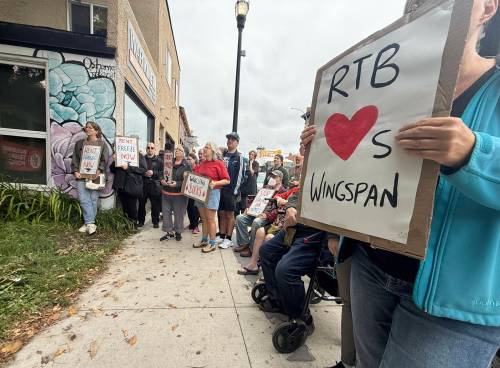
The content, crafted in English, has quickly found its way to websites and platforms popular with American voters. Footage of a recent anti-immigration protest broadcast by Russian outlet RT, for example, was racking up thousands of views this week on X, the platform formerly known as Twitter, and prompting angry replies from other users.
The Russian outlet Sputnik ran a story this week about growing calls to build a U.S.-Mexico border wall, a priority for Trump, who failed to complete the job as president. An analysis of other sites that later linked to the Sputnik piece shows more than half were in the U.S., according to data from the online analytics firm Semrush.com. Overall, Americans make up the English-language Sputnik’s largest audience.
U.S. officials have warned that Russia could seek to meddle in the elections of dozens of countries in 2024, when more than 50 nations accounting for half of the world’s population are scheduled to hold national votes. While Russia has a strategic interest in the outcome of many of them — the European Parliament, for one — few offer the opportunity and the prize that America does.
For Russia’s bid to conquer Ukraine, this year’s U.S. election stakes couldn’t be higher. President Joe Biden has pledged to fully back Ukraine. Republicans have been far less supportive. Trump has openly praised Putin and the former president has suggested he would encourage Russia to attack America’s NATO allies if they don’t pay their fair share for the military alliance.
More than half of Republicans believe the U.S. is spending too much on Ukraine, according to a recent poll from The Associated Press-NORC Center for Public Affairs Research that found Democrats to be much more supportive of additional aid.
Soon after the war started, Russia mounted a disinformation campaign designed to cut into support for Ukraine. Claims included wild stories about secret U.S. germ warfare labs or Nazi conspiracies or that Ukrainian refugees were committing crimes and taking jobs from people who had welcomed them.
That effort continues, but Russia also has shifted its attention to issues with no obvious tie to Moscow that are more likely to create cracks in the unity of its adversaries — for example immigration, or inflation, high-profile topics in the U.S. and Europe.
“They’re very savvy and understand the right buttons to push,” said Bret Schafer, senior fellow and head of the information manipulation team at the Alliance for Securing Democracy, a Washington-based nonprofit. “If your ultimate objective is to reduce support for Ukraine, your inroad might be talking about how bad things are on the southern border. Their path to win this thing is to get the U.S. and the E.U. to stop sending weapons and aid to Ukraine.”
A message left with the Russian Embassy in Washington wasn’t immediately returned.
America’s election may also be a tempting target for other authoritarian nations such as China and Iran that, like Russia, have shown a willingness to use online propaganda and disinformation to further their objectives.
The online landscape has dramatically shifted since Russia sought to meddle in America’s 2016 presidential race won by Trump. Platforms such as Facebook and Instagram have banned many Russian state accounts and built new safeguards aimed at preventing anyone from exploiting their sites. In one recent example, Meta, the owner of Facebook, announced last fall that it had identified and stopped a network of thousands of fake accounts created in China in an apparent effort to fool American voters.
Other platforms, including X, have taken a different approach, rolling back or even eliminating content moderation and rules designed to stop disinformation. Then there is TikTok, whose ties to China and popularity with young people have set off alarms in several state capitals and Washington.
Artificial intelligence is another concern. The technology now makes it easier than ever to create audio or video that is lifelike enough to fool voters.
Social media is no longer the only battleground either. Increasingly, Russia and other disinformation spreaders use encrypted messaging sites or websites that masquerade as legitimate news outlets.

“A lot of their activity has moved off the major platforms to places where they can operate more freely,” said John Hultquist, chief analyst at Mandiant Intelligence, a cybersecurity firm monitoring Russian disinformation.
Walter, Logically’s research director, said he is most concerned about disinformation on X and TikTok this year, given their lack of controls and their popularity, especially with young voters. TikTok’s ties to China have raised national security concerns.
He said that while election years tend to highlight the dangers of disinformation, the most effective information operations are launched years in advance. America’s adversaries have spent a long time studying its politics, building online networks and cultivating domestic divisions.
Now comes the payoff.
“They don’t need to put a ton of effort into causing disinformation,” Walter said. “They’ve already laid the groundwork leading up to 2024.”