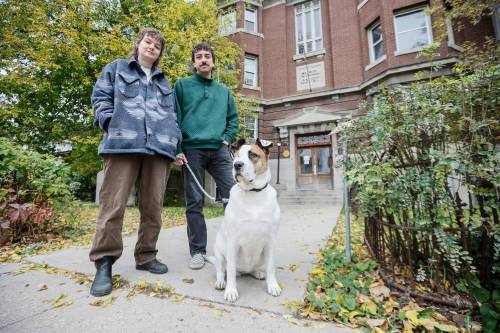
Insurer delays and denials hamper patients seeking at-home breathing machines
Advertisement
Read this article for free:
or
Already have an account? Log in here »
To continue reading, please subscribe:

Digital Subscription
One year of digital access for only $205*
- Enjoy unlimited reading on winnipegfreepress.com
- Read the E-Edition, our digital replica newspaper
- Access News Break, our award-winning app
- Play interactive puzzles
*First annual payment billed as $205.00 + GST for one year. This annual subscription will automatically renew at $233.00 + GST every 52 weeks (10% off the regular annual price of $259.35). Offer available to new and qualified returning subscribers only. Cancel any time.
To continue reading, please subscribe:
Add Free Press access to your Brandon Sun subscription for only an additional
$1 for the first 4 weeks*
- Enjoy unlimited reading on winnipegfreepress.com
- Read the E-Edition, our digital replica newspaper
- Access News Break, our award-winning app
- Play interactive puzzles
*Your next Brandon Sun subscription payment will increase by $1.00 and you will be charged $17.95 plus GST for four weeks. After four weeks, your payment will increase to $24.95 plus GST every four weeks.
Read unlimited articles for free today:
or
Already have an account? Log in here »
Hey there, time traveller!
This article was published 09/03/2024 (948 days ago), so information in it may no longer be current.
Lou Gehrig’s disease took away Grace Armant’s ability to speak, but the 84-year-old still has plenty to say about her insurance.
UnitedHealthcare has rejected several requests from her doctors for coverage of a machine Armant needs to breathe as she deals with the fatal illness.
“They are no good,” Armant said, typing slowly into a device that speaks for her. “I can’t do without the machine.”

Doctors around the country say UnitedHealthcare and other insurers have made it harder to get coverage for certain home ventilators that patients like Armant need as their lungs fail. They say patients often must struggle first with less effective — and cheaper — devices before some insurers will pay. In other cases, insurers balk at paying for a second machine needed when patients transfer from their bed to a wheelchair.
Temple University doctoral student Jaggar DeMarco waited more than three years to get his.
“Breathing is not a luxury,” he said. “It’s really the bare minimum, and that’s what we’re asking for.”
Some physicians believe insurers are making it harder on patients because more of the devices are being prescribed. Spending by the federal government’s Medicare program on the ventilators jumped from about $3 million to nearly $269 million between 2009 and 2017, according to the U.S. Department of Health and Human Services Office of Inspector General.
Insurers say they do cover the machines, but that coverage can depend on several factors.
These “noninvasive” ventilators help patients breathe around the clock by forcing air into the lungs, often through a mask. They are called noninvasive because they don’t require trachea surgery to open the airway, like ones used in hospitals.
The machines have battery backups so they can keep working when the power goes out. They also are more powerful than other devices meant to be used mainly at night for conditions like sleep apnea. At around $1,200 a month, they can be three times as expensive as those devices.
These ventilators can help prolong the life of someone with Lou Gehrig’s disease, also known as amyotrophic lateral sclerosis, doctors say.
But insurance rejections have picked up for those patients and people dealing with advanced cases of chronic obstructive pulmonary disease, said Chuck Coolidge, chief strategy officer for VieMed, which provides respiratory equipment for patients in 46 states.
That includes both initial approvals and reauthorizations, he said.
“In early 2023, it was almost like a switch flipped,” he said.
UnitedHealthcare spokeswoman Heather Soule said her company covers the machines and re-evaluates requests if it gets new information. Coverage can depend on the patient’s condition, terms of their health plan or guidelines from the federal government’s Medicare program.
Those guidelines give insurers room to reject many ventilator requests, even those for seriously ill patients, said Dr. John Hansen-Flaschen, a pulmonary medicine expert with the University of Pennsylvania.
Government-funded Medicare Advantage plans run by UnitedHealthcare now deny nearly all initial requests for the ventilators, said Dr. Cathy Lomen-Hoerth, a neurologist with the University of California San Francisco.
In West Virginia, Dale Harper says it took several months and a personal plea before UnitedHealthcare would cover a ventilator for his 25-year-old son, Jacob, who has a rare and aggressive form of ALS.
After appeals from Jacob’s doctor failed, Harper called a number on his insurance card and asked for a supervisor.
“I said, ‘I can feed him, I can help him go to the bathroom, I can move him from one place to the other,’” the Winfield, West Virginia, resident recalled. “The only thing I cannot do is breathe for him … and he can’t breathe.”
Harper said ventilator coverage was approved within an hour of that call early last year.
Doctors caring for Armant, who lives outside New Orleans, say they usually get decent ventilator coverage.
“No one thought there would be a problem,” said Deidre Devier, an LSU Health experimental psychologist who specializes in cognitive disorders.
They first sought coverage in May, 2022, and Devier said Armant has only had it for around three months near the end of that year. She said a medical device company has been providing Armant’s ventilator for free while her case was appealed. But those appeals have ended.
Armant’s daughter said she’s considering starting hospice care, which would allow for ventilator coverage but prevent her mom from seeing her regular doctors. She’s also looking online for a refurbished machine.
“She doesn’t have $20,000″ to buy the machine, Terrellyn Armant said.
Representatives of both patients with UnitedHealthcare coverage gave the insurer written permission to discuss their cases, but Soule declined to comment on the record.
Coverage complications aren’t limited to UnitedHealthcare. DeMarco, the Temple student, said Aetna denied a request for a second breathing machine, and then several appeals. Eventually, his father’s employer essentially overruled the insurer and allowed coverage.
Doctors recommend a second ventilator for people who use wheelchairs during the day. That avoids mistakes in adjusting the machine’s settings when moving someone from their bed.
“I’m constantly angry that my life and what I can do with (it) is sometimes determined by insurance companies and bureaucracy,” said the 30-year-old DeMarco, who has chronic respiratory failure.
An Aetna representative said the company could not comment on individual cases. But he added that Aetna does cover second ventilators in certain circumstances. Aetna’s policy bulletin says they are medically necessary for people who need an additional ventilator for their wheelchair during the day.
Ventilator coverage problems started picking up after technology improvements made the devices easier to use, according to Dr. Lisa Wolfe, a professor at Northwestern’s Feinberg School of Medicine. That led to a rise in use for patients with conditions that are not immediately life-threatening.
She said she thinks insurers are reacting to that expanded use.

ALS patients without ventilator access have limited options. They can use a device that’s covered but doesn’t work as well. They may get ventilator coverage by entering hospice care or having a tracheostomy.
They also might wind up bouncing in and out of hospitals, said Hansen-Flaschen, the Penn physician.
“Or they die prematurely, and it’s a wretched death because they can’t breathe,” he said.
___
The Associated Press Health and Science Department receives support from the Howard Hughes Medical Institute’s Science and Educational Media Group. The AP is solely responsible for all content.