New Brunswick volunteers build flying telescope to see total eclipse above the clouds
Advertisement
Read this article for free:
or
Already have an account? Log in here »
To continue reading, please subscribe:

Digital Subscription
One year of digital access for only $205*
- Enjoy unlimited reading on winnipegfreepress.com
- Read the E-Edition, our digital replica newspaper
- Access News Break, our award-winning app
- Play interactive puzzles
*First annual payment billed as $205.00 + GST for one year. This annual subscription will automatically renew at $233.00 + GST every 52 weeks (10% off the regular annual price of $259.35). Offer available to new and qualified returning subscribers only. Cancel any time.
To continue reading, please subscribe:
Add Free Press access to your Brandon Sun subscription for only an additional
$1 for the first 4 weeks*
- Enjoy unlimited reading on winnipegfreepress.com
- Read the E-Edition, our digital replica newspaper
- Access News Break, our award-winning app
- Play interactive puzzles
*Your next Brandon Sun subscription payment will increase by $1.00 and you will be charged $17.95 plus GST for four weeks. After four weeks, your payment will increase to $24.95 plus GST every four weeks.
Read unlimited articles for free today:
or
Already have an account? Log in here »
Hey there, time traveller!
This article was published 10/03/2024 (916 days ago), so information in it may no longer be current.
HALIFAX – Early next month, millions of Canadians will gaze skyward to witness a total solar eclipse. But some stand to be disappointed as clouds get in the way.
David Hunter plans to have an unobstructed view, and he’s inviting others to join him. The retired medical physicist in western New Brunswick has led a group of volunteers to build a sun-tracking telescope that will be hoisted aloft by a weather balloon on the afternoon of April 8.
“The primary goal is to get over any existing cloud cover,” Hunter said in an interview, adding that the helium-filled balloon could rise as high as 30 kilometres above the Earth after its launch from Florenceville-Bristol, N.B., at 3:30 p.m. Atlantic daylight time.
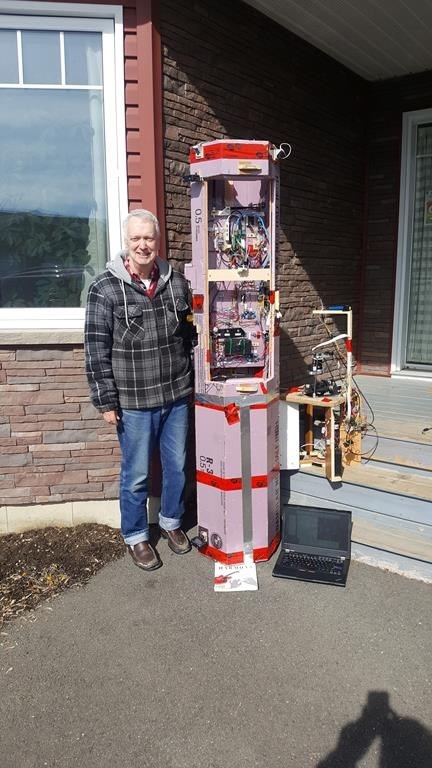
As it ascends, the balloon will be carrying a 2.3-metre tube-shaped box equipped with tiny computers, four tracking devices and several cameras, some of which will be transmitting images to a ground station at the Florenceville Inn.
From there, the video will be livestreamed to several viewing locations in western New Brunswick, as well as a YouTube channel, the link for which will soon be posted on Hunter’s website.
The moon’s 185-kilometre-wide shadow will enter Florenceville-Bristol at 4:32 p.m. ADT, plunging the surrounding area into darkness for more than three minutes. Only then will it be possible to safely look at the sun without eye protection.
Assuming there is little cloud cover, the sun’s rays will disappear into twilight, glimmering stars and planets will appear and the horizon will glow orange like at sunset. At that point, the sun’s wispy corona will fan out from behind a black moon, an ethereal sight normally lost in daylight glare.
The temperature will drop about 5 C and nearby animals may act strangely, experts say. And then it will be over, as the moon’s shadow races to the east at about 3,700 kilometres per hour.
Hunter said the biggest technical challenge his team had to overcome was designing a machine to enable the telescope to continuously track the sun as the balloon’s eight-kilogram payload wobbles in the wind.
“It spins, but it also bobs and weaves,” Hunter said, adding that students from the University of New Brunswick also worked on the project. “This has been the most difficult part … I was told it was impossible.”
Using technology developed at Université Laval in Quebec City, Hunter and his team built their own version of a gimbal mechanism known as the “Agile Eye.” Instead of pointing the flying telescope at the sun, it is aimed downward at a mirror attached to two computerized control motors.
“The mirror moves in such a way that it always points the sun into the telescope,” Hunter said.
Experiencing solar eclipses has been a lifelong passion for Hunter. As a boy growing up in Florenceville, he saw his first eclipse in 1963, having read about the solar system and the universe in a series of “How and Why Wonder Books.”
“Seeing the pictures of galaxies and, particularly, the Orion nebula, I thought, ‘Oh my heavens, that’s beautiful.'”
He built a telescope from a kit, and in March 1970 he travelled to Nova Scotia with his family to see a total solar eclipse.
“It was cloudy,” he said with a sigh. “It was such a helpless feeling. That was my first experience with being clouded out on an eclipse.”
As an adult, Hunter worked in Toronto on digital imaging methods for breast cancer screening. But his interest in cosmology never waned. “When I retired, I thought that if I moved back to New Brunswick, there’s open space,” he said. “You can actually see stuff in the sky, which is not so easy in Toronto.”
And when he learned that the 2024 solar eclipse would see the moon’s shadow pass directly over his hometown, he thought, “I don’t want to be clouded out again.”
Meanwhile, the prevailing westerly winds are expected to carry the balloon along the moon’s projected path, but that’s not a sure thing. “We have no directional control over where it is going,” Hunter said. “We’re at the mercy of the winds.”

Still, Hunter said a November test flight went off without a hitch. As the balloon neared the Gulf of St. Lawrence on New Brunswick’s east coast, a signal from the ground station instructed an on-board computer to sever the rope between the balloon and its payload. The payload dropped safely to the ground, a parachute slowing its descent.
Despite their cosmic mystique, total solar eclipses aren’t rare. They appear once or twice every year somewhere on the planet, according to NASA. Most locations typically wait between 400 and 1,000 years for a repeat performance. The last time a total solar eclipse passed through the area now known as central New Brunswick was AD 982, Hunter said.
Nova Scotia, by contrast, has been relatively spoiled, experiencing total solar eclipses in 1970 and again in 1972. And next month’s eclipse will also track across the northern tip of Cape Breton. Since 1963, Canadians have witnessed five total solar eclipses, though the one in 2008 tracked across the upper reaches of the Arctic.
This report by The Canadian Press was first published March 10, 2024.
— David Hunter’s website is at https://eclipseplus.ca.