

North Carolina appeals court upholds ruling that kept Confederate monument in place
Advertisement
Read this article for free:
or
Already have an account? Log in here »
To continue reading, please subscribe:

Digital Subscription
One year of digital access for only $205*
- Enjoy unlimited reading on winnipegfreepress.com
- Read the E-Edition, our digital replica newspaper
- Access News Break, our award-winning app
- Play interactive puzzles
*First annual payment billed as $205.00 + GST for one year. This annual subscription will automatically renew at $233.00 + GST every 52 weeks (10% off the regular annual price of $259.35). Offer available to new and qualified returning subscribers only. Cancel any time.
To continue reading, please subscribe:
Add Free Press access to your Brandon Sun subscription for only an additional
$1 for the first 4 weeks*
- Enjoy unlimited reading on winnipegfreepress.com
- Read the E-Edition, our digital replica newspaper
- Access News Break, our award-winning app
- Play interactive puzzles
*Your next Brandon Sun subscription payment will increase by $1.00 and you will be charged $17.95 plus GST for four weeks. After four weeks, your payment will increase to $24.95 plus GST every four weeks.
Read unlimited articles for free today:
or
Already have an account? Log in here »
Hey there, time traveller!
This article was published 19/03/2024 (873 days ago), so information in it may no longer be current.
RALEIGH, N.C. (AP) — A North Carolina appeals court ruled Tuesday that local leaders who refused calls to remove a Confederate monument from outside a county courthouse acted in a constitutional manner and kept in place the statue at its longtime location in accordance with state law.
The three-judge panel unanimously upheld a trial court judge’s decision to side with Alamance County and its commissioners over the 30 foot (9.1 meter)-tall statue, which features a Confederate infantryman perched at the top. The state NAACP, the Alamance NAACP chapter, and other groups and individuals had sued the county and its leaders in 2021 after the commissioners rejected calls to take the statue down.
Confederate monuments in North Carolina, as elsewhere nationwide, were a frequent focal point for racial inequality protests in the late 2010s, and particularly in 2020 following the murder of George Floyd by a Minneapolis police officer. North Carolina legislators enacted a law in 2015 that limits when an “object of remembrance” such as a military monument can be relocated.
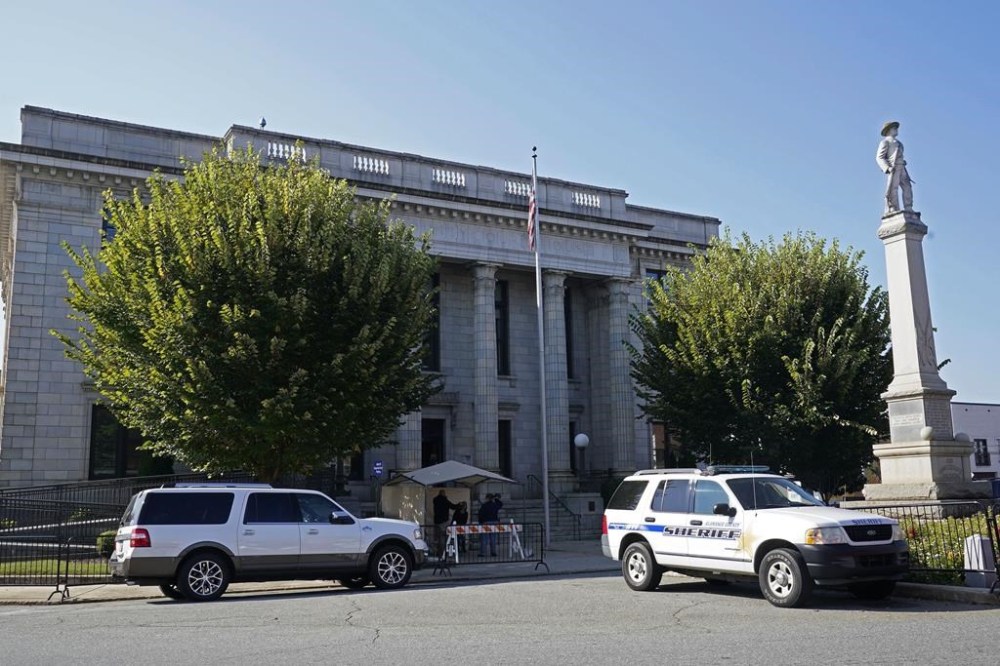
The lawsuit’s plaintiffs said the county and the commissioners violated the state constitution by exercising discriminatory intent to protect a symbol of white supremacy outside the historic Alamance County Courthouse, thus creating the appearance of racial prejudice there.
In the opinion, Court of Appeals Chief Judge Chris Dillon wrote that the county commissioners lacked authority under the 2015 law to remove the statue. He also said the county manager’s email to commissioners in June 2020, in which he asked them to consider removing the monument out of concern for protesters’ safety, did not qualify for an exception to that law.
“At all times, the Monument Protection Law required the County to leave the Monument in its current place,” Dillon wrote. He added that a provision in the state constitution intended to ensure state courts are open to the public doesn’t prohibit the placement of objects of historical remembrance in and around a courthouse. The courthouse monument was dedicated in 1914.
“Indeed, in many courthouses and other government buildings across our State and nation, there are depictions of historical individuals who held certain views in their time many today would find offensive,” Dillon wrote.
Judges Donna Stroud and Valerie Zachary joined in the opinion.
Even with the 2015 law, Confederate monuments in North Carolina have been taken down in recent years, sometimes through force.
In 2018, protesters tore down a Confederate statue known as “Silent Sam” at the University of North Carolina campus at Chapel Hill. Statues of soldiers from the North Carolina Confederate Monument on the old Capitol grounds in Raleigh came down in June 2020. Gov. Roy Cooper, citing public safety, directed that the remainder of the monument and two others on Capitol grounds be removed.
The state Supreme Court is currently considering litigation stemming from a 2021 decision by the Asheville City Council to dismantle an obelisk honoring Civil War-era Gov. Zebulon Vance.