Nevada’s first big-game moose hunt will be tiny as unusual southern expansion defies climate change

Advertisement

Advertise with us

RENO, Nev. (AP) — In what will be a tiny big-game hunt for some of the largest animals in North America, Nevada is planning its first-ever moose hunting season this fall.

Read this article for free:


or

Already have an account? Log in here »

To continue reading, please subscribe:

Subscribe and receive a limited-edition Free Press branded hat or tote.

Digital Subscription

One year of digital access for only $205*

  • Enjoy unlimited reading on winnipegfreepress.com
  • Read the E-Edition, our digital replica newspaper
  • Access News Break, our award-winning app
  • Play interactive puzzles

*First annual payment billed as $205.00 + GST for one year. This annual subscription will automatically renew at $233.00 + GST every 52 weeks (10% off the regular annual price of $259.35). Offer available to new and qualified returning subscribers only. Cancel any time.

To continue reading, please subscribe:

Add Free Press access to your Brandon Sun subscription for only an additional

$1 for the first 4 weeks*

  • Enjoy unlimited reading on winnipegfreepress.com
  • Read the E-Edition, our digital replica newspaper
  • Access News Break, our award-winning app
  • Play interactive puzzles
Start now

*Your next Brandon Sun subscription payment will increase by $1.00 and you will be charged $17.95 plus GST for four weeks. After four weeks, your payment will increase to $24.95 plus GST every four weeks.

Hey there, time traveller!
This article was published 23/03/2024 (886 days ago), so information in it may no longer be current.

RENO, Nev. (AP) — In what will be a tiny big-game hunt for some of the largest animals in North America, Nevada is planning its first-ever moose hunting season this fall.

Wildlife managers say explosive growth in Nevada moose numbers over the past five years, increasing to a population of more than 100, justifies the handful of harvests planned.

Scientists say the experiment of sorts should also provide a real-time peek at how the complexities of climate change affect wildlife, and why these majestic — some say goofy-looking — mammals the size of a horse have unexpectedly expanded their range into warmer territory.
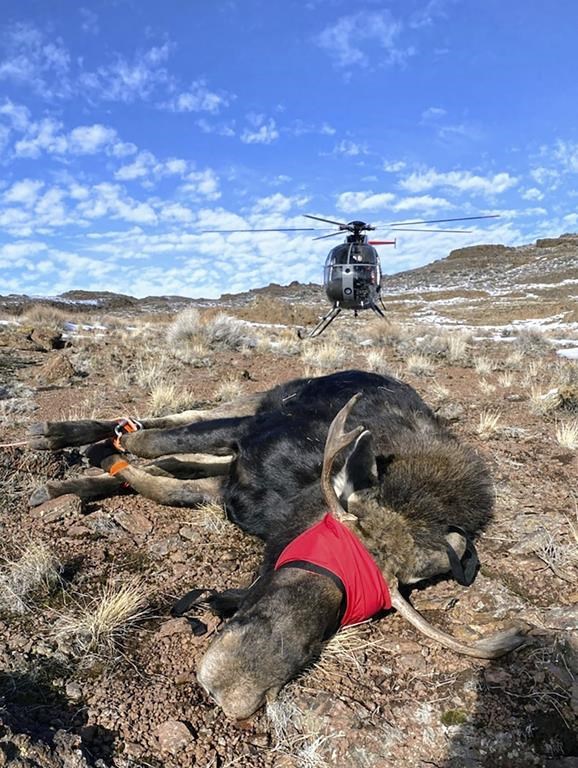
In this photo provided by the Nevada Department of Wildlife, a sedated moose lies on the ground in Elko County, Nev., after being collared and its health and vitals examined, in 2022. In what will be a very tiny hunt for some of the biggest game in North America, Nevada is planning its first-ever moose hunting season during fall 2024. State officials expect thousands of applications for the handful of hunting tags and, with an estimated population barely topping 100, it's already controversial. (Nevada Department of Wildlife via AP)

“Moose are newcomers to North America,” said Cody McKee, a Nevada Department of Wildlife specialist.

The last deer species to cross the Bering Sea land bridge into Alaska and Canada, McKee said the movement of moose into the Lower 48 has occurred almost exclusively in the past 150 years.

“Their post-glacial range expansion isn’t really complete,” McKee said. “And that’s what we’re currently seeing in Nevada right now, is those moose are moving into the state and finding suitable habitat.”

Only a few Nevada moose, perhaps just one, will be killed across an area larger than Massachusetts and New Jersey combined. But state officials expect thousands of applications for the handful of hunting tags, and it’s already controversial.

“Why a moose hunt at all?” Stephanie Myers of Las Vegas asked at a recent wildlife commission meeting. “We want to see moose, view moose. Not kill moose.”

The first moose was spotted in Nevada in the 1950s, not long before the dim-witted cartoon character “Bullwinkle” made his television debut. Only a handful of sightings followed for decades, but started increasing about 10 years ago.

By 2018, officials estimated there were 30 to 50, all in Nevada’s northeast corner. But the population has more than doubled and experts believe there’s enough habitat to sustain about 200, a level that could be reached in three years.

Bryan Bird, Defenders of Wildlife’s Southwest program director, is among the skeptics who suspect it’s a short-lived phenomenon.

“I believe the moose story is one of `ghost’ habitat or `ghost’ range expansion. By that I mean, these animals are expanding into habitat that may not be suitable in 50 years due to climate change,” Bird said.

Government biologists admit they don’t fully understand why the moose have moved so far south, where seasonal conditions are warmer and drier than they traditionally prefer.

“It seems to be opposite of where we would expect to see moose expansion given their ecology,” said Marcus Blum, a Texas A&M University researcher hired to help assess future movement. He analyzed aerial surveys, individual sightings and habitat to project growth trends.

Six feet (1.8 meters) tall at the shoulder and up to 1,000 pounds (453.5 kilograms), moose live in riparian areas where they munch on berry bushes and aspen leaves along the edges of mountain forests native to the northern half of Nevada.

They usually avoid places where temperatures regularly exceed 68 degrees Fahrenheit (20 Celsius).

The Nevada study documented moose spending nearly half their time in areas where that “thermal threshold” was exceeded about 150 days a year, while climate change models suggest the threshold will be surpassed by another 14 days annually by 2050, Blum said.

To be clear, the valleys beneath the snow-capped winter mountain ranges with moose are 500 miles (805 kilometers) from the Las Vegas Strip in the desert many people picture as Nevada.

Researchers have more questions than answers about why moose continue to expand their range into Nevada where extended drought has taken a toll on other wildlife, McKee said.

“There’s a lot of speculation and questions about why they are here, given concerns about the changing environment and how it’s probably getting warmer and dryer,” McKee said. “Why is it that our extensive drought cycles haven’t seemed to be affecting the moose population?”

Populations along the U.S.-Canada border have oscillated for more than a century. Several states, from Idaho to Minnesota and Maine, have dramatically reduced hunting quotas at times to allow populations to recover.

Alaska is home to the vast majority of U.S. moose, upwards of 200,000, with about 7,000 harvests annually. Maine has nearly 70,000, which is five times more than any other Lower 48 state, and issued 4,100 permits last year. Neighboring New Hampshire offered only 35 for 3,000-plus moose and Idaho issued about 500 for its 10,000 to 12,000.

No moose were observed in Washington state before the 1960s but its growing population now exceeds 5,000. The state issued three hunting permits in 1977 and now tops 100 annually.

Nevada’s research suggests its population could sustain more harvests than planned, McKee said, but “conservative is the name of the game here.”

Aerial surveys are now backed by radio-tracking collars biologists have fitted on four bull moose and nine cows since 2020. In some spots, males significantly outnumber females. Removing a bull or two might improve herd dynamics, he said.

The exact number of permits will be determined in the coming weeks, but McKee anticipates no more than three. Only Nevadans can apply for the inaugural hunt, which will help guide decisions about future endeavors.

Successful hunters must present the skull and antlers for state inspection within five days. That will give scientists more insight into herd health, body conditions, disease and parasites.

Bill Nolan of Sparks, who first hunted ducks at age 12, says he intends to apply for a chance he describes as “slim and none” to draw a moose tag.

“For hunters, it would be like hitting the lottery,” he said.
Report Error Submit a Tip

More Stories

Man sues WRHA, doctors after wrong leg amputated at Grace Hospital in 2024

Erik Pindera 4 minute read Preview

Man sues WRHA, doctors after wrong leg amputated at Grace Hospital in 2024

Erik Pindera 4 minute read Updated: Yesterday at 4:58 PM CDT

A man whose left leg was mistakenly amputated — rather than his infected lower right leg — at the Grace Hospital in 2024 has filed a lawsuit against the Winnipeg Regional Health Authority and two doctors involved in his care.

Jason Kennedy, who lives in Winnipeg and is a member of Bloodvein First Nation, filed his statement of claim in Court of King’s Bench last week, naming the WRHA and orthopedic surgeons Dr. David John Dillon and Dr. Yiyang Zhang as defendants.

He accuses the health authority and doctors of negligence and breach of duty, among other allegations.

Kennedy was 48 when he went to Seven Oaks General Hospital on Oct. 22, 2024, with pain and an infection in his right foot.

Read
Updated: Yesterday at 4:58 PM CDT

Software engineer who built lessons on AI for kids was ‘terrified’ into action

Maggie Macintosh 5 minute read Preview

Software engineer who built lessons on AI for kids was ‘terrified’ into action

Maggie Macintosh 5 minute read 4:59 PM CDT

When Mohamad Alhamoud witnessed his young son ask an artificial intelligence-powered chatbot to do his homework for him, the software engineer felt “terrified.”

It was midway through the 2024-25 school year and the boy, then a Grade 3 student in Winnipeg’s Louis Riel School Division, had been tasked with inventing something new.

“This was supposed to be his moment of innovation, of imagination, of trying to come up with something on his own,” Alhamoud said.

The father of three has since turned his panic into motivation to help his kids and their classmates become digitally literate.

Read
4:59 PM CDT

Taxpayers federation pushes for continued federal gas tax holiday

Carol Sanders 4 minute read Preview

Taxpayers federation pushes for continued federal gas tax holiday

Carol Sanders 4 minute read 5:57 PM CDT

The Canadian Taxpayers Federation is calling on the prime minister to extend the 10-cent per litre gas tax holiday, set to end on Labour Day.

“We’ve done polling that shows a majority of Canadians from across the country oppose the tax coming back on at the pumps,” said Gage Haubrich, Prairie director of the non-profit advocacy group in front of the Manitoba legislature Tuesday.

Those polled in Manitoba and Saskatchewan were more opposed to the return of the federal gas tax than anywhere else in Canada, he said.

Haubrich said the group was also asking Premier Wab Kinew to “follow in the steps of (Ontario) Premier Doug Ford and send a letter to the prime minister calling on him to extend the gas tax cut as well.”

Read
5:57 PM CDT

Northern Manitoba mobile MRI makes first move in 15 months

Carol Sanders 4 minute read Preview

Northern Manitoba mobile MRI makes first move in 15 months

Carol Sanders 4 minute read 6:43 PM CDT

Northern Manitoba’s mobile MRI made its first move since it began scanning in Thompson nearly 15 months ago, setting up shop Monday in The Pas.

“It’s really exciting that we finally have this piece of equipment here,” said Dayna McTaggart, a medical radiological technologist in The Pas and provincial manager for the Canadian Association of Medical Radiation Technologists Manitoba.

The mobile MRI will travel between the two communities that are 400 kilometres apart in an effort to strengthen northern health-care delivery, the provincial government said in a news release.

“This rotation ensures patients in northern communities have easier, more equitable access to vital diagnostic imaging without the burden of long-distance travel,” Dr. AbdulRazaq Sokoro, Shared Health’s chief operating officer of diagnostic services, said in the release.

Read
6:43 PM CDT

Inflation-battered U.S. voters could prove to be key Canadian ally in fight against Trump’s trade tyranny

Dan Lett 5 minute read Preview

Inflation-battered U.S. voters could prove to be key Canadian ally in fight against Trump’s trade tyranny

Dan Lett 5 minute read Yesterday at 1:37 PM CDT

Is there anything or anyone that can help Canada and the United States avoid an unprecedented trade war?

Both nations stand poised on the precipice of a tariff battle that could — in the worst-case scenario — trigger an economic downturn. Both countries have a lot to lose, but neither country is showing any sign of backing down.

Canadian Prime Minister Mark Carney has, by all accounts, given negotiation a full chance to defuse the trade war. It didn’t work and it appears now that nothing — neither thoughtful negotiation or retaliatory measures — will dissuade U.S. President Donald Trump from his war of trade attrition.

Increasingly, it appears that if Trump is going to back away from punitive tariffs against Canada, it will be because of mounting pressure from within the United States and not because of tough talk and countermeasures from this side of the border.

Read
Yesterday at 1:37 PM CDT

Thirteen accused in gun, drug trafficking network in rural Manitoba

Erik Pindera 4 minute read Preview

Thirteen accused in gun, drug trafficking network in rural Manitoba

Erik Pindera 4 minute read Updated: 3:59 PM CDT

RCMP and Winkler police have arrested more than a dozen people allegedly connected to a drug-and-gun trafficking network that operated in rural Manitoba.

The joint investigation began in December 2024, when officers from the Winkler Police Service asked the Mounties for help after learning kilograms of cocaine were being imported to a Winkler-area truck repair business, said RCMP Supt. Jeff Asmundson, who oversees the force’s Manitoba integrated law enforcement team.

Mounties and Winkler police gathered evidence for 19 months and expanded the probe, dubbed Project Dolor, as investigators learned other types of illicit substances and firearms were being trafficked by the network in a number of southern Manitoba communities, said Asmundson, whose team investigates serious and organized crime.

“It started as a cocaine trafficking investigation, and obviously, as we move along in a project or a file, evidence is gathered and an opportunity arose and we wanted to ensure public safety,” he told reporters Tuesday. “We were able to secure some firearms.”

Read
Updated: 3:59 PM CDT