

Software engineer who built lessons on AI for kids was ‘terrified’ into action

Advertisement
Read this article for free:
or
Already have an account? Log in here »
To continue reading, please subscribe:

Digital Subscription
One year of digital access for only $205*
- Enjoy unlimited reading on winnipegfreepress.com
- Read the E-Edition, our digital replica newspaper
- Access News Break, our award-winning app
- Play interactive puzzles
*First annual payment billed as $205.00 + GST for one year. This annual subscription will automatically renew at $233.00 + GST every 52 weeks (10% off the regular annual price of $259.35). Offer available to new and qualified returning subscribers only. Cancel any time.
To continue reading, please subscribe:
Add Free Press access to your Brandon Sun subscription for only an additional
$1 for the first 4 weeks*
- Enjoy unlimited reading on winnipegfreepress.com
- Read the E-Edition, our digital replica newspaper
- Access News Break, our award-winning app
- Play interactive puzzles
*Your next Brandon Sun subscription payment will increase by $1.00 and you will be charged $17.95 plus GST for four weeks. After four weeks, your payment will increase to $24.95 plus GST every four weeks.
Read unlimited articles for free today:
or
Already have an account? Log in here »
When Mohamad Alhamoud witnessed his young son ask an artificial intelligence-powered chatbot to do his homework for him, the software engineer felt “terrified.”
It was midway through the 2024-25 school year and the boy, then a Grade 3 student in Winnipeg’s Louis Riel School Division, had been tasked with inventing something new.
“This was supposed to be his moment of innovation, of imagination, of trying to come up with something on his own,” Alhamoud said.
JOHN WOODS / FREE PRESS
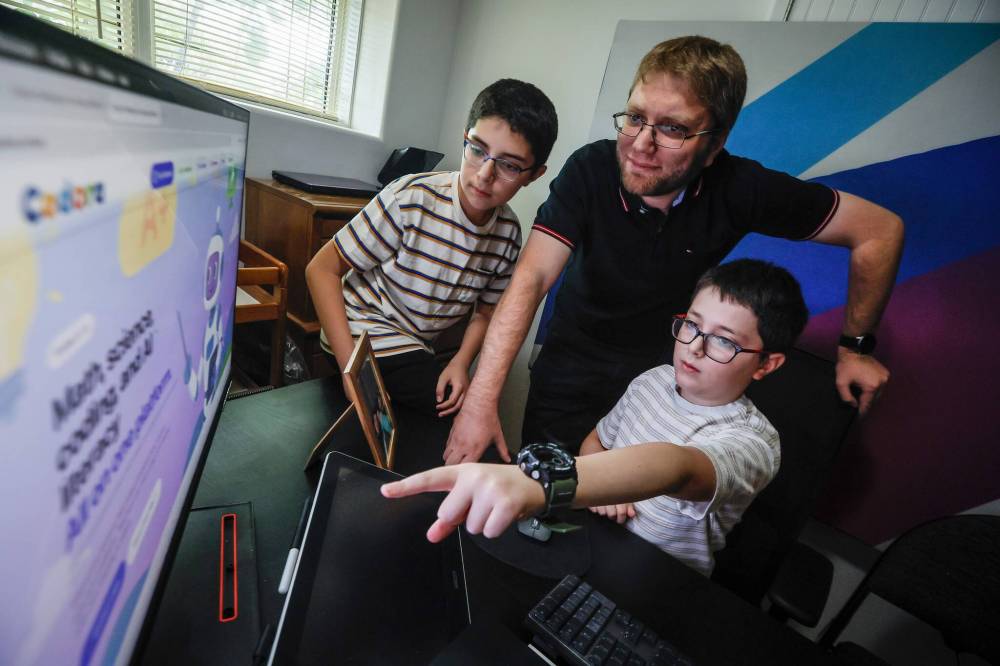
Mohamad Alhamoud gets feedback from sons Khaled, 11, and Joud, 9, on his AI-literacy platform Codora.
The father of three has since turned his panic into motivation to help his kids and their classmates become digitally literate.
He spent the better part of the last two years developing interactive, kid-friendly lessons on AI literacy, coding and mathematics, and a platform to host them.
Codora (codora.school) is the solution to his parental concerns, as well as the product of extensive coding, consultation with teacher friends and “lots of late nights,” he said.
Alhamoud works full time as a software engineer at Amazon. He previously worked at the Manitoba Institute of Trades and Technology, where he built the post-secondary institute’s computer science program and honed his mentorship and training skills.
Drawing on his technological expertise, Alhamoud has created more than 170 interactive lessons related to AI literacy that kindergarten-to-Grade 12 teachers can adopt “with zero training or setup,” his website says.
Lessons investigate online privacy, verification and other big-picture concepts explained at an elementary student level. There are also sessions on how AI tools are trained, prompt-writing and this technology’s potential to improve accessibility and inclusion.
For senior years students, a five-part “essentials” course expands on fundamentals and complex ideas related to how AI can impact student development and the dangers of treating chatbots like humans.
The roughly two-hour-long program is a requirement for Grade 9 and 10 students registered at the University of Winnipeg Collegiate this fall.
Alhamoud is in talks with other school leaders to pilot his courses, but nothing has been finalized to date.
“Before we let a kid get behind the wheel of a car, they have to go through a whole training program and know how to drive safely,” said Nick Janzen, a geography and history teacher at Linden Christian School.
He said there should be a similar setup in place to protect and empower young people when it comes to using AI systems.
The high school teacher said he has taken inspiration from a beta version of Codora to create lessons.
One of Janzen’s strategies to prevent AI-related plagiarism is conducting final interviews with students about their projects.
“AI can provide them with a lot of answers, but we want them to be able to problem solve and think independently and be able to reason through things,” he said, adding that he’s a fan of how Alhamoud’s program emphasizes all of those things.
Alhamoud has sought advice from Canada Computing, an information technology services company in Winnipeg, to develop his AI courses.
He also called his two oldest children, who are entering Grade 5 and 7 this fall, his “little quality assurance testers.”
His eldest, Khaled, said “the fun part” of their dad’s course is looking at examples of AI misuse and how students should use it correctly.
His brother, Joud, said they read their dad’s lessons and took all of his quizzes to make sure there weren’t any problems.
“I used (to use) ChatGPT to give me the final answer, but now I use it to explain the question so I can figure it out on my own,” the middle child said.
Codora’s mandate includes helping students grasp why “AI can sound confident and still be wrong,” a concept also known as chatbot hallucinations.
New Brunswick announced in the spring its plans to introduce a comprehensive K-12 AI curriculum this fall.
“Learning with, through, about, and without AI helps build capable, thoughtful, and independent learners,” that province’s government says on its website.
New Brunswick’s stance is that all students should learn to use AI as a “thinking partner,” to generate ideas and explore how the technology works, as well as its ethical, societal and real-world implications.
Alhamoud and Janzen both endorsed the approach — as did Michael Holden, an assistant professor who researches AI’s impact on teacher evaluations at the U of W.
“We’re nearly four years into this… We cannot just keep trying to stick our heads in the sand and ignoring the problems that AI presents,” Holden said in reference to the onset of the technology boom that began with the public release of ChatGPT in November 2022.
The academic said he encourages all teachers to be extremely clear about when students can and cannot use AI, redesign lessons to be responsive to the technology and do not rely on detector software.
His advice to school leaders? Create local AI guidelines and protocols for “ethical refusal” so students and teachers are not forced to use these tools.

Less than a quarter of Manitoba’s 37 school divisions had publicly available AI guidelines at the end of June.
Holden is among the educators calling on the province to draw some “hard lines” for all schools.
“The risk (without them) is that you get a hodge-podge where everybody’s doing their own thing, where there’s no coherence from course to course to course,” the assistant professor said.
“That really threatens the value and the coherence of a student’s academic experience.”
maggie.macintosh@freepress.mb.ca
Maggie Macintosh
Education reporter
Maggie Macintosh reports on education for the Free Press. Originally from Hamilton, Ont., she first reported for the Free Press in 2017. Read more about Maggie.
Funding for the Free Press education reporter comes from the Government of Canada through the Local Journalism Initiative.
Every piece of reporting Maggie produces is reviewed by an editing team before it is posted online or published in print — part of the Free Press‘s tradition, since 1872, of producing reliable independent journalism. Read more about Free Press’s history and mandate, and learn how our newsroom operates.
Our newsroom depends on a growing audience of readers to power our journalism. If you are not a paid reader, please consider becoming a subscriber.
Our newsroom depends on its audience of readers to power our journalism. Thank you for your support.
Maggie Macintosh
Education reporter
Maggie Macintosh reports on education for the Free Press. Originally from Hamilton, Ont., she first reported for the Free Press in 2017. Read more about Maggie.
Funding for the Free Press education reporter comes from the Government of Canada through the Local Journalism Initiative.
Every piece of reporting Maggie produces is reviewed by an editing team before it is posted online or published in print — part of the Free Press‘s tradition, since 1872, of producing reliable independent journalism. Read more about Free Press’s history and mandate, and learn how our newsroom operates.
Our newsroom depends on a growing audience of readers to power our journalism. If you are not a paid reader, please consider becoming a subscriber.
Our newsroom depends on its audience of readers to power our journalism. Thank you for your support.
Advertisement Advertise With Us
Advertisement Advertise With Us