Moral anxiety
Drama of ‘Satanic Panic’ of 1980s and ’90s linked with modern themes in deft adult debut
Advertisement
Read this article for free:
or
Already have an account? Log in here »
To continue reading, please subscribe:

Digital Subscription
One year of digital access for only $205*
- Enjoy unlimited reading on winnipegfreepress.com
- Read the E-Edition, our digital replica newspaper
- Access News Break, our award-winning app
- Play interactive puzzles
*First annual payment billed as $205.00 + GST for one year. This annual subscription will automatically renew at $233.00 + GST every 52 weeks (10% off the regular annual price of $259.35). Offer available to new and qualified returning subscribers only. Cancel any time.
To continue reading, please subscribe:
Add Free Press access to your Brandon Sun subscription for only an additional
$1 for the first 4 weeks*
- Enjoy unlimited reading on winnipegfreepress.com
- Read the E-Edition, our digital replica newspaper
- Access News Break, our award-winning app
- Play interactive puzzles
*Your next Brandon Sun subscription payment will increase by $1.00 and you will be charged $17.95 plus GST for four weeks. After four weeks, your payment will increase to $24.95 plus GST every four weeks.
Read unlimited articles for free today:
or
Already have an account? Log in here »
Hey there, time traveller!
This article was published 30/03/2024 (924 days ago), so information in it may no longer be current.
Graphic novelist and young adult author Maggie Thrash has chosen a doozy of a topic for her first novel aimed at adult readers. In Rainbow Black, Thrash digs deep into the trauma and emotional damage inflicted by the sensationalized and frenzied trials of the ‘Satanic Panic’ of the 1980s and ‘90s.
In New Hampshire during the summer of 1990, Lacey Bond’s parents are arrested on suspicion of having abused the children in their home daycare. Lacey and her older sister Éclair must fend largely for themselves while their parents are in jail awaiting trial. They manage to hire a fast-talking lawyer who believes in the parents’ innocence and that the locals in town have gotten swept up in the hysteria of the Satanic Panic. Day-to-day life for Lacey gets more difficult as she becomes known as the Satanist girl. Deep into the trial, further tragedy strikes and Lacey flees New Hampshire to help her only friend who is now in Vermont.
Twenty years later, Lacey has been living under a new name in Montreal, but details from around the time of her parents’ trial reemerge and she is thrust back into the spotlight, with New Hampshire authorities dead set on extraditing her back to the U.S. The novel’s plot is jam-packed and moves quickly but never feels forced. It is a testament to Thrash’s writing that she manages to keep such an expansive and high-stakes plot which takes place over decades under such tight control.

Supplied photo
Maggie Thrash manages to keep an expansive, high-stakes plot under tight control.
While the trial of Lacey’s parents has some sordid details of what has supposedly been done to children, the novel is not concerned with gore or horror, but rather the emotional destruction wrought by the moral panic which swept through the ‘80s and ‘90s. Thrash mentions the most famous Satanic Panic case, the McMartin trial, which was the most expensive trial in U.S. history (all accused were acquitted, though the damage to their lives had been done). Through Lacey, Thrash considers the perspective of someone not caught up in the panic, but rather an innocent victim of it — someone who has done nothing wrong but whose life is irrevocably upended.
A possible risk of centring a novel on such large social constructs would be everything feeling quite impersonal, but Thrash illustrates how those institutions exert pressure on particular characters and what it does to their lives, their emotions and their motivations. Lacey is failed by all the adults in her life who should be able to protect her, particularly by the men in positions of some kind of authority. While the adult Lacey is indeed a flawed and difficult woman, she is a product of these larger pressures.
Thrash also aptly contends with the cyclical nature of such moral panics; years after the Satanic Panic we are now seeing a mind-bogglingly similar tale of sordid underground Satanism from QAnon and Pizzagate.
Seemingly apart from the moral panic of Satanism, society’s dehumanizing of Lacey also extends to her queerness. In the Bonds’ trial, much is made of Lacey being a lesbian and whether that is a symptom of her parents’ abuse. When Lacey is sucked back into the details of the trial years later while living in Montreal, same-sex marriage has just been legalized in Canada.
Further still to our own present moment, there is another moral panic around access to health care and basic recognition for trans youth. While these may seem unrelated topics, Thrash deftly connects the threads which intertwine these larger cultural frenzies and that do real damage to particular people. It’s a scapegoat function that society likes to pretend we no longer require and yet it rears its head every few years in predictable cycles.
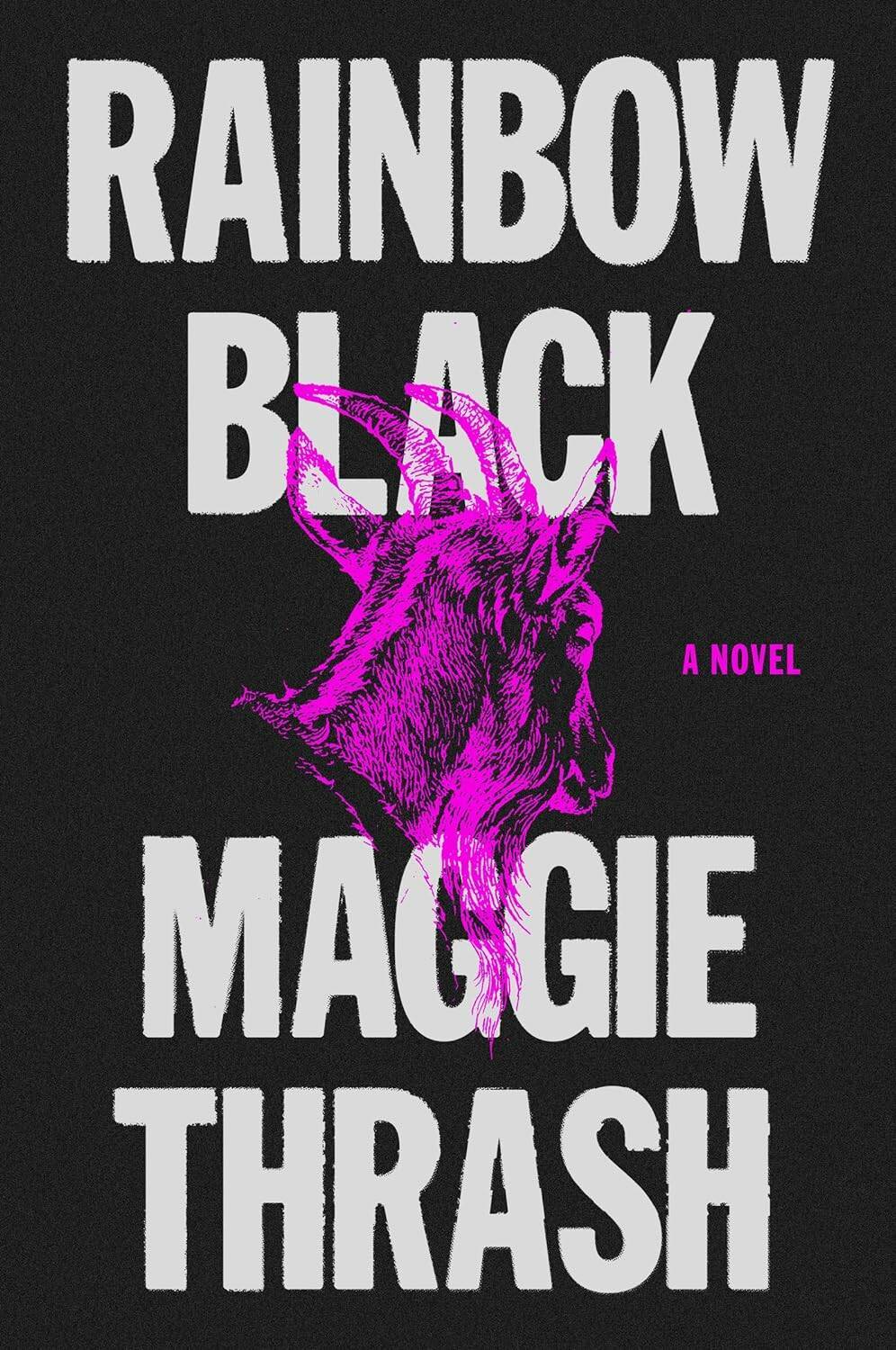
Rainbow Black
An impressively fast-paced and tightly controlled narrative with endearingly flawed characters set during one of the more intriguing if baffling moments of recent history, anyone interested in the Satanic Panic or courtroom drama will enjoy this one.
Keith Cadieux is a Winnipeg writer and editor. Most recently he co-edited the horror anthology What Draws Us Near, published by Little Ghosts Books, and a short story collection is forthcoming from At Bay Press.