Awe and dread: How religions have responded to total solar eclipses over the centuries
Advertisement
Read this article for free:
or
Already have an account? Log in here »
To continue reading, please subscribe:

Digital Subscription
One year of digital access for only $205*
- Enjoy unlimited reading on winnipegfreepress.com
- Read the E-Edition, our digital replica newspaper
- Access News Break, our award-winning app
- Play interactive puzzles
*First annual payment billed as $205.00 + GST for one year. This annual subscription will automatically renew at $233.00 + GST every 52 weeks (10% off the regular annual price of $259.35). Offer available to new and qualified returning subscribers only. Cancel any time.
To continue reading, please subscribe:
Add Free Press access to your Brandon Sun subscription for only an additional
$1 for the first 4 weeks*
- Enjoy unlimited reading on winnipegfreepress.com
- Read the E-Edition, our digital replica newspaper
- Access News Break, our award-winning app
- Play interactive puzzles
*Your next Brandon Sun subscription payment will increase by $1.00 and you will be charged $17.95 plus GST for four weeks. After four weeks, your payment will increase to $24.95 plus GST every four weeks.
Read unlimited articles for free today:
or
Already have an account? Log in here »
Hey there, time traveller!
This article was published 04/04/2024 (900 days ago), so information in it may no longer be current.
Throughout history, solar eclipses have had profound impact on adherents of various religions around the world. They were viewed as messages from God or spiritual forces, inducing emotions ranging from dread to wonder.
Ahead of the total solar eclipse that will follow a long path over North America on Monday, here’s a look at how several of the world’s major religions have responded to such eclipses over the centuries and in modern times.
Buddhism:
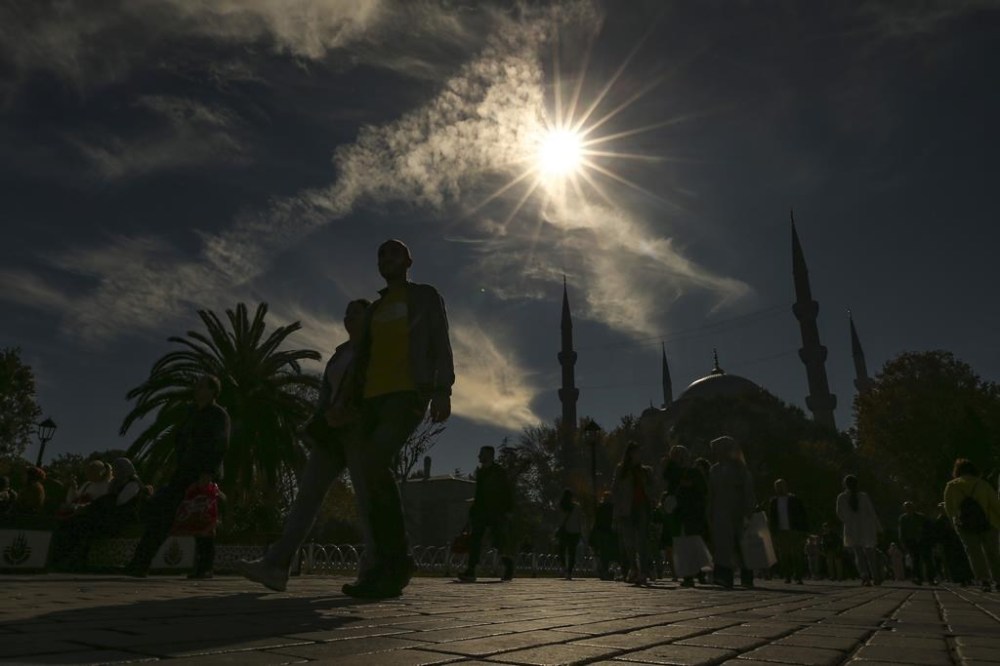
In the Tibetan Buddhist tradition, it is believed that the energy of positive and negative actions is multiplied during major astronomical events such as a solar eclipse.
According to the late Lama Zopa Rinpoche with the Foundation for the Preservation of the Mahayana Tradition, both lunar and solar eclipses are auspicious days for spiritual practice. He has said that the merit — which represents the positive karmic results of good intentions and actions — generated on lunar eclipses is multiplied by 700,000 and on solar eclipses by 100 million. Some of the recommended spiritual activities on these days include chanting mantras and sutras.
Christianity:
Some Christians have believed that an eclipse portends the coming of the “end times” that will precede Christ’s return to Earth as prophesized at various points in the Bible. One such passage is in the second chapter of Acts: “The sun will be turned to darkness and the moon to blood before the coming of the great and glorious day of the Lord.”
There also has been a persisting belief among some Christians that an eclipse occurred during the crucifixion because three of the Bible’s four Gospels mention a three-hour period of darkness as Jesus died.
“It was now about noon, and darkness came over the whole land until three in the afternoon, for the sun stopped shining,” says Luke 23:44.
It’s been noted that a three-hour period of darkness doesn’t suggest a solar eclipse, which produces only a few minutes of darkness.
But a recent commentary on ChurchLeaders.com — a website supported by numerous prominent evangelical pastors — said the darkness depicted in the three Gospels “represents a profound spiritual transition.”
“The temporary obscuring of the sun, juxtaposed with the ultimate sacrifice of Jesus, offers a powerful metaphor for the transient nature of despair and the eternal promise of salvation and rebirth,” the commentary says.
Hinduism:
The origin of eclipses in Hinduism is explained in ancient legends known as puranas. In one legend, the devas and asuras, who symbolized good and evil respectively, churned the ocean to receive the nectar of eternal life. As one of the asuras, Svarbhanu, posed as a deva to receive the nectar, the Sun god (Surya) and Moon god (Chandra) alerted Mohini, an incarnation of Lord Vishnu, who then used a discus to behead Svarbhanu.
But because the asura had already consumed a portion of the nectar, his immortal but detached head and body lived on under the names Rahu and Ketu. Legend has it that Rahu occasionally swallows the sun and the moon because of the gods’ part in his misery, causing solar and lunar eclipses.
Hindus generally regard a solar or lunar eclipse as a bad omen. Some observe fasts before and many do not eat during the period of the eclipse. Observant Hindus ritually bathe to cleanse themselves during the first and final phases of an eclipse. Some also offer prayers to ancestors. Most temples are closed for the duration of the eclipse. Devotees gather for prayers along pilgrimage sites near holy rivers during the onset of an eclipse. The event is considered to be a good time for prayer, meditation and chanting of mantras — all believed to ward off evil.
Islam:
In Islam, a solar eclipse is a time to turn to God and pray. The eclipse prayer is based on narrations of sayings and actions of Prophet Muhammad.
Kaiser Aslam, Muslim chaplain at the Center for Islamic Life at Rutgers University, said one narration cited the prophet as saying: “The sun and the moon are two signs amongst the signs of Allah and they do not eclipse because of the death of someone. … Whenever you see these eclipses pray and invoke (Allah).”
The story was that “after the death of the Prophet Muhammad’s son, Ibrahim, his companions tried to comfort him by saying that the sun eclipsed due to the greatness of the loss,” Aslam said. “The Prophet corrected them by reminding them that the sun and moon are signs of God and to not add any superstitions as to why an eclipse happens.”
On April 8, Aslam will lead the “kusuf” prayer on campus. Customarily, there’s a brief sermon after the prayer to explain the lessons behind it and dispel any superstitions around it, he added.
“It is a beautiful and meaningful prayer that emphasizes our relationship with God’s creation, making sure to give our devotion to God, instead of incidental occurrences in God’s creation,” Aslam said.
Mahmoud Alhawary, an official with Al-Azhar’s Islamic Research Academy in Cairo, said it’s better for the eclipse prayer to be performed in congregation at the mosque, but that Muslims may also pray individually elsewhere.
The wisdom “is for the individual to seek refuge in God, requesting the lifting of this affliction,” Alhawary said. “People should know that the occurrences of the whole universe are in God’s hands.”
Judaism:
The Talmud — the collection of writings compiled more than 1,500 years ago that constitute Jewish religious law — offers specific blessings for many natural phenomena, but not for eclipses. Instead, it depicts an eclipse as “an ill omen for the world.”
On Chabad.org — a website serving an Orthodox Jewish audience — Chicago-based Rabbi Menachem Posner sought to view the Talmud passage in a modern context, given the consensus that eclipses are natural events that can be predicted centuries in advance.
“Eclipses should be opportunities to increase in prayer and introspection — as opposed to prompting joyous blessings,” Posner wrote. “It is a sign that we really could and should be doing better.”
Writing in early March for the Orthodox Jewish education organization Aish, Rabbi Mordechai Becher noted that Judaism has longstanding interconnections with astronomy. He said there are three craters on the moon named after medieval rabbis with expertise in astronomy.
As for eclipses, Becher — an instructor at Yeshiva University — suggested they were made possible by God for a profound reason.

“He created a system that would remind us regularly that our choices can create darkness, even at times when there should be light,” he wrote. “Our free will choices can create a barrier between us and the Divine light, but can also allow Divine light to be seen here.”
___
Looking at a solar eclipse without glasses can be dangerous, here’s what to know.
___
Associated Press religion coverage receives support through the AP’s collaboration with The Conversation US, with funding from Lilly Endowment Inc. The AP is solely responsible for this content.

Advertisement Advertise With Us
Advertisement Advertise With Us
The Free Press acknowledges the financial support it receives from members of the city’s faith community, which makes our coverage of religion possible.