

Guyana condemns Venezuela for signing into law a referendum approving annexation of disputed region
Advertisement
Read this article for free:
or
Already have an account? Log in here »
To continue reading, please subscribe:

Digital Subscription
One year of digital access for only $205*
- Enjoy unlimited reading on winnipegfreepress.com
- Read the E-Edition, our digital replica newspaper
- Access News Break, our award-winning app
- Play interactive puzzles
*First annual payment billed as $205.00 + GST for one year. This annual subscription will automatically renew at $233.00 + GST every 52 weeks (10% off the regular annual price of $259.35). Offer available to new and qualified returning subscribers only. Cancel any time.
To continue reading, please subscribe:
Add Free Press access to your Brandon Sun subscription for only an additional
$1 for the first 4 weeks*
- Enjoy unlimited reading on winnipegfreepress.com
- Read the E-Edition, our digital replica newspaper
- Access News Break, our award-winning app
- Play interactive puzzles
*Your next Brandon Sun subscription payment will increase by $1.00 and you will be charged $17.95 plus GST for four weeks. After four weeks, your payment will increase to $24.95 plus GST every four weeks.
Read unlimited articles for free today:
or
Already have an account? Log in here »
Hey there, time traveller!
This article was published 04/04/2024 (920 days ago), so information in it may no longer be current.
GEORGETOWN, Guyana (AP) — Venezuelan President Nicolás Maduro’s move to sign into law the results of a recent referendum laying claim to two-thirds of Guyana triggered fierce condemnation Thursday from the neighboring South American country’s government.
The text of the law was not immediately made public. Even so, Guyana’s Ministry of Foreign Affairs vowed not to yield any land to Venezuela and called the move targeting Guyana’s western Essequibo region an “egregious violation of the most fundamental principles of international law.”
In early December, Maduro held a referendum to claim sovereignty over the oil- and mineral-rich region that represents two-thirds of Guyana, arguing it was stolen when the border was drawn more than a century ago. On Wednesday, Maduro held a signing ceremony recalling the referendum as a “stellar and historic moment.”
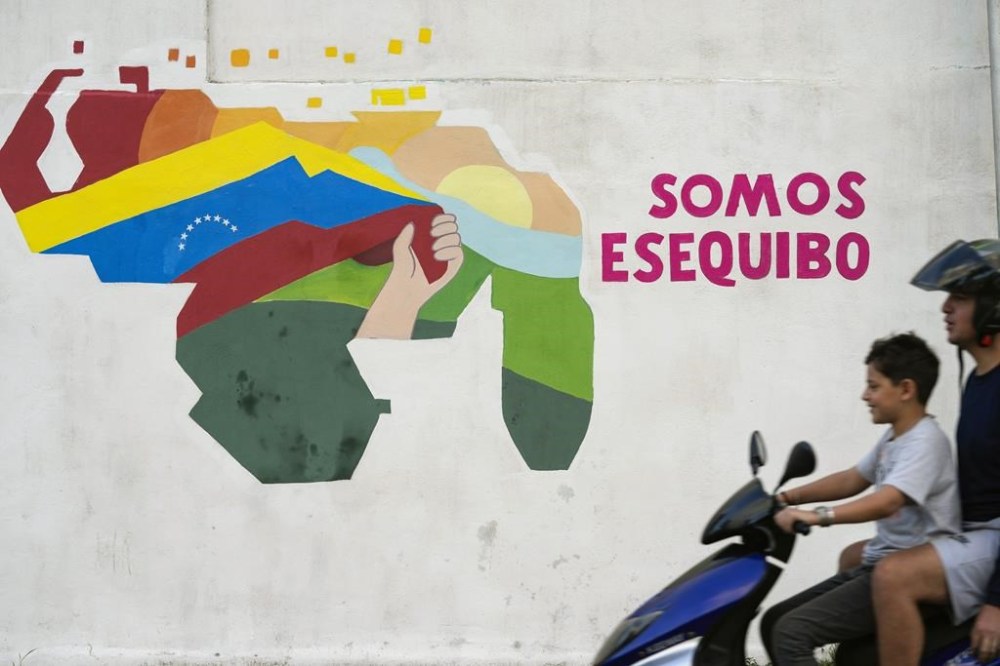
“The decision of December 3, has now become the Law of the Republic, to form part of the legal structure of the internal political and institutional movement of our country,” Maduro tweeted on Wednesday. “The decision made by the Venezuelans in the consultative referendum will be fulfilled in all its parts, and with this Law, we will continue the defense of Venezuela on international stages.”
Guyana’s government responded sharply hours later: “If Venezuela wants to contest title to the territory in question, the proper forum is the International Court of Justice.”
It’s not clear how Venezuelan authorities intend to implement the idea of exercising jurisdiction over Essequibo. Maduro said that until the dispute is resolved, the appointment of an Essequibo governor will remain in his hands and that the National Assembly will exercise legislative powers of the territory. He did not provide further details.
Guyana and Venezuela have been feuding over the region for decades, with tensions deepening after vast oil deposits were found near Guyana’s coast in 2015 in offshore areas intersecting the disputed territory.
In 2018, Guyana took the case to the United Nations’ highest court, asking judges to rule that an 1899 border decision is valid and binding. Meanwhile, Venezuela insists that a 1966 agreement nullified the original arbitration.
A court ruling is not expected before next year.
Meanwhile, Guyana is collaborating with the U.S., France and India to fortify its military in the event of any annexation attempts, President Irfaan Ali said recently. Guyana’s military also has stepped up recruitment exercises with advertisements on social media sites and visits to various regions around the country.
Satellite imagery has revealed that Venezuela’s military is amassing troops and expanding bases near the border it shares with Guyana.
The presidents of Guyana and Venezuela met in the eastern Caribbean island of St. Vincent in mid-December at the urging of regional leaders who have tried to diffuse the situation, but they failed to resolve the territorial dispute, agreeing only to not use threats or force against each other.
A second meeting between Ali and Maduro was supposed to been held last month, but not date has been scheduled.