Trump trial: Why can’t Americans see or hear what is going on inside the courtroom?
Advertisement
Read this article for free:
or
Already have an account? Log in here »
To continue reading, please subscribe:

Digital Subscription
One year of digital access for only $205*
- Enjoy unlimited reading on winnipegfreepress.com
- Read the E-Edition, our digital replica newspaper
- Access News Break, our award-winning app
- Play interactive puzzles
*First annual payment billed as $205.00 + GST for one year. This annual subscription will automatically renew at $233.00 + GST every 52 weeks (10% off the regular annual price of $259.35). Offer available to new and qualified returning subscribers only. Cancel any time.
To continue reading, please subscribe:
Add Free Press access to your Brandon Sun subscription for only an additional
$1 for the first 4 weeks*
- Enjoy unlimited reading on winnipegfreepress.com
- Read the E-Edition, our digital replica newspaper
- Access News Break, our award-winning app
- Play interactive puzzles
*Your next Brandon Sun subscription payment will increase by $1.00 and you will be charged $17.95 plus GST for four weeks. After four weeks, your payment will increase to $24.95 plus GST every four weeks.
Read unlimited articles for free today:
or
Already have an account? Log in here »
Hey there, time traveller!
This article was published 15/04/2024 (891 days ago), so information in it may no longer be current.
NEW YORK (AP) — It’s a moment in history — the first U.S. president facing criminal charges in an American courtroom. Yet only a handful of observers are able to see or even hear what is going on.
Instead, most of the nation is getting news of former President Donald Trump’s hush money trial secondhand. Starting with preliminary motions and jury selection Monday, reporters in a Manhattan courtroom must convey what is being said to the outside world after the fact.
That’s all because New York state law regarding media coverage of court proceedings is one of the most restrictive in the country. Last week’s death of O.J. Simpson, whose murder trial beamed live from a California courtroom captivated a nation three decades ago, was a telling reminder of how New York is behind the times — or, at least, a holdout.
WHY WON’T NEW YORK LET ME SEE IT?
Regulations limiting media coverage in courtrooms date back nearly a century, when the spectacle of bright flashbulbs and camera operators standing on witness tables during the 1935 trial of the man accused of kidnapping and killing Charles Lindbergh’s baby son horrified the legal community, according to a 2022 report by the New York-based Fund for Modern Courts.
Rules to enforce decorum spread nationally, amended to account for the invention of television, as defense lawyers worried that video coverage would harm their cases, the report said.
Yet an interest in open government chipped away at these laws and — slowly, carefully — video cameras began to be permitted in courts across the country, often at the discretion of judges presiding in individual cases.
New York allowed them, too, on an experimental basis between 1987 and 1997, but they were shut down. Lobbyists for defense lawyers remain strong in New York and hold particular sway among lawyers in the state Assembly, said Victor Kovner, a former New York City corporation counsel who advocates for open courtrooms.
New York and Louisiana are the only states remaining that completely restrict video coverage, the Fund for Modern Courts said.
To Kovner and others, that’s outrageous.
“We’re the media capital of the world, we like to think, and the fact that cameras aren’t permitted in one of our three branches of government is unacceptable,” said New York State Sen. Brad Hoylman-Sigal, who has sponsored a bill to try to change that.
“It’s one of the most consequential trials of our modern age,” the senator said. “I think the public has a right to see exactly what happens in that courtroom.”
At the trial’s outset, some reporters suggested that it appeared there were times that Trump drifted off to sleep while watching the proceedings. The former president’s campaign disputed that. With no video camera in place and trained on him, there’s no way of knowing for sure.
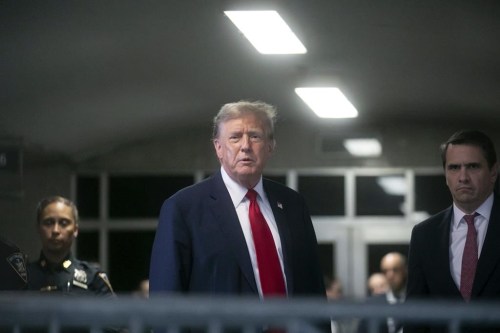
WAIT — I SAW A PICTURE OF TRUMP IN COURT AT THE TRIAL’S START
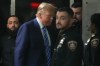
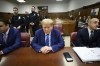
That’s because the presiding judge, Juan M. Merchan, permitted a handful of still photographers to shoot photos of Trump before the day’s proceedings started. Once court was called into session, courtroom sketch artists — a dying communications form — hold sway.
There is actually some video coverage of the trial, available on monitors in an overflow room adjacent to the main courtroom. It was packed Monday with reporters, court officers and a few members of the public, including Ron Sinibaldi, a former accountant from Long Island who lined up outside the courthouse before midnight for a seat.
“I read presidential biographies,” Sinibaldi said. “I go to presidential libraries. I’m here for the history.”
HOW CAN THOSE INVOLVED GET AROUND THE RESTRICTIONS?
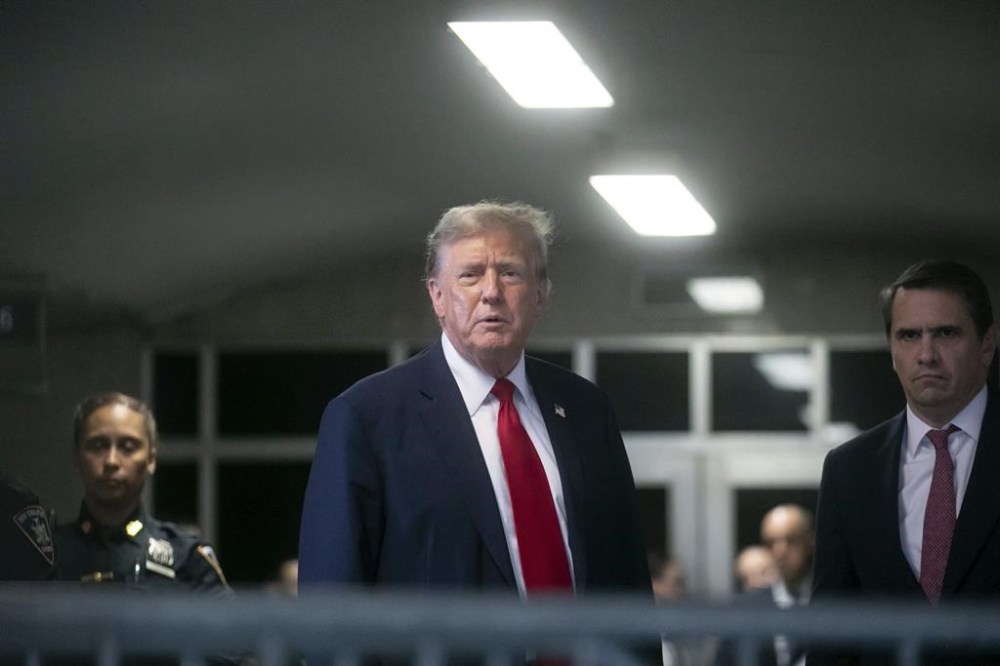
In a hallway outside of the courtroom, a limited number of cameras and a small pool of reporters are positioned to capture remarks of anyone involved in the trial who want to address the outside world. That included Trump, even before the proceedings started.
Absent live coverage of the trial, how often the former president chooses to take advantage of those cameras and whether news organizations carry his remarks either live, taped or not at all will play a big role in how the case is perceived publicly.
MSNBC carried his remarks live on Monday morning. “They’re trying to grab the narrative regardless of the outcome,” CNN reporter Phil Mattingly said of the Trump defense team.
HOW ARE JOURNALISTS COVERING THE TRIAL HANDLING IT?
With some difficulty. CNN stationed a team on the streets of Manhattan outside the courtroom, where a truck festooned with pro-Trump flags frequently drove by, blaring horns and music from loudspeakers. Reporters sometimes struggled to be heard. “It is kind of a circus down here,” CNN’s Kaitlan Collins said.
Commentators and experts, many of them with experience in jury selection, offered opinions from outside the courtroom or from studios. Fox News analyst Jonathan Turley said “most cities, at least those outside of New York,” will see the case as a weaponization of criminal justice.
With estimates that jury selection could take two weeks, and no way of showing it, journalists will have a lot of time to fill unless they turn their attention elsewhere.
WILL OTHER TRUMP CASES BE TELEVISED?
Georgia, where Trump faces charges of election meddling, gives judges discretion over whether to allow television cameras. Superior Court of Fulton County Judge Scott McAfee has said he will make all hearings and trials in that case available for broadcast. That has already included hearings on whether Fulton County District Attorney Fani Willis would be removed from the case.
Federal courts do not allow cameras in criminal cases. Trump is facing separate federal cases for election interference and mishandling classified documents, although it is not clear when, or if, trials will take place.

The feds offer one glimmer of hope: The U.S. Supreme Court permits audio of oral arguments to be broadcast outside of the courtroom. But there’s no indication that this would apply to Trump’s case. New York’s law does not allow audio coverage of his hush money trial.
Proponents of legislation to open up New York courts to electronic media coverage are hoping the attention paid to the Trump case may boost their proposals. The idea is being considered as part of current negotiations over the New York state budget so, theoretically, a new law could even affect the Trump trial if it is passed and goes into effect immediately.
Given New York state’s history, it’s best not to count on it.
___
Associated Press correspondent Jennifer Peltz and Jake Offenhartz in New York, and Anthony Izaguirre and Maysoon Khan in Albany, N.Y., contributed to this report. David Bauder writes about media for The Associated Press. Follow him at http://twitter.com/dbauder.
Related Articles
First 7 jurors are chosen for Trump's hush money criminal trial, with 11 more still needed
Advertisement Advertise With Us
Advertisement Advertise With Us