

Chinese foreign minister arrives in Cambodia, Beijing’s closest Southeast Asian ally
Advertisement
Read this article for free:
or
Already have an account? Log in here »
To continue reading, please subscribe:

Digital Subscription
One year of digital access for only $205*
- Enjoy unlimited reading on winnipegfreepress.com
- Read the E-Edition, our digital replica newspaper
- Access News Break, our award-winning app
- Play interactive puzzles
*First annual payment billed as $205.00 + GST for one year. This annual subscription will automatically renew at $233.00 + GST every 52 weeks (10% off the regular annual price of $259.35). Offer available to new and qualified returning subscribers only. Cancel any time.
To continue reading, please subscribe:
Add Free Press access to your Brandon Sun subscription for only an additional
$1 for the first 4 weeks*
- Enjoy unlimited reading on winnipegfreepress.com
- Read the E-Edition, our digital replica newspaper
- Access News Break, our award-winning app
- Play interactive puzzles
*Your next Brandon Sun subscription payment will increase by $1.00 and you will be charged $17.95 plus GST for four weeks. After four weeks, your payment will increase to $24.95 plus GST every four weeks.
Read unlimited articles for free today:
or
Already have an account? Log in here »
Hey there, time traveller!
This article was published 21/04/2024 (900 days ago), so information in it may no longer be current.
PHNOM PENH, Cambodia (AP) — Chinese Foreign Minister Wang Yi arrived in Cambodia on Sunday for a three-day official visit to reaffirm ties with Beijing’s closest ally in Southeast Asia. His visit is the last stop on a three-nation regional swing that also took him to Indonesia and Papua New Guinea.
He is visiting amid foreign concerns about two big Chinese-funded projects in Cambodia — a planned canal and a naval base — that critics allege could aid Beijing’s strategic military interests in Southeast Asia.
China is Cambodia’s most important ally and benefactor, with strong influence in its economy. That is illustrated by numerous Chinese-funded projects — particularly infrastructure, including airports and roads, but also private projects such as hotels, casinos and property development. More than 40% of Cambodia’s $10 billion in foreign debt is owed to China.
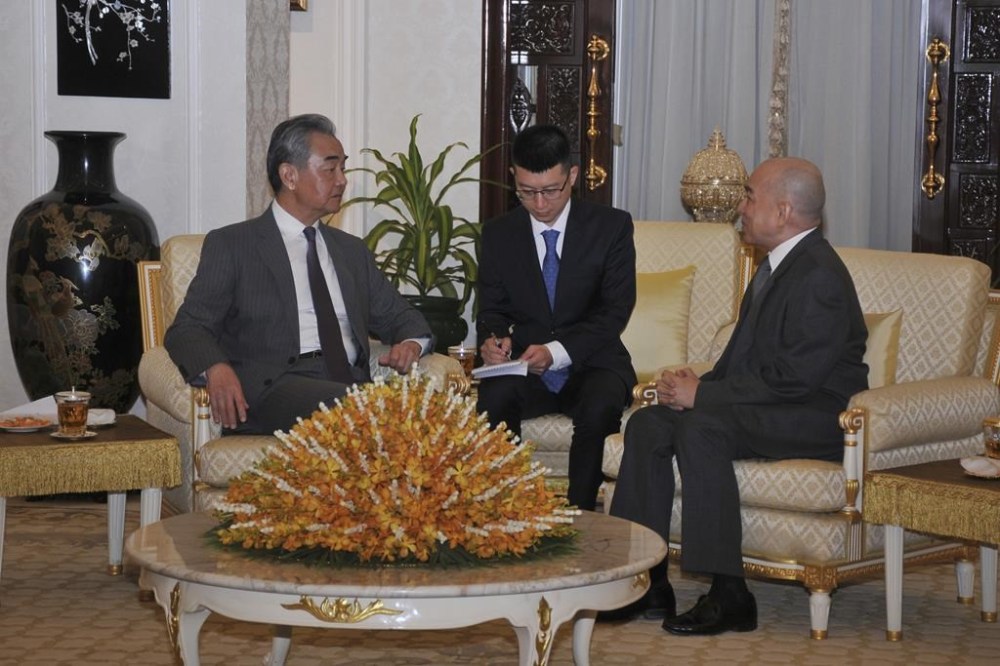
Wang is scheduled to have separate meetings with Prime Minister Hun Manet and his father, Hun Sen, now serving as president of the Senate after serving for 38 years as Cambodia’s head of government until he stepped down last year to be succeeded by his son. Wang was also granted a royal audience with King Norodom Sihamoni.
Hun Manet has shown no sign of deviating from his father’s pro-Beijing foreign policy. In August 2023, Wang visited Cambodia just days after Hun Sen announced he would step down as prime minister in favor of his eldest son.
Beijing’s support allows Cambodia to disregard Western concerns about its poor record on human and political rights, and in turn Cambodia generally supports Beijing’s positions on foreign policy issues such as its territorial claims in the South China Sea.
Cambodia has recently reiterated its determination to go ahead with the Chinese-financed 180-kilometer (112-mile) long, $1.7 billion Funan Techo Canal project across four provinces in the southern part of the country to connect the capital, Phnom Penh, to the Gulf of Thailand.
The plan has raised concern from neighboring Vietnam, where some scholars speculated the 100-meter (330-foot) -wide and 5.4 meter (18-foot) -deep canal could make it easier for China to send military forces southward, close to Vietnam’s southern coast. There are often frosty relations between Vietnam and its massive northern neighbor China, which aggressively claims maritime territory claimed by Hanoi and in 1979 staged a brief invasion.
The United States has also weighed in on the project, appealing for transparency on the part of Cambodia’s government. Wesley Holzer, a U.S. Embassy spokesperson in Phnom Penh, was quoted as telling the Voice of America that “the Cambodian people, along with people in neighboring countries and the broader region, would benefit from transparency on any major undertaking with potential implications for regional water management, agricultural sustainability, and security,”
Hun Manet, speaking Thursday to government officials and villagers in southern Takeo province, dismissed the Vietnamese concern and vowed to push forward with the project, which he said would provide a huge benefit to Cambodia.
China also is involved with another project causing foreign concern, its Ream Naval Base on the Gulf of Thailand , which the United States and some international security analysts say is destined to serve as a strategic outpost for Beijing’s navy.
The Ream base initially attracted attention in 2019 when The Wall Street Journal reported that an early draft of an agreement seen by U.S. officials would allow China 30 years’ use of the base, where it would be able to post military personnel, store weapons and berth warships.
Hun Sen in response repeatedly denied there was such an agreement, pointing out that Cambodia’s constitution does not allow foreign military bases to be established on its soil and declaring that visiting ships from all nations are welcome.
The base is situated on the Gulf of Thailand, adjacent to the South China Sea, where China has aggressively asserted its claim to virtually the entire strategic waterway. The U.S. has refused to recognize China’s sweeping claims and routinely conducts military maneuvers there to reinforce its status as international waters.
On Dec. 7, two Chinese naval vessels became the first ships to dock at a new pier at the base, coinciding with an official visit to Cambodia by China’s top defense official.