As the climate changes, so too do Canadians’ farm fields and dinner tables
Advertisement
Read this article for free:
or
Already have an account? Log in here »
To continue reading, please subscribe:
Digital Subscription
One year of digital access for only $1.44 a week*
- Enjoy unlimited reading on winnipegfreepress.com
- Read the E-Edition, our digital replica newspaper
- Access News Break, our award-winning app
- Play interactive puzzles
*Billed as $5.77 plus GST every four weeks. After 52 weeks, price increases to the regular rate of $19.95 plus GST every four weeks. Offer available to new and qualified returning subscribers only. Cancel any time.
To continue reading, please subscribe:
Add Free Press access to your Brandon Sun subscription for only an additional
$1 for the first 4 weeks*
- Enjoy unlimited reading on winnipegfreepress.com
- Read the E-Edition, our digital replica newspaper
- Access News Break, our award-winning app
- Play interactive puzzles
*Your next Brandon Sun subscription payment will increase by $1.00 and you will be charged $17.95 plus GST for four weeks. After four weeks, your payment will increase to $24.95 plus GST every four weeks.
Read unlimited articles for free today:
or
Already have an account? Log in here »
Hey there, time traveller!
This article was published 26/04/2024 (907 days ago), so information in it may no longer be current.
Canada’s farm fields are in the midst of a transformation.
As the country rapidly warms from human-caused climate change, farmers are being pushed to reconsider conventional wisdom about what can and can’t survive in this northern climate.
Crops are getting planted later in the year than ever as killer winter frost delays its arrival in Ontario. Berries in British Columbia devastated by recent climate-driven extreme heat and floods are moving into the controlled climates of vertical farms.
A spice commonly found in India is finding a new home in the Maritimes. Tropical fruits are springing from a greenhouse on the Prairies.
In fields and greenhouses, farmers are also seeding solutions to the generational challenge of climate change. Their success will not only bear on Canada’s agricultural sector, but its dinner table.
Here is a look at some of the ways climate change is changing Canadian agriculture:
Saffron finds a home in Nova Scotia
Saffron, a spice so expensive that it has been dubbed red gold, is traditionally grown in Iran, India, Afghanistan and Spain, among a handful of countries.
But when Matthew Roy moved from New Hampshire to begin farming in Nova Scotia in 2020, he identified saffron as a promising crop, in part because of the changing climate and saffron’s short growing season.
The owner of Coastal Grove Farm began planting the crocus bulbs that yield saffron on his property in Upper Port La Tour, N.S., that August. By mid-November, the 15,000 bulbs had yielded about 78 grams of the spice.
“We knew that it is going to be getting warmer here in Nova Scotia,” Roy said in an interview. “And we figured that we could bring in two new crops to the province, the first one being tea and the second one being saffron.”
In his second year, Roy harvested 172 grams of saffron. In 2022, it was 342 grams. But last year it fell to 66 grams, which Roy said could be because of a wet summer. One hundred grams of the spice fetches about $600, so Roy is not yet getting rich off saffron, but he is optimistic that production will increase.
Margaret Skinner, a research professor at the University of Vermont, studies the plant and has been working with Roy on his saffron farm. While warming temperatures make Nova Scotia more hospitable for saffron, other climate effects such as drought and flooding could be harmful, she said.
Bashir Ahmad Allie, head of the saffron research station at Sher-e-Kashmir University of Agricultural Sciences and Technology in India, is not surprised that parts of Canada are able to cultivate saffron, considering how climate is changing across the globe. The spice is now grown in parts of Nova Scotia, Quebec, Ontario and British Columbia.
Allie noted that the climate change that has made saffron cultivation viable in Canada has had the opposite effect in the regions of India where it is grown. Jammu and Kashmir in India has been experiencing erratic temperatures, floods, heat waves and snow, which have caused “havoc” for saffron producers in the region, he said.
– By Hina Alam in Fredericton.
___
As frost delays, Ontario canola farmers plant winter crop
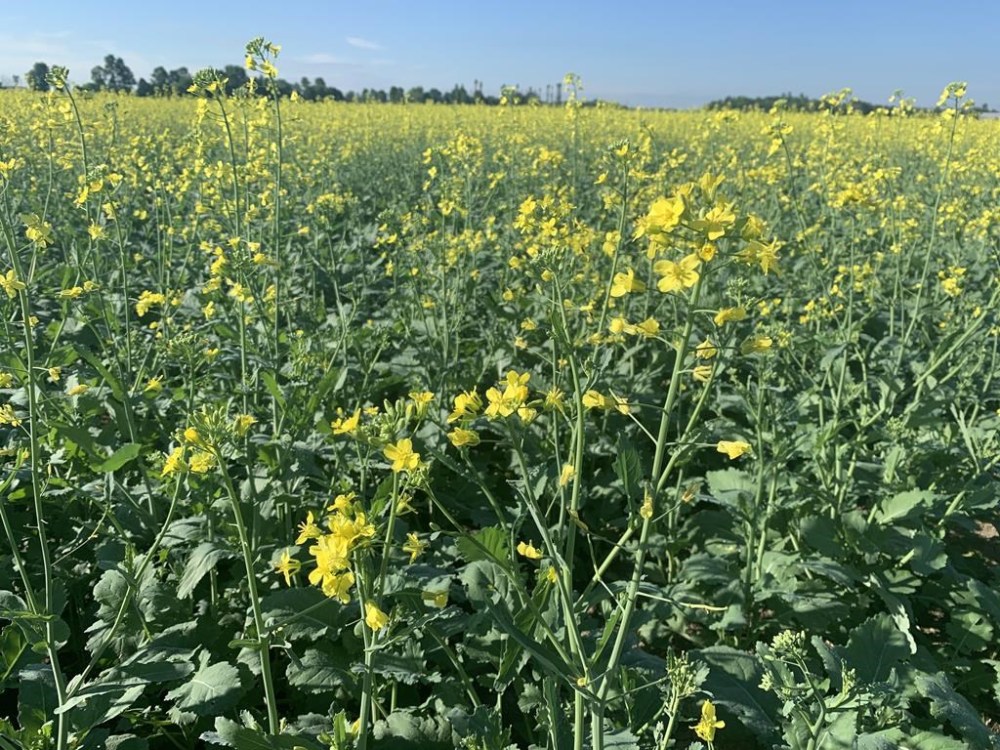
In Ontario, global warming has delayed the arrival of so-called “killing frost” and has allowed some farmers to explore new crops that can outlive the winter season.
Jennifer Doelman says on her farm in Renfrew County, located near the Ottawa River, she has been planting canola during the colder months, in addition to growing typical springtime canola.
“Winter canola was never something we could dream of,” says Doelman, who is also a bee-keeper.
“And we’re growing now, as a response to climate change, winter canola … because our killing frost isn’t happening until November.”
Doelman says the frost used to appear in October, when temperatures dropped below 0 C for several hours at a time and killed newly planted crops.
But she hasn’t seen the frost appear until November for the last three years.
Doelman says that delay has given farmers the opportunity to plant canola in September, immediately after the typical harvest season for spring canola. The winter crop is then able to grow strong enough to withstand the frost when it arrives in November.
“Even though they’re planted in September, they get big enough to be able to overwinter under the snow,” she says.
She says the winter canola is harvested in July and is used for canola oil and biodiesel.
“What’s left over once they crush it is really, really high-quality livestock feed,” she said.
Being able to grow crops during the winter season has helped with balance for farmers, who usually have a “mad dash” during the typical five-month summer and spring season to harvest in the fall, Doelman says.
A winter crop “spreads out your workload, it spreads out your risk,” she says.
– By Fakiha Baig in Toronto.
___
As farmers grapple with climate-driven weather extremes, berry crops shelter indoors
By the time fresh blueberries hit Canadian grocery shelves in the winter, they may already be a month old after coming from countries such as Mexico and Peru.
A team of researchers from Simon Fraser University aims to give consumers a fresh, sustainable, locally grown option with a project that demonstrates how blueberries can be grown indoors during the winter in British Columbia.
Biological sciences professor Jim Mattsson is leading the research. He says the berries grown in a tightly controlled indoor environment are fresher and taste better than their imported counterparts. The process uses less water, keeps pesticide use to a minimum, and the indoor crops boast a smaller carbon footprint, he adds.
Canada’s typical blueberry season runs from July to September, with consumers relying on imports for non-frozen berries throughout the winter.
In B.C., the industry has been grappling with climate-related challenges in recent years, including heat waves, cold snaps, and widespread flooding in 2021.
Mattsson says growing indoors avoids such stressors, while the temperature and light can be controlled to prevent the plants from entering dormancy each winter.
“It has been shown that you can get more than one harvest per year,” he says.” You can get, on the same plants, two harvests per year.”
The process is an example of “vertical farming,” where plants are positioned in rows on shelves stacked on top of each other, Mattsson says.
Water and nutrients may be recycled for further use, he says, and recent technological advancements allow the recycling of heat from LED lighting.
The researchers are currently working with B.C.-based agritech company BeriTech Inc. on the first round of growth trials. After that, Mattsson says they will compete for a $5-million grant to build a prototype facility and scale the project up.
The work also involves exploring how berries grown indoors in Canada can compete with imports from an economic perspective, he says.
Mattsson adds that BeriTech is interested in exploring how the research on blueberries could be applied to other crops, such as raspberries and blackberries.
– By Brenna Owen in Burnaby, B.C.
___
Saskatoon bananas? Greenhouse crop harvested in December
Dean Sopher says he’s pessimistic about the world’s future.
It’s why he bought land near Saskatoon and built his own homestead, growing crops and raising livestock to meet his family’s needs.
But Sopher isn’t gardening typical Prairie produce. He’s growing bananas, oranges, lemons, limes, passion fruit, guava and figs in a greenhouse he built.
“It’s real food, eating fresh,” Sopher said in an interview on his farm near Saskatchewan’s largest city.
Concerned about worsening food quality and inflation, Sopher says he built his greenhouse about three years ago and harvested his first banana crop in December. He says the roughly $60,000 greenhouse was designed to optimize the heat and light from the sun.
“Once you have the structure properly designed, insulated, and well built, you can grow pretty much anything here,” he said.
While Sopher has moved the needle on what can grow on the Prairies, researchers say it’s unlikely tropical fruits will sprout from open fields in the future as the climate changes.
However, they say farmers may instead grow other types of grains and legumes, such as corn and soybeans, in regions where that’s currently not feasible.
In a scientific literature review, researchers at the University of Alberta found the Prairies have become hotter and drier over the last 120 years. There has also been less snowfall and more disruptive weather, the researchers found.
While it could mean more corn and soy in some areas, higher temperatures may cause some pests to flourish and create additional challenges to producers.
Associate professor Emmanuel Mapfumo at Concordia University of Edmonton said farmers are resilient and will continue to adapt.
Some strategies include zero tillage, rotating crops, growing varieties that are drought resistant and changing seeding rates.
“There’s no one solution,” he said.
– By Jeremy Simes in Saskatoon.
___
This report by The Canadian Press was first published April 26, 2024.