
A wild orangutan used a medicinal plant to treat a wound, scientists say

Advertisement

Advertise with us

WASHINGTON (AP) — An orangutan appeared to treat a wound with medicine from a tropical plant— the latest example of how some animals attempt to soothe their own ills with remedies found in the wild, scientists reported Thursday.

Read this article for free:


or

Already have an account? Log in here »

To continue reading, please subscribe:

Subscribe and receive a limited-edition Free Press branded hat or tote.

Digital Subscription

One year of digital access for only $205*

  • Enjoy unlimited reading on winnipegfreepress.com
  • Read the E-Edition, our digital replica newspaper
  • Access News Break, our award-winning app
  • Play interactive puzzles

*First annual payment billed as $205.00 + GST for one year. This annual subscription will automatically renew at $233.00 + GST every 52 weeks (10% off the regular annual price of $259.35). Offer available to new and qualified returning subscribers only. Cancel any time.

To continue reading, please subscribe:

Add Free Press access to your Brandon Sun subscription for only an additional

$1 for the first 4 weeks*

  • Enjoy unlimited reading on winnipegfreepress.com
  • Read the E-Edition, our digital replica newspaper
  • Access News Break, our award-winning app
  • Play interactive puzzles
Start now

*Your next Brandon Sun subscription payment will increase by $1.00 and you will be charged $17.95 plus GST for four weeks. After four weeks, your payment will increase to $24.95 plus GST every four weeks.

Hey there, time traveller!
This article was published 02/05/2024 (894 days ago), so information in it may no longer be current.

WASHINGTON (AP) — An orangutan appeared to treat a wound with medicine from a tropical plant— the latest example of how some animals attempt to soothe their own ills with remedies found in the wild, scientists reported Thursday.

Scientists observed Rakus pluck and chew up leaves of a medicinal plant used by people throughout Southeast Asia to treat pain and inflammation. The adult male orangutan then used his fingers to apply the plant juices to an injury on the right cheek. Afterward, he pressed the chewed plant to cover the open wound like a makeshift bandage, according to a new study in Scientific Reports.

Previous research has documented several species of great apes foraging for medicines in forests to heal themselves, but scientists hadn’t yet seen an animal treat itself in this way.
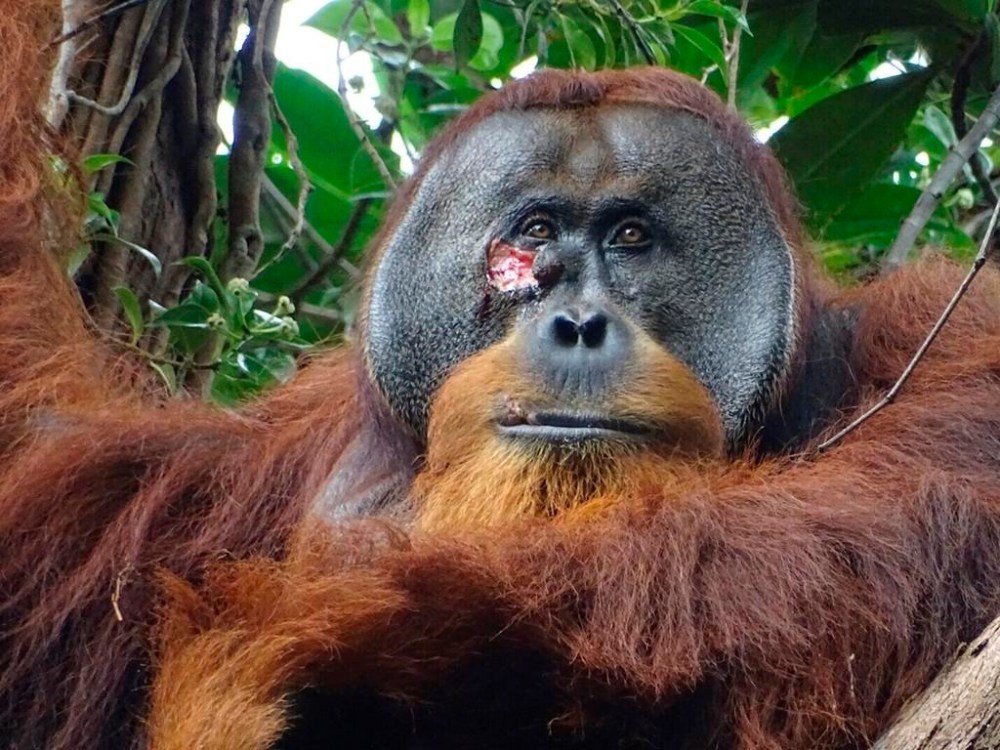
This photo provided by the Suaq foundation shows a facial wound on Rakus, a wild male Sumatran orangutan in Gunung Leuser National Park, Indonesia, on June 23, 2022, two days before he applied chewed leaves from a plant, used throughout Southeast Asia to treat pain and inflammation and to kill bacteria, to the wound. (Armas/Suaq foundation via AP)

“This is the first time that we have observed a wild animal applying a quite potent medicinal plant directly to a wound,” said co-author Isabelle Laumer, a biologist at the Max Planck Institute of Animal Behavior in Konstanz, Germany.

The orangutan’s intriguing behavior was recorded in 2022 by Ulil Azhari, a co-author and field researcher at the Suaq Project in Medan, Indonesia. Photographs show the animal’s wound closed within a month without any problems.

Scientists have been observing orangutans in Indonesia’s Gunung Leuser National Park since 1994, but they hadn’t previously seen this behavior.

“It’s a single observation,” said Emory University biologist Jacobus de Roode, who was not involved in the study. “But often we learn about new behaviors by starting with a single observation.”

“Very likely it’s self-medication,” said de Roode, adding that the orangutan applied the plant only to the wound and no other body part.

It’s possible Rakus learned the technique from other orangutans living outside the park and away from scientists’ daily scrutiny, said co-author Caroline Schuppli at Max Planck.

Rakus was born and lived as a juvenile outside the study area. Researchers believe the orangutan got hurt in a fight with another animal. It’s not known whether Rakus earlier treated other injuries.

Scientists have previously recorded other primates using plants to treat themselves.

This combination of photos provided by the Suaq foundation shows a facial wound on Rakus, a wild male Sumatran orangutan in Gunung Leuser National Park, Indonesia, on June 23, 2022, two days before he applied chewed leaves from a medicinal plant, left, and on Aug. 25, 2022, after his facial wound was barely visible. (Armas, Safruddin/Suaq foundation via AP)

Bornean orangutans rubbed themselves with juices from a medicinal plant, possibly to reduce body pains or chase away parasites.

Chimpanzees in multiple locations have been observed chewing on the shoots of bitter-tasting plants to soothe their stomachs. Gorillas, chimpanzees and bonobos swallow certain rough leaves whole to get rid of stomach parasites.

“If this behavior exists in some of our closest living relatives, what could that tell us about how medicine first evolved?” said Tara Stoinski, president and chief scientific officer of the nonprofit Dian Fossey Gorilla Fund, who had no role in the study.

___

The Associated Press Health and Science Department receives support from the Howard Hughes Medical Institute’s Science and Educational Media Group. The AP is solely responsible for all content.


Report Error Submit a Tip

More Stories

Manitoba e-scooter legislation changes set to impose speed limit, age restrictions, sidewalk ban

Matthew Frank 5 minute read Preview

Manitoba e-scooter legislation changes set to impose speed limit, age restrictions, sidewalk ban

Matthew Frank 5 minute read Sunday, Oct. 11, 2026

People riding e-scooters and other personal electric vehicles in Manitoba will have to strap on a helmet, stay off sidewalks and follow new age limits once new provincial rules for the devices take effect next year.

The vehicles, which also include electric skateboards, hoverboards and unicycles, will fall under The Highway Traffic Act starting in 2027, according to the province’s website. E-bikes are excluded from the new rules, according to the province’s frequently-asked-questions page.

All riders must be at least 16 years old and wear properly fitting helmets — that goes for passengers, too, the province said.

The proposed new legislation sets a speed limit of 25 km/h and would prohibit personal electric vehicles from sidewalks unless signs specifically allow sidewalk use. Riders would be using shared paths or roads with speed limits of 50 km/hr or less. They won’t be allowed to operate the vehicles under the influence of alcohol or drugs and they must use hand signals and obey traffic signs.

Read
Sunday, Oct. 11, 2026

Letters, Oct. 13

7 minute read Preview

Letters, Oct. 13

7 minute read Updated: 8:14 AM CDT

The major assumption Manitoba Hydro undertakes is the weather. Hydro projected a $214 million profit for the 2025-26 fiscal year. On Sept. 29, it reported a $446 million loss. It took on additional debt due to $751 million in operating losses. In addition, Hydro stated the fiscal results for 2025-26 were “significantly influenced by circumstances largely beyond Hydro’s control.”

Read
Updated: 8:14 AM CDT

A question of public utility

Tom Pearson 5 minute read 2:00 AM CDT

The editorial page of the Free Press often provides perspectives that are thought-provoking and sometimes contradictory. “Keeping the lights on,” (Oct. 5) by Hal Turner and “Wasteful operations should be held accountable,” (Oct. 6) by Barry Prentice are both thought-provoking. They are not contradictory because they cover two quite different topics. Where they differ is in their delivery and the quality of the underlying facts.

Mr. Turner provides what is, in my view, the most cogent rationale for gas-fuelled generation that I have read. He highlights the essential aspect of power supply to Manitobans. He supports the argument for natural gas generation with succinct, relatable facts and anecdotes relating to what other comparable utilities have done. He states that, “Manitoba Hydro’s experts are neither anti-wind nor pro-fossil fuel.” They are simply seeking the best possible solution for Manitobans — a fact many special-interest groups either ignore or sadly, impugn.

Although some would argue the contrary, I believe that Mr. Turner’s position and longevity in the Manitoba Hydro organization lend gravitas to his column. Mr. Turner understands that “keeping the lights on” is a non-negotiable requirement and a public trust.

Before I turn to Mr. Prentice’s column, I should disclose that before I retired (it’s been a while), I was responsible at different times for Winnipeg’s regional water system and subsequently water supply from source to tap. In that context I was also responsible for the operation of the Greater Winnipeg Water District (GWWD) railway. Like Mr. Turner’s perspective on the supply of electricity to Manitobans, I regard the supply of safe drinking water to Winnipeggers as a public trust.

Backstreet Boys extend Toronto residency to 11 nights

The Canadian Press 2 minute read Preview

Backstreet Boys extend Toronto residency to 11 nights

The Canadian Press 2 minute read Sunday, Oct. 11, 2026

TORONTO - Hit '90s boyband The Backstreet Boys are adding more tour dates to their Toronto residency.

What was first announced as a four-night run at Rogers Centre has swelled to 11 shows, with the band's recent announcement they're adding concerts on March 5 and 6.

The band says on its website the new dates were added "due to overwhelming demand."

Dubbed “Into the Millennium – Homecoming: Live in Canada,” the residency will kick off on Feb. 12.

Read
Sunday, Oct. 11, 2026

Creatures’ comfort key to coping with loss

Maureen Scurfield 4 minute read 2:00 AM CDT

DEAR MISS LONELYHEARTS: Not long ago I lost my husband to illness at far too young an age. My spouse was a great guy, but I do want another one.

I just want to pass on a little tip. When my husband was dying, he encouraged me to bring home warm and loving pets to our acreage just outside the city. They were my saviours when my husband was ill.

Since he has died, they continue to help me keep warm, happy and affectionate. They were my greatest comfort in the later stages when my man was in too much pain to hold me or be held. The cats and the dog would welcome me home from the hospital and transfer their cuddling to me, giving me all the attention I needed, and I always felt so loved.

I have been dating a fair bit for a fairly recent widow because I’m ready to be held and loved, and I feel my husband and the pets saying, “Way to go.”

Piece of magic history disappears

Kelly-Anne Riess 5 minute read Preview

Piece of magic history disappears

Kelly-Anne Riess 5 minute read Updated: Yesterday at 4:15 PM CDT

A piece of Winnipeg’s magic history has vanished, and internationally renowned escape artist Dean Gunnarson is offering a $500 reward to anyone who can make it reappear.

The plaque marked the birthplace of what has become the world’s largest organization of professional and amateur magicians, the International Brotherhood of Magicians, which was founded in Winnipeg more than a century ago.

Gunnarson said fellow magician and local magic historian Bruce Thompson discovered the disappearance Tuesday while on his way to work.

Thompson returned to inspect the site and found what appeared to be evidence it had been forcibly removed.

Read
Updated: Yesterday at 4:15 PM CDT

