

Hungary will vote against U.N. resolution commemorating the 1995 genocide in Bosnia, minister says
Advertisement
Read this article for free:
or
Already have an account? Log in here »
To continue reading, please subscribe:

Digital Subscription
One year of digital access for only $205*
- Enjoy unlimited reading on winnipegfreepress.com
- Read the E-Edition, our digital replica newspaper
- Access News Break, our award-winning app
- Play interactive puzzles
*First annual payment billed as $205.00 + GST for one year. This annual subscription will automatically renew at $233.00 + GST every 52 weeks (10% off the regular annual price of $259.35). Offer available to new and qualified returning subscribers only. Cancel any time.
To continue reading, please subscribe:
Add Free Press access to your Brandon Sun subscription for only an additional
$1 for the first 4 weeks*
- Enjoy unlimited reading on winnipegfreepress.com
- Read the E-Edition, our digital replica newspaper
- Access News Break, our award-winning app
- Play interactive puzzles
*Your next Brandon Sun subscription payment will increase by $1.00 and you will be charged $17.95 plus GST for four weeks. After four weeks, your payment will increase to $24.95 plus GST every four weeks.
Read unlimited articles for free today:
or
Already have an account? Log in here »
Hey there, time traveller!
This article was published 15/05/2024 (878 days ago), so information in it may no longer be current.
BUDAPEST, Hungary (AP) — Hungary will vote against a United Nations resolution commemorating the 1995 genocide of Bosnian Muslims at Srebrenica, the foreign minister said on Wednesday, arguing that it would inflame tensions in the Balkan country and the surrounding region.
Péter Szijjártó was hosting Bosnian Serb leader Milorad Dodik in the Hungarian capital of Budapest, where Szijjártó accused the U.N., as well as the high representative for Bosnia and Herzegovina, of taking steps to destabilize the country that was devastated in the 1992-1995 war.
During that conflict, more than 8,000 Bosniak Muslim men and boys were executed by Bosnian Serb troops in Srebrenica, an eastern Bosnian enclave. The victims’ remains were dumped in mass graves and later reburied to hide evidence of atrocities.
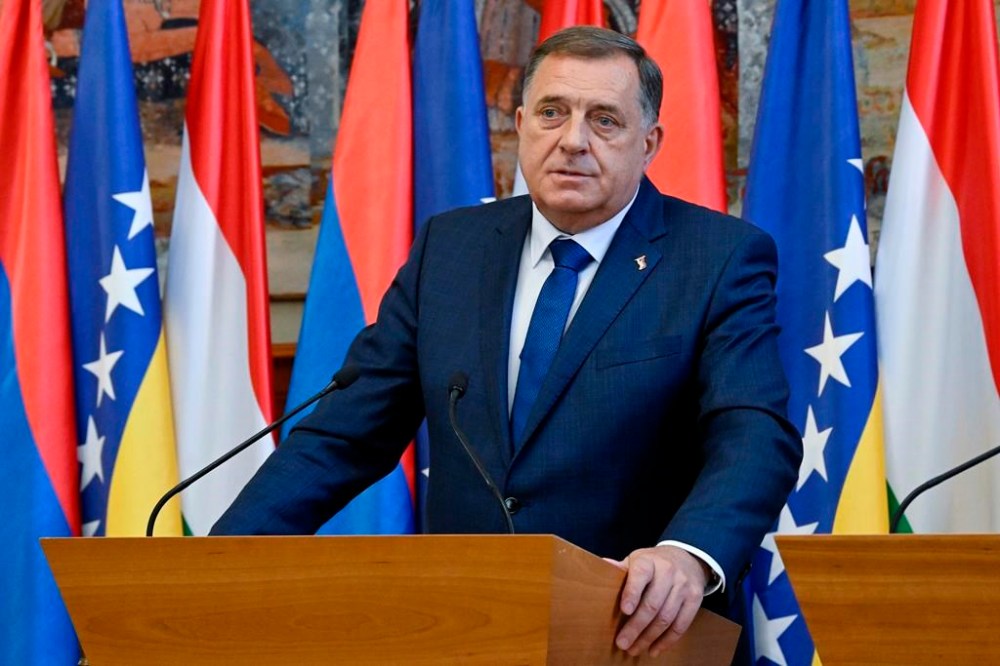
On Wednesday, Szijjártó said Hungary would vote against the planned U.N. resolution on the genocide — which he called the “Srebrenica tragedy” — because it “intentionally or unintentionally would demonize the entire Serbian nation.”
“We believe that international political actors should end the escalation of tensions in Bosnia and Herzegovina, end the threat of sanctions and end the violent interference in its internal affairs,” Szijjártó said.
The U.N. resolution is supported by Bosniak politicians in Bosnia along with a number of European countries and the United States. Proposed by Germany and Rwanda, it would designate 11 July as the “International Day of Reflection and Commemoration of the 1995 Genocide in Srebrenica.”
Bosnian Serbs and neighboring Serbia have strongly opposed it, saying it would brand the Serbs as a “genocidal nation.” The Serbs are supported by Russia and China.
International courts in The Hague, Netherlands, have branded the crime in Srebrenica a genocide, Europe’s first since World War II. Bosnian Serb top army officers and political leaders also have been convicted of genocide by U.N. judges.
Dodik, the Bosnian Serb separatist leader of the Serb-majority entity of Republika Srpska, has denied that the massacre in Srebrenica was a genocide. He was placed under U.S. sanctions in 2022 that accused him of “corrupt activities” that threaten to destabilize the region and undermine a U.S.-brokered peace accord from more than 25 years ago.
On Wednesday, Dodik said the Serbian side “does not dispute that a terrible crime took place in Srebrenica,” but that the U.N. resolution would “destabilize the situation in Bosnia and Herzegovina to the extent of completely paralyzing any possible relations.” He thanked Szijjártó for taking a position against it.
In a post on X on Wednesday, head of the Srebrenica Memorial Center Emir Suljagić called Hungary’s position “a deeply troubling stance that cannot be ignored.” He blamed the country’s nationalist prime minister, Viktor Orbán, for aligning Hungary “with forces of denial and revisionism, undermining international efforts to acknowledge and learn from this tragedy.”
“Orbán’s opposition to the resolution on Srebrenica can be seen as part of a broader pattern of rejecting international consensus on human rights issues,” Suljagić wrote. “By refusing to acknowledge the genocide, Hungary under Orbán is sending a dangerous message that historical truths can be conveniently ignored for political expediency.”