Study says aquaculture likely driving wild salmon extinction in Newfoundland

Advertisement

Advertise with us

ST. JOHN'S, N.L. - A new study shows an Atlantic salmon population in southern Newfoundland is disappearing, and it says nearby aquaculture operations are likely to blame.

Read this article for free:


or

Already have an account? Log in here »

To continue reading, please subscribe:

Subscribe and receive a limited-edition Free Press branded hat or tote.

Digital Subscription

One year of digital access for only $205*

  • Enjoy unlimited reading on winnipegfreepress.com
  • Read the E-Edition, our digital replica newspaper
  • Access News Break, our award-winning app
  • Play interactive puzzles

*First annual payment billed as $205.00 + GST for one year. This annual subscription will automatically renew at $233.00 + GST every 52 weeks (10% off the regular annual price of $259.35). Offer available to new and qualified returning subscribers only. Cancel any time.

To continue reading, please subscribe:

Add Free Press access to your Brandon Sun subscription for only an additional

$1 for the first 4 weeks*

  • Enjoy unlimited reading on winnipegfreepress.com
  • Read the E-Edition, our digital replica newspaper
  • Access News Break, our award-winning app
  • Play interactive puzzles
Start now

*Your next Brandon Sun subscription payment will increase by $1.00 and you will be charged $17.95 plus GST for four weeks. After four weeks, your payment will increase to $24.95 plus GST every four weeks.

Hey there, time traveller!
This article was published 15/05/2024 (878 days ago), so information in it may no longer be current.

ST. JOHN’S, N.L. – A new study shows an Atlantic salmon population in southern Newfoundland is disappearing, and it says nearby aquaculture operations are likely to blame.

The report published last month in the journal Reviews in Fisheries Science and Aquaculture concludes that though climate change and predation also have negative impacts, the effects of aquaculture operations near the Conne River are the most significant probable factor pushing the local wild salmon population toward extinction.

“These impacts will likely increase as populations decline toward local extirpation,” the study said.
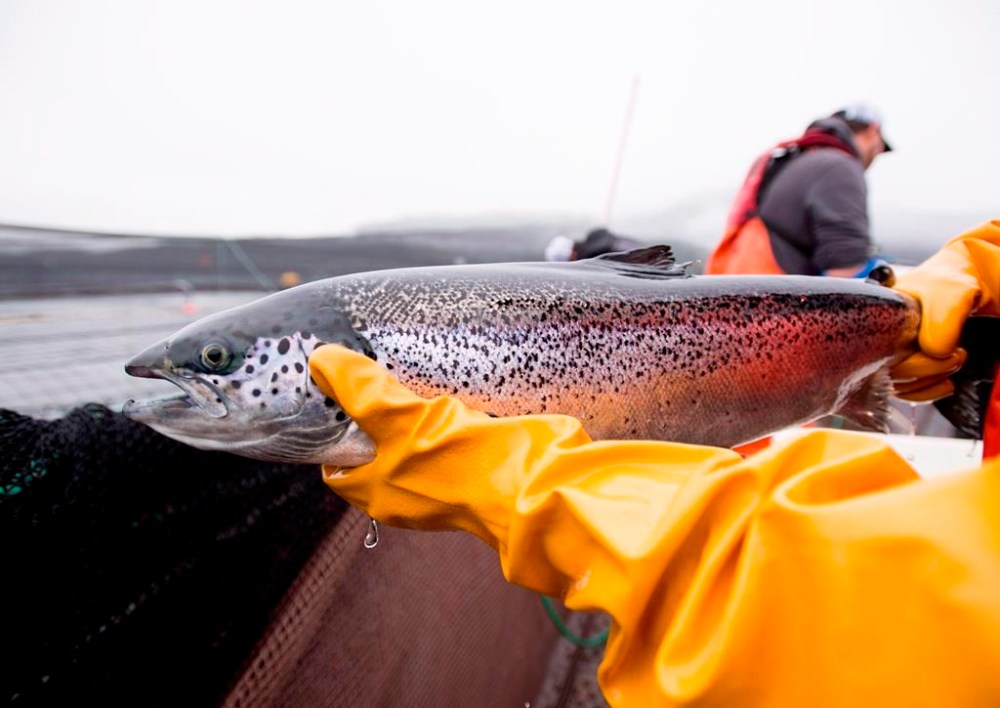
An Atlantic salmon is seen during a Department of Fisheries and Oceans fish health audit near Campbell River, B.C., on October 31, 2018. THE CANADIAN PRESS /Jonathan Hayward

The authors — eight researchers from the federal Fisheries Department — say that as Newfoundland and Labrador plans to expand its aquaculture industry, more studies are needed to determine how climate change, sea lice and disease will impact threatened or endangered wild salmon.

The Conne River feeds into the Bay d’Espoir, along Newfoundland’s south coast. Salmon farming in the Bay d’ Espoir began in the 1980s. The industry is often celebrated by the provincial government for restoring the economy in the remote area after the commercial cod fishery was shut down in 1992 because of species collapse.

The local wild salmon population shrank by 92 per cent between 1986 and 2022, according to figures in the report.

Conne River salmon was once an important food source for the Miawpukek First Nation, but it halted its food, social and ceremonial fisheries there in 1998 because of conservation concerns, the report said.

The study uses past reports and data, as well as input from scientists who regularly work in the area, to narrow down a list of more than a dozen possible contributors to the salmon’s demise. It then uses statistical modelling to determine which of those are most likely driving the decline.

Aquaculture comes out on top, with the report noting that there is ample documentation of wild salmon breeding with escaped farm salmon in the area. Offspring from such hybrids tend to be weaker and to carry genetic mutations that make it harder for the fish to survive. They’re also more likely to spread disease, the study said.

It notes that though there is little data on sea lice in the local wild salmon population, the spread of the tiny marine parasites from aquaculture operations has led to documented declines in wild salmon in Norway, Ireland and Scotland.

Neville Crabbe, with the Atlantic Salmon Federation, said the report provides conclusive evidence that aquaculture is harming wild salmon.

“It pushes the issue from correlation, where we have all of this evidence of declining populations in proximity to the salmon farms, and this is demonstrating direct causation, that those industrial installations are affecting wild salmon and causing very, very significant declines,” he said in an interview.

“It’s a study of one river in one place, but it can be extrapolated out to all of the other places where the industry is occurring in Atlantic Canada.”

Jamie Baker, executive director of the Newfoundland Aquaculture Industry Association, said in an email that the report is based on old data and contributes “nothing new in terms of actual research.”

“It’s an accepted fact that salmon populations across the Atlantic have been in decline for decades, well before salmon farming started,” Baker wrote. “The majority of rivers in Newfoundland and Labrador have seen concerning declines, and they’re nowhere near any farming activity.”

He said he believes climate change and warming oceans are the largest driver of those changes.

The study calls on fisheries managers, the local First Nation and the aquaculture industry to “actively pursue evidence-based research” to figure out how to protect the wild salmon, and to put those measures in place.

This report by The Canadian Press was first published May 15, 2024.

Report Error Submit a Tip

More Stories

Dog feces vandalism shuts down food pantry

Kelly-Anne Riess 4 minute read Preview

Dog feces vandalism shuts down food pantry

Kelly-Anne Riess 4 minute read Thursday, Oct. 8, 2026

A few shelves set up beneath a West End community notice board were meant to offer a place where neighbours could leave food for anyone who needed it.

Read
Thursday, Oct. 8, 2026

Police looking into robbery of children captured on video

Morgan Modjeski 3 minute read Preview

Police looking into robbery of children captured on video

Morgan Modjeski 3 minute read Yesterday at 3:08 PM CDT

The Winnipeg Police Service said it is aware of a video circulating online that appears to show two children robbed while walking home from the library.

The mother of the siblings said the Sept. 26 incident, which happened in the area of Andrews Street and Magnus Avenue at around 7:30 p.m., has left her children afraid and her feeling guilty.

“I should have been there with them. I felt horrible,” said Brittany Beaudet. “I would have been out the door if I knew any sooner to help them out.”

In the 40-second video, the two children, 14-year-old Mason and nine-year-old Kenzie, are approached by a man wearing a black shirt, black pants and white shoes.

Read
Yesterday at 3:08 PM CDT

Puppies, stocks — ‘zoomies’ abound

Andrew Froese 4 minute read 2:01 AM CDT

This spring, I adopted a three-month-old rescued German Shepherd mix. To say she is easily excitable is an understatement.

It is not really her fault. A puppy’s frontal cortex, the part of the brain that helps with decision-making and impulse control, is still developing. When an older dog, or a human, gets tired, we generally understand we should rest. Puppies have not quite figured that out. They often interpret tiredness as a signal something is wrong, which makes them more alert, more reactive and harder to settle.

That creates a feedback loop. The puppy gets tired, which makes her frantic, which makes her more tired, which makes her even more frantic. Eventually, this becomes what people call the “zoomies”: frantic sprinting, biting, jumping and general chaos.

From the outside, it looks like the puppy has too much energy. In reality, the opposite is true. The zoomies are not a sign of excess energy. They are a sign the puppy is overtired and does not know it yet.

Bit of creepy consultation could go a long way

Maureen Scurfield 5 minute read Yesterday at 2:01 AM CDT

DEAR MISS LONELYHEARTS: Halloween has always been my favourite time of year. I do my house up with lots of spooky lighting and characters on the lawn with eerie sounds booming out.

But last year I got seriously hassled by some people in the neighbourhood who thought it was too creepy. How do I get them on board this year? I don’t want to fight with them again.

— Want to Be Good Neighbour, River Heights

Dear Good Neighbour: Go to your close neighbours and explain what you want to do with your yard for Halloween this year, and also provide them with a firm time by which the celebrating will wrap up and things can quiet down.

Dozens of Uber, Lyft drivers switched to cheaper insurance coverage: MPI probe

Erik Pindera 5 minute read Preview

Dozens of Uber, Lyft drivers switched to cheaper insurance coverage: MPI probe

Erik Pindera 5 minute read Thursday, Oct. 8, 2026

Ride-service drivers have been defrauding Manitoba Public Insurance by improperly insuring their vehicles as for personal use.

The public insurer and the City of Winnipeg, which regulates ride-hailing services like Uber and Lyft, discovered the widespread fraud after MPI conducted a review in December last year.

“When a driver changes their coverage from ride-share insurance to a personal vehicle coverage and continues to operate as a ride-share driver, that is fraud, plain and simple,” said MPI chief executive officer Satvir Jatana at a news conference Thursday.

MPI’s review looked at a random sample of 408 ride-hailing vehicles and found 108 were operating without the proper vehicle-for-hire insurance coverage. In order to register with the city as a ride-service driver, a vehicle must have such insurance and proof must be provided to the ride-booking company.

Read
Thursday, Oct. 8, 2026

Protein crests current appetite wave

Laura Rance-Unger 5 minute read Preview

Protein crests current appetite wave

Laura Rance-Unger 5 minute read 2:01 AM CDT

Holiday feasts often reflect the latest fads and trends influencing how we eat.

This Thanksgiving’s table is likely to feature more Canadian content than it might otherwise as a point of national pride.

In the recent past, the carb-free craze has made cauliflower a substitute for the mashed potatoes on some family spreads. Some have gone meatless, while others have added more. Still others offer gluten-free, dairy-free or fat-free alternatives.

Nowadays, it seems consumers can’t get enough protein. Desmond Sobool, deputy chief economist Farm Credit Canada, told a recent economic update for the agri-food sector there are two converging influences in play.

Read
2:01 AM CDT