Tourism sector rolls out road map to boost visitor numbers to pre-pandemic levels

Advertisement

Advertise with us

The tourism industry hasrolled out a road map it hopes will bring more visitors to Canada after the bruising it took during the COVID-19 pandemic.

Read this article for free:


or

Already have an account? Log in here »

To continue reading, please subscribe:

Subscribe and receive a limited-edition Free Press branded hat or tote.

Digital Subscription

One year of digital access for only $205*

  • Enjoy unlimited reading on winnipegfreepress.com
  • Read the E-Edition, our digital replica newspaper
  • Access News Break, our award-winning app
  • Play interactive puzzles

*First annual payment billed as $205.00 + GST for one year. This annual subscription will automatically renew at $233.00 + GST every 52 weeks (10% off the regular annual price of $259.35). Offer available to new and qualified returning subscribers only. Cancel any time.

To continue reading, please subscribe:

Add Free Press access to your Brandon Sun subscription for only an additional

$1 for the first 4 weeks*

  • Enjoy unlimited reading on winnipegfreepress.com
  • Read the E-Edition, our digital replica newspaper
  • Access News Break, our award-winning app
  • Play interactive puzzles
Start now

*Your next Brandon Sun subscription payment will increase by $1.00 and you will be charged $17.95 plus GST for four weeks. After four weeks, your payment will increase to $24.95 plus GST every four weeks.

Hey there, time traveller!
This article was published 16/05/2024 (877 days ago), so information in it may no longer be current.

The tourism industry hasrolled out a road map it hopes will bring more visitors to Canada after the bruising it took during the COVID-19 pandemic.

At the country’s largest annual tourism convention being held in Edmonton, Destination Canada and the federal government unveiled a plan Thursday that aims to extend the travel season, increase the length of stays and attract more locals, foreigners and business people to a broader range of sites.

A warming planet means wildfires are warding off visitors and milder winters are wreaking havoc on ski resorts. But the hotter weather has also opened a way to draw travellers in the spring and fall that could fill hotels and tour buses into the shoulder seasons, Destination Canada CEO Marsha Walden said.

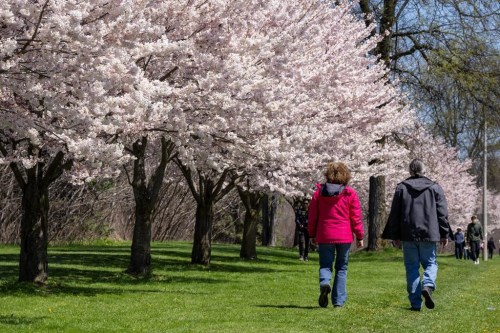
The tourism industry is rolling out a roadmap it hopes will guide more visitors to Canada after the bruising it took during the COVID-19 pandemic. People walk past flowering cherry trees in Centennial Park, in Toronto on Monday, April 22, 2024. THE CANADIAN PRESS/Frank Gunn

“We would love to retain our workforce longer into the season. And normally the product doesn’t need to be hugely adapted to take in a new season like fall and approaching into winter,” Walden said in an interview.

“We really need to lean heavily on expanding further into the shoulders.”

Building out attractions into year-round vacation spots is also an option, with resorts from Quebec’s Mont Tremblant to Ontario’s Blue Mountain showcasing how summer activities can lure visitors beyond the traditional ski crowd.

“When you think Whistler, what do you think — you think skiing, right? But Whistler in the summer, it’s also pretty amazing,” said Tourism Minister Soraya Martinez Ferrada in an interview.

Meanwhile, more drawn-out getaways would amount to millions more in the coffers of hospitality companies.

“Having people stay longer — having people spend more money — is just good for tourism for us in Canada,” she said. Marketing campaigns that focus on “getting travellers to say, ‘If you’re going to come, you’d better stay a couple days more, because Canada is big,’” comprise part of the plan.

The federal strategy also looks to promote a broader range of destinations, from Indigenous-owned projects to ecotourism spots off the beaten path.

Business trips continue to lag behind the return of leisure travel, a post-pandemic hangover the plan aims to address as well.

By 2030, the goal is to boost Canada’s spot in a World Economic Forum ranking on tourism development after the country slipped out of the top 10 for the first time in 2022.

Tourism has come roaring back from pandemic lows, but operators say the sector has yet to reach pre-COVID levels and debt remains a hefty burden for thousands of small businesses across the country.

International visitor numbers last year sat below figures from four years earlier, with tourists from the U.S. at 85 per cent of 2019 levels and those from further afield at 78 per cent, according to Destination Canada. However, nearly four out of every five dollars generated from tourism comes from a Canadian, Walden said.

The industry brought in more than $109 billion in revenue in 2023, about four per cent more than in 2019 but significantly less in real terms after accounting for inflation, according to the Tourism Industry Association of Canada.

Beth Potter, who heads the association, has called on the federal government to create a new low-interest loan program and temporary foreign worker stream, both specific to the tourism industry.

She said she has seen no signs of movement on those fronts in Ottawa.

Beating back Canada’s growing reputation as a country ablaze marks yet another challenge.

“People thought the whole country was on fire,” Martinez Ferrada said of last summer’s wildfire evacuations. “We made the New York Times front page.”

The minister highlighted a marketing campaign by British Columbia in the fall that made an “urgent appeal” to residents there and in Alberta and Washington to explore areas recently affected by wildfires.

Even a month of lost revenue can be “devastating,” added Walden.

The sector’s recovery continues to trail that of the broader business world.

The number of active tourism-linked businesses sat slightly below pre-pandemic levels as of December, while the number of businesses overall surpassed 2019 figures, data from Destination Canada showed.

Across all sectors, two in three small- and medium-sized enterprises still held pandemic debt at the end of last year, with an average of $107,700, according to a Canadian Federation of Independent Business survey of 3,148 members. Out of 14 sectors surveyed, operators in hospitality and transportation were among the most pessimistic about the coming year. Only retail scored worse.

This report by The Canadian Press was first published May 16, 2024.

Report Error Submit a Tip

More Stories

Phoneless concert a beautiful chance to bask in moment

Jen Zoratti 6 minute read Preview

Phoneless concert a beautiful chance to bask in moment

Jen Zoratti 6 minute read 2:01 AM CDT

Outside the Scotiabank Arena in Toronto, digital billboards flashed fans their singular photo op for the night: “I took this photo before I saw Phoebe Bridgers: The Lost Tour 2026.”

It is, as it is for so many other people, my only documentation of a concert by one of my favourite artists. The American singer-songwriter — who I discovered at the Winnipeg Folk Festival in 2018 — has had a meteoric rise in the past few years, winning three Grammys in 2024 as one third of Boygenius, the indie-rock supergroup rounded out by Lucy Dacus and Julien Baker, and opening for Taylor Swift on select dates of her titanic Eras Tour.

Now, Bridgers is touring in support of Lost Weekend, her third album and first since 2020’s Punisher. It’s a feat of a record, a richly textured meditation on loss and grief, written in the aftermath of the death of her dad, with whom she had a complicated relationship.

So she is in a position to not only play multiple sold-out arena shows, but also insist that those shows be phone-free.

Read
2:01 AM CDT

Alberta’s gopher museum closed until further notice as owners find new facility

Daniela Germano, The Canadian Press 3 minute read Preview

Alberta’s gopher museum closed until further notice as owners find new facility

Daniela Germano, The Canadian Press 3 minute read Updated: Yesterday at 12:54 PM CDT

A quirky Alberta roadside attraction that has delighted travellers for decades with its stuffed rodents in tiny costumes is closed until further notice.

The World Famous Gopher Hole Museum, located in Torrington, a hamlet about 120 kilometres north of Calgary, made the announcement online earlier this week.

Laural Kurta, museum director, said she was forced to close the doors because the two historical buildings that house the exhibits need to be replaced.

"We have done every patch repair, staple, spackle, everything we could possibly do, and it is just at its end," Kurta said in an interview Tuesday.

Read
Updated: Yesterday at 12:54 PM CDT

Police looking into robbery of children captured on video

Morgan Modjeski 3 minute read Preview

Police looking into robbery of children captured on video

Morgan Modjeski 3 minute read Yesterday at 3:08 PM CDT

The Winnipeg Police Service said it is aware of a video circulating online that appears to show two children robbed while walking home from the library.

The mother of the siblings said the Sept. 26 incident, which happened in the area of Andrews Street and Magnus Avenue at around 7:30 p.m., has left her children afraid and her feeling guilty.

“I should have been there with them. I felt horrible,” said Brittany Beaudet. “I would have been out the door if I knew any sooner to help them out.”

In the 40-second video, the two children, 14-year-old Mason and nine-year-old Kenzie, are approached by a man wearing a black shirt, black pants and white shoes.

Read
Yesterday at 3:08 PM CDT

Puppies, stocks — ‘zoomies’ abound

Andrew Froese 4 minute read 2:01 AM CDT

This spring, I adopted a three-month-old rescued German Shepherd mix. To say she is easily excitable is an understatement.

It is not really her fault. A puppy’s frontal cortex, the part of the brain that helps with decision-making and impulse control, is still developing. When an older dog, or a human, gets tired, we generally understand we should rest. Puppies have not quite figured that out. They often interpret tiredness as a signal something is wrong, which makes them more alert, more reactive and harder to settle.

That creates a feedback loop. The puppy gets tired, which makes her frantic, which makes her more tired, which makes her even more frantic. Eventually, this becomes what people call the “zoomies”: frantic sprinting, biting, jumping and general chaos.

From the outside, it looks like the puppy has too much energy. In reality, the opposite is true. The zoomies are not a sign of excess energy. They are a sign the puppy is overtired and does not know it yet.

Heated hiring debate over iced coffee

Tory McNally 7 minute read Preview

Heated hiring debate over iced coffee

Tory McNally 7 minute read 2:01 AM CDT

Apparently, we have found the latest battleground in the generational war over what constitutes professionalism: iced coffee.

Not wages. Not work-life balance. Not whether employees should answer emails after 5 p.m.

There has been quite a bit of discussion lately about whether it is appropriate for a job candidate to walk into an interview carrying an iced coffee. To some hiring managers, it is a clear sign of poor judgment, a lack of professionalism or an attitude that says, “This isn’t really a big deal.” To others, it is simply a person walking into a meeting with a drink they picked up on the way.

I have to admit, as an HR person, I can see both sides.

Read
2:01 AM CDT

Tourism sector rolls out road map to boost visitor numbers to pre-pandemic levels

Christopher Reynolds, The Canadian Press 4 minute read Preview

Tourism sector rolls out road map to boost visitor numbers to pre-pandemic levels

Christopher Reynolds, The Canadian Press 4 minute read Thursday, May. 16, 2024

The tourism industry hasrolled out a road map it hopes will bring more visitors to Canada after the bruising it took during the COVID-19 pandemic.

At the country’s largest annual tourism convention being held in Edmonton, Destination Canada and the federal government unveiled a plan Thursday that aims to extend the travel season, increase the length of stays and attract more locals, foreigners and business people to a broader range of sites.

A warming planet means wildfires are warding off visitors and milder winters are wreaking havoc on ski resorts. But the hotter weather has also opened a way to draw travellers in the spring and fall that could fill hotels and tour buses into the shoulder seasons, Destination Canada CEO Marsha Walden said.

“We would love to retain our workforce longer into the season. And normally the product doesn't need to be hugely adapted to take in a new season like fall and approaching into winter,” Walden said in an interview.

Read
Thursday, May. 16, 2024