Worship boosts mental health
Studies show the psychological benefits of religious practice

Advertisement
Read this article for free:
or
Already have an account? Log in here »
To continue reading, please subscribe:

Digital Subscription
One year of digital access for only $205*
- Enjoy unlimited reading on winnipegfreepress.com
- Read the E-Edition, our digital replica newspaper
- Access News Break, our award-winning app
- Play interactive puzzles
*First annual payment billed as $205.00 + GST for one year. This annual subscription will automatically renew at $233.00 + GST every 52 weeks (10% off the regular annual price of $259.35). Offer available to new and qualified returning subscribers only. Cancel any time.
To continue reading, please subscribe:
Add Free Press access to your Brandon Sun subscription for only an additional
$1 for the first 4 weeks*
- Enjoy unlimited reading on winnipegfreepress.com
- Read the E-Edition, our digital replica newspaper
- Access News Break, our award-winning app
- Play interactive puzzles
*Your next Brandon Sun subscription payment will increase by $1.00 and you will be charged $17.95 plus GST for four weeks. After four weeks, your payment will increase to $24.95 plus GST every four weeks.
Read unlimited articles for free today:
or
Already have an account? Log in here »
Hey there, time traveller!
This article was published 25/05/2024 (847 days ago), so information in it may no longer be current.
If religion is good for mental health, why don’t more people want to be part of churches, synagogues, mosques, temples and other places of worship? That’s what a friend asked me recently, in response to a column about the downturn in attendance at religious services.
Study after study shows that people who are part of worshipping communities tend to have better health, less depression and a more positive outlook on life.
For example, a Harvard Public Health study in 2024 found that regular weekly religious service attendance is associated with “lower mortality risk, lower depression, less suicide, better cardiovascular disease survival, better health behaviors, and greater marital stability, happiness, and purpose in life.”
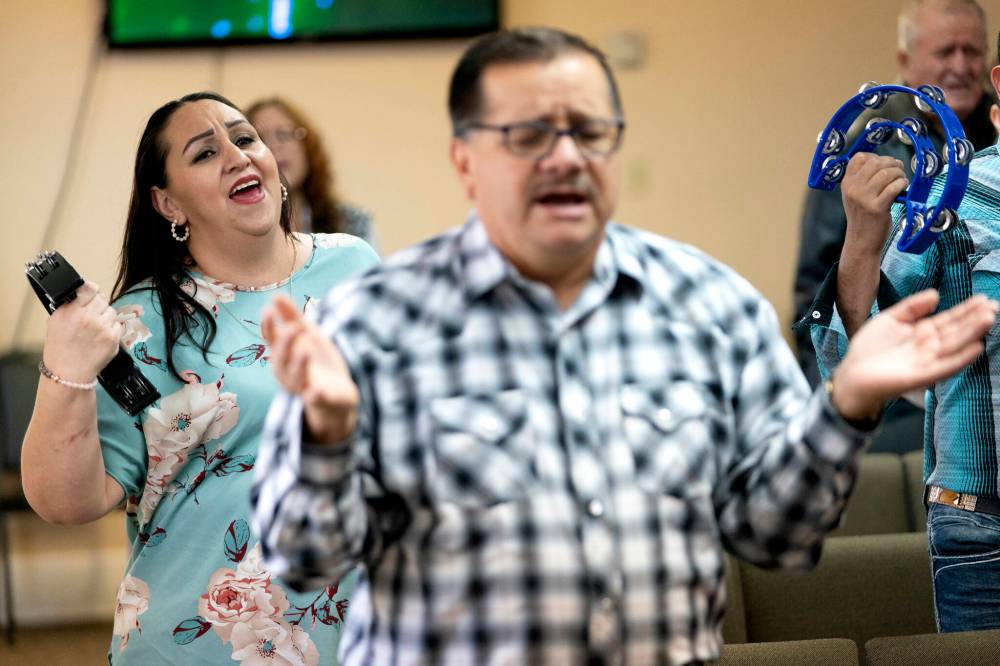
Guadalupe Rodriguez Pino, left, sings with members of her church’s congregation as as they worship during a church service, Sunday, Dec. 17, 2023, in Fort Morgan, Colo. Rodriguez and her husband, who have four U.S.-born children, are in the process of getting legal immigration status. (AP Photo/Julio Cortez)
A paper published by the Royal College of Psychiatrists in the U.K. in 2005 found positive correlations between religion and mental health, along with healthier lifestyles as a result of better diet and less alcohol and drug use.
Kenneth I. Pargamen is a leading expert in the psychology of religion and spirituality. In an article published in 2013 by the American Psychological Association, he noted that studies show that religion and spirituality are generally helpful when dealing with major life stressors such as natural disaster, illness, loss of loved ones, divorce and serious mental illness.
These positive religious coping methods include “spiritual support from God or a higher power, rituals to facilitate life transitions, spiritual forgiveness, support from a religious institution or clergy and reframing a stressful situation into a larger, more benevolent system of meaning,” he said.
In Canada, a 2020 study found that religiosity and spirituality are associated with an array of positive health outcomes and the absence of a variety of adverse mental health conditions — people who go to church regularly report being less depressed and having fewer feelings of psychological distress.
“People higher in religion and spirituality are more likely to psychologically flourish, while simultaneously avoiding psychological ailments,” the study concluded.
Another Canadian study in 2023 found that not only was religion and spirituality associated with positive mental health among all participants, but there also was a stronger relationship between it and positive mental health for older adults — something worth noting, as Canada ages.
Yet despite all this evidence for good mental and other health outcomes from being religious, Canadians are dropping out of religion. Hence my friend’s question. What’s up?
Some would point the finger at the media, which often only reports about the bad things that happen in organized religion — things like clergy sexual abuse, violence committed in the name of God, or the terrible historical abuses in church-run residential schools.
But some of the blame also falls to organized religious groups. Many do a poor job of sharing about the positive things they do. Only a few have professional communicators on staff who are skilled at passing those stories on to the media or sharing it on social media.
This all leads to what Ray Pennings, executive vice president of Cardus, a Canadian Christian think-tank, called a “public relations problem” for religious groups in this country.
Although these faith groups do a lot of positive things — hosting food banks, providing social service programs, hosting groups like Alcoholics Anonymous or sponsoring refugees and welcoming newcomers — that’s not what most Canadians see when they think about religion. For many, said Pennings, what they see when they think about religion is mostly negative.
To support that contention, he cited a 2023 Cardus survey that found that 31 per cent of non-religious Canadians saw the contribution of religion in Canada as more bad than good. Fifteen per cent saw it as very bad for society.

To counter this, Pennings recommended that religious groups get better at telling their stories beyond their own walls in ways that are authentic and that don’t just focus on leaders, doctrines and official statements.
At the same time, when bad news arises — as it inevitably will — they need to “be honest and transparent when dealing with it, not hiding from mistakes and challenges,” he said.
So what’s the answer to my friend’s question? Is it as simple as faith groups telling more positive stories? That would be a good start. It would be an important way to balance the negative stories that will always be told.
But maybe they could also do what most businesses do when they experience a downturn in sales — talk to their “customers,” the people in the pews and beyond, in this case, to find out what’s wrong and to ask what they need from faith groups today. That might provide some important clues for how to try to reverse the decline, too.
faith@freepress.mb.ca
The Free Press is committed to covering faith in Manitoba through our Religion in the News project. This reporting continues because readers like you step forward to fund it.
Donate now to support our reporting on religion.
Your donation is eligible for a charitable tax receipt.
BECOME A FAITH JOURNALISM SUPPORTER
Our newsroom depends on a growing audience of readers to power our journalism. If you are not a paid reader, please consider becoming a subscriber.
Our newsroom depends on its audience of readers to power our journalism. Thank you for your support.
The Free Press is committed to covering faith in Manitoba through our Religion in the News project. This reporting continues because readers like you step forward to fund it.
Donate now to support our reporting on religion.
Your donation is eligible for a charitable tax receipt.
BECOME A FAITH JOURNALISM SUPPORTER
Our newsroom depends on a growing audience of readers to power our journalism. If you are not a paid reader, please consider becoming a subscriber.
Our newsroom depends on its audience of readers to power our journalism. Thank you for your support.
Advertisement Advertise With Us
Advertisement Advertise With Us
The Free Press acknowledges the financial support it receives from members of the city’s faith community, which makes our coverage of religion possible.