Ottawa working on artificial intelligence strategy for the public service

Advertisement

Advertise with us

Ottawa is developing a new artificial intelligence strategy for federal government operations, Treasury Board President Anita Anand said Monday.

Read this article for free:


or

Already have an account? Log in here »

To continue reading, please subscribe:

Subscribe and receive a limited-edition Free Press branded hat or tote.

Digital Subscription

One year of digital access for only $205*

  • Enjoy unlimited reading on winnipegfreepress.com
  • Read the E-Edition, our digital replica newspaper
  • Access News Break, our award-winning app
  • Play interactive puzzles

*First annual payment billed as $205.00 + GST for one year. This annual subscription will automatically renew at $233.00 + GST every 52 weeks (10% off the regular annual price of $259.35). Offer available to new and qualified returning subscribers only. Cancel any time.

To continue reading, please subscribe:

Add Free Press access to your Brandon Sun subscription for only an additional

$1 for the first 4 weeks*

  • Enjoy unlimited reading on winnipegfreepress.com
  • Read the E-Edition, our digital replica newspaper
  • Access News Break, our award-winning app
  • Play interactive puzzles
Start now

*Your next Brandon Sun subscription payment will increase by $1.00 and you will be charged $17.95 plus GST for four weeks. After four weeks, your payment will increase to $24.95 plus GST every four weeks.

Hey there, time traveller!
This article was published 27/05/2024 (846 days ago), so information in it may no longer be current.

Ottawa is developing a new artificial intelligence strategy for federal government operations, Treasury Board President Anita Anand said Monday.

“It is a big step towards a cohesive and consistent federal approach to AI,” Anand said at a meeting of AI experts in Gatineau, Que., where the strategy is being discussed.

The intention is to make government operations more efficient and improve services for Canadians, while also improving capacity for science and research.

Anand said the question is about how to “add greater efficiencies but also simplify the interactions of the Canadian population and organizations and businesses with federal services.”

She said AI could be used to automate routine tasks, but said generative AI “isn’t generally going to be used” when it comes to confidential uses like those involving containing cabinet confidences.

The effort is not about reducing the number of jobs in the federal public service, she said.

The initiative will include setting up a specific division to retrain existing public servants. Anand said the government will also work on hiring “quickly and competitively” to bring in more top tech talent.

In addition to Monday’s meeting of experts, the government will consult broadly in the coming months before unveiling the strategy. There is no deadline for producing the strategy.

The federal government has already begun incorporating AI into its operations, using the technology in hundreds of different ways.

As the largest employer in Canada, the federal government sets an example for employers in the private sector, Anand said.

She said there is a need for balance when it comes to responsibly using AI, which includes ensuring that privacy laws are respected and that AI isn’t used for “discriminatory or unsavoury” purposes.

The announcement came as eight more private organizations signed on to a voluntary federal code of conduct for artificial intelligence, including Mastercard, Lenovo and the Quebec real-estate brokers’ association.

Adopters of the code launched last year must agree to undertake several measures aimed at reducing the risks of AI, including screening data sets for potential biases and monitoring systems for possible harms.

This report by The Canadian Press was first published May 27, 2024.
Report Error Submit a Tip

More Stories

A quick look at where provinces and territories stand on time changes

The Canadian Press 2 minute read Preview

A quick look at where provinces and territories stand on time changes

The Canadian Press 2 minute read Friday, Sep. 18, 2026

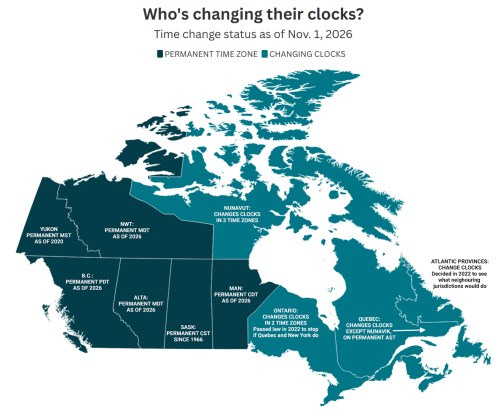
WINNIPEG - Manitoba's government said Thursday the province will be sticking with daylight time year-round, making it the latest jurisdiction to move away from twice-annual time changes. Here's a look at where things stand across Canada:

British Columbia said in March that it was moving to permanent Pacific daylight time. The change also means that parts of northeastern B.C., which have been on mountain standard time year round, are now in alignment with the rest of the province.

Alberta also switched to permanent daylight time this year in what it calls Alberta time. The change means it now has the same time as Saskatchewan year round.

Saskatchewan has been on permanent central standard time since 1966.

Read
Friday, Sep. 18, 2026

Today’s horoscope

Georgia Nicols 4 minute read Preview

Today’s horoscope

Georgia Nicols 4 minute read 2:00 AM CDT

MOON ALERT: There are no restrictions to shopping or important decisions today. The moon is in Capricorn.

ARIES (March 21-April 19)

Be aware that people notice you more than usual. In fact, some people will even know personal details about your private life. Consider this in case you have to do some damage control. This is a relaxed day and a chatty one.

TAURUS (April 20-May 20)

Read
2:00 AM CDT

New Jets show promise despite loss to experienced Oilers

Mike McIntyre 8 minute read Preview

New Jets show promise despite loss to experienced Oilers

Mike McIntyre 8 minute read Updated: 9:34 AM CDT

Preseason hockey games are always more about the process than the result, and that’s especially true when the opposing rosters appear to be a major mismatch on paper.

So a 5-2 loss by an inexperienced group of Winnipeg Jets skaters against a star-studded Edmonton Oilers squad on Saturday night in the Alberta capital was neither surprising nor alarming.

There was, however, plenty to like from the visitors’ perspective despite the outcome.

Let’s break it down.

Read
Updated: 9:34 AM CDT

Family account spiced with magic realism, geopolitical intrigue and a ghost story

Reviewed by Zilla Jones 4 minute read Preview

Family account spiced with magic realism, geopolitical intrigue and a ghost story

Reviewed by Zilla Jones 4 minute read Yesterday at 2:01 AM CDT

Tom Lin’s second novel Babylon, South Dakota moves beyond a historical account of an immigrant family’s struggle, delightfully blending and bending genres.

Lin is a Chinese-born novelist whose family emigrated to the U.S. when he was four years old. His debut novel, The Thousand Crimes of Ming Tsu, won the 2022 Andrew Carnegie Medal for Excellence in Fiction, making him the youngest ever recipient of that award. He earned a PhD in English from the University of California Davis and is currently an assistant professor of English and creative writing at the University of Iowa.

Babylon, South Dakota takes place in an unspecified time period that can be understood to be during the Mao era — likely the 1950s or ’60s. A young Chinese couple, the Hsuis, immigrate to the rural community that gives the book its title. They take the names Saul and Mei and settle on a 160-acre homestead left to them by a distant relative.

Saul’s dream is to breed and sell chrysanthemums from seeds he brought from China, while Mei wants to raise livestock. They speak no English, know nothing of life in the United States, are unprepared for the harshness of winter and the isolation of the farm and bring nothing with them except some gold, which Mei hides around the house for emergencies. Their only link to the outside world is a discarded and marginally functioning TV set, which Saul rescues and rigs up.

Read
Yesterday at 2:01 AM CDT

Steinbach Credit Union member warns others after scammer steals $10K

Scott Billeck 5 minute read Preview

Steinbach Credit Union member warns others after scammer steals $10K

Scott Billeck 5 minute read Friday, Sep. 18, 2026

A Winnipeg single mother whose bank account was drained of nearly $10,000 says Steinbach Credit Union needs to warn its members about what she believes is a broader security problem.

The woman, who is not being named to protect her identity, said a scammer gained access to her account earlier this week after calling SCU’s contact centre, claiming to be her and successfully completing the credit union’s authentication process.

She said she knows of at least six others who have experienced similar incidents in which callers impersonate SCU account holders and pass the authentication checks.

The woman discovered something was wrong when her minor son asked why money had been transferred out of an account they jointly hold.

Read
Friday, Sep. 18, 2026

Gillingham in lead with decided voters

Nicole Buffie 6 minute read Preview

Gillingham in lead with decided voters

Nicole Buffie 6 minute read Friday, Sep. 18, 2026

A cloud of uncertainty is hanging over Winnipeg as October’s municipal election nears.

Three months after a poll showed more than 40 per cent of Winnipeggers wanted to see someone other than current mayor Scott Gillingham elected, a new Abacus Data poll indicates more than half of Winnipeg voters are undecided heading into next month’s civic election.

Of decided voters, 55 per cent favour Gillingham compared to 23 per cent for former councillor and provincial cabinet minister Kevin Klein and 11 per cent for funeral director Mike Vogiatzakis.

Of all respondents, just over 50 per cent said they were unsure while 13 per cent said they will not vote.

Read
Friday, Sep. 18, 2026