What are leaking underground storage tanks and how are they being cleaned up?
Advertisement
Read this article for free:
or
Already have an account? Log in here »
To continue reading, please subscribe:

Digital Subscription
One year of digital access for only $205*
- Enjoy unlimited reading on winnipegfreepress.com
- Read the E-Edition, our digital replica newspaper
- Access News Break, our award-winning app
- Play interactive puzzles
*First annual payment billed as $205.00 + GST for one year. This annual subscription will automatically renew at $233.00 + GST every 52 weeks (10% off the regular annual price of $259.35). Offer available to new and qualified returning subscribers only. Cancel any time.
To continue reading, please subscribe:
Add Free Press access to your Brandon Sun subscription for only an additional
$1 for the first 4 weeks*
- Enjoy unlimited reading on winnipegfreepress.com
- Read the E-Edition, our digital replica newspaper
- Access News Break, our award-winning app
- Play interactive puzzles
*Your next Brandon Sun subscription payment will increase by $1.00 and you will be charged $17.95 plus GST for four weeks. After four weeks, your payment will increase to $24.95 plus GST every four weeks.
Read unlimited articles for free today:
or
Already have an account? Log in here »
Hey there, time traveller!
This article was published 29/05/2024 (867 days ago), so information in it may no longer be current.
For more than a decade, some residents of the tiny Richmond, Rhode Island, neighborhood of Canob Park drank and bathed using tap water that had been tainted by gasoline that leaked from storage tanks buried under service stations a few hundred yards from their homes. They spent years battling oil companies, dealing with the daily misery of boiling most of their water and wondering about lasting damage to themselves and their children.
The Canob Park disaster sparked a national outcry in the 1980s to clean up and regulate the thousands of underground tanks storing petroleum, heating oil and other hazardous chemicals across the United States. It’s a program that continues today, where the tanks are a leading cause of groundwater pollution even after more than a half-million sites have been cleaned up.
___
EDITOR’S NOTE: This article is a collaboration between The Associated Press and The Uproot Project.
___
Nearly half of Americans depend on groundwater for their drinking water, according to the Environmental Protection Agency, and it’s not just well water that is threatened. A city’s water supply, while treated and processed to make sure it meets federal standards, may still collect contaminants from gas leaks on its way to the tap. In some cases, this can happen when the water originates from an unregulated well — some cities get their drinking water from a mix of surface and groundwater — or through cracked pipes.
For privately owned wells, which aren’t regulated by the government, the homeowner has the responsibility to treat and filter the water.
HOW LEAKS HAPPEN
Environmental experts say even a pinprick-size hole in an underground tank can send 400 gallons of fuel a year into the ground, polluting soil and water. Spills can also destroy habitat and kill wildlife. Roughly 81 million people live within a quarter-mile of an underground storage tank that’s experienced at least one leak, based on the latest EPA data.
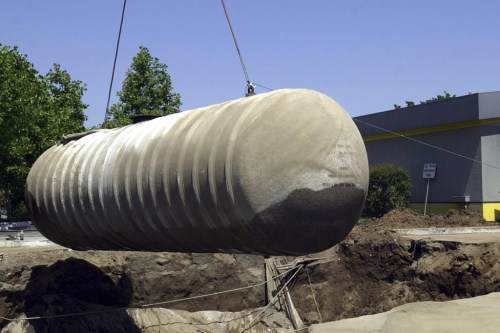
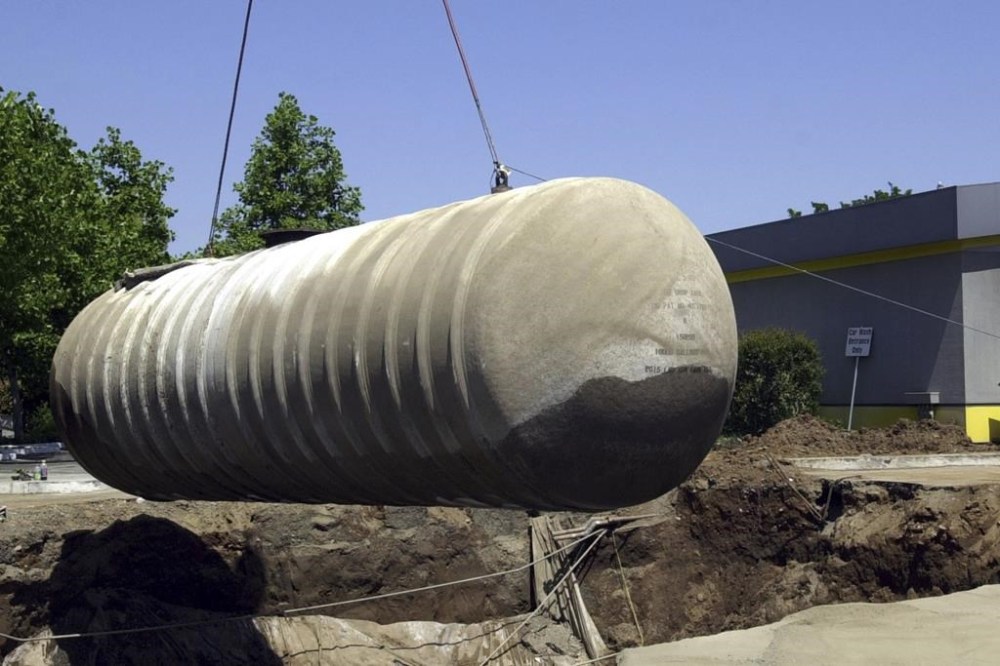
Most tanks were made of steel in the mid-1980s and likely to corrode over time. Modern tanks are fiberglass, which is more resistant to corrosion, but all tanks begin to leak sooner or later, said Dr. Kelly Pennell, a professor of environmental engineering and water resources at the University of Kentucky. The cylindrical tanks typically hold tens of thousands of gallons of fuel.
Detecting leaks is not easy, she said.
“If a gasoline station operated for 10 or 15 years, you may not be able to detect those small leaks,” said Dr. Pennell. “You wouldn’t be losing 1,000 gallons a day – you’re losing drips – but over time those matter.”
Leaks can form chemical plumes that move through groundwater and turn into vapor that rises up through cracks in the foundations of homes and businesses. Those fumes can contain cancer-causing chemicals including benzene, an ingredient in gasoline. And they carry a risk of fire and explosion. When contamination was found in Canob Park, the local fire chief sampled drinking water at one of the service stations and said it was “almost ignitable.”
Cleaning up groundwater pollution is costly, said Anne Rabe, environmental policy director at the New York Public Interest Research Group, a non-profit that works on environmental issues, including leaking underground storage tanks.
“You really have to do extensive testing to determine when these underground storage tanks are leaking and take immediate action or every week it spreads and spreads, and that increases the cost of remediation,” Rabe said.
More than 516,000 leaks have been cleaned up since Congress directed EPA to begin regulating underground tanks in 1984, but more than 57,000 known sites still await a full cleanup, the EPA said.
COSTS OF CLEANUP
The average cost to clean up a site is $154,000, according to the Association of State and Territorial Solid Waste Management Officials, an organization that acts as a liaison between state and territorial leaking underground storage tank programs and the EPA. But that cost can be much higher or lower depending on how much work is needed.
The owners of tanks are supposed to carry insurance and pay for cleanup, but that doesn’t always happen. A trust fund that gets money from a gas tax helps — it currently holds about $1.5 billion — but the program costs states and the federal government about $1 billion a year beyond the fund.
While leaking underground storage tanks are located in nearly every town in the U.S., those who live closest to these sites tend to be in communities that are lower income with a higher proportion of minorities, according to the EPA.
The EPA requires owners and operators of underground storage tanks to install approved leak detection equipment and to regularly test these systems. But they aren’t foolproof. There are different types of systems, and any one type can miss a leak or its magnitude. Trade associations suggest building a system that uses more than one leak detection method, but that doesn’t always happen, and sometimes the one chosen may not be the best one for a particular tank. And owners may not maintain them properly.

Complying with the regulations, the EPA estimated in 2015, would cost tank owners and operators a total of $160 million a year — or about $715 per facility per year. But it would mean less taxpayer money needed for cleanups, the agency said.
Some of the properties cleaned up since the program began got funding from federal and state brownfields programs, which encourage the cleanup and reuse of contaminated or potentially contaminated sites.
The EPA last year announced a $315 million historic investment in the brownfields program, with most of the money coming from the bipartisan infrastructure deal President Joe Biden signed into law more than two years ago.
___
The Associated Press’ climate and environmental coverage receives financial support from multiple private foundations. AP is solely responsible for all content. Find AP’s standards for working with philanthropies, a list of supporters and funded coverage areas at AP.org.