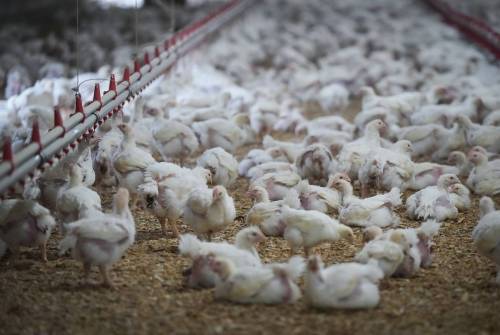
With 100M birds dead, poultry industry could serve as example as dairy farmers confront bird flu
Advertisement
Read this article for free:
or
Already have an account? Log in here »
To continue reading, please subscribe:

Digital Subscription
One year of digital access for only $205*
- Enjoy unlimited reading on winnipegfreepress.com
- Read the E-Edition, our digital replica newspaper
- Access News Break, our award-winning app
- Play interactive puzzles
*First annual payment billed as $205.00 + GST for one year. This annual subscription will automatically renew at $233.00 + GST every 52 weeks (10% off the regular annual price of $259.35). Offer available to new and qualified returning subscribers only. Cancel any time.
To continue reading, please subscribe:
Add Free Press access to your Brandon Sun subscription for only an additional
$1 for the first 4 weeks*
- Enjoy unlimited reading on winnipegfreepress.com
- Read the E-Edition, our digital replica newspaper
- Access News Break, our award-winning app
- Play interactive puzzles
*Your next Brandon Sun subscription payment will increase by $1.00 and you will be charged $17.95 plus GST for four weeks. After four weeks, your payment will increase to $24.95 plus GST every four weeks.
Read unlimited articles for free today:
or
Already have an account? Log in here »
Hey there, time traveller!
This article was published 10/06/2024 (853 days ago), so information in it may no longer be current.
DES MOINES, Iowa (AP) — As the U.S. dairy industry confronts a bird flu outbreak, with cases reported at dozens of farms and the disease spreading to people, the egg industry could serve as an example of how to slow the disease but also shows how difficult it can be to eradicate the virus.
There have been earlier bird flu outbreaks in the U.S., but the current one started in February 2022 and has forced the slaughter of nearly 100 million chickens and turkeys. Hot spots still occur, but their frequency has dropped in part because of biosecurity efforts at farms and a coordinated approach between companies and agricultural officials, experts say.
Dairy farmers could try to implement similar safeguards, but the vast differences between the animals and the industries limit what lessons can be learned and applied.
How can a 1,500-pound cow and a 5-pound chicken have the same illness?
It’s commonly called bird flu because the disease is largely spread by wild birds that can survive infections. Many mammals have caught the illness too, including sea lions and skunks.
Animals can be infected by eating an infected bird or by being exposed to environments where the virus is present. That said, there are big differences in how cows and chickens have fared after getting infected.
Bird flu is typically fatal to chickens and turkeys within days of an infection, leading to immediate mass killings of birds. That’s not true for cows.
Dairies in several states have reported having to kill infected animals because symptoms continued to linger and their milk production didn’t recover, but that’s not the norm, said Russ Daly, an extension veterinarian at South Dakota State University.
He said it appears that bird flu isn’t usually fatal to cows but that an infected animal can be more vulnerable to other ailments typically founds in dairies, such as bacterial pneumonia and udder infections.
What has the egg industry done to protect chickens?
Egg operators have become clean freaks.
To prevent disease from spreading, egg producers require workers to shower and change into clean clothes before they enter a barn and shower again when they leave. They also frequently wash trucks and spray tires with solutions to kill off virus remnants.
Many egg operations even use lasers and install special fencing to discourage wild birds from stopping by for a visit.
“Gone is the day of the scarecrow,” said Emily Metz, president of the American Egg Board.
Without these efforts, the current outbreak would be much worse, said Jada Thompson, a University of Arkansas agriculture business professor. Still, maintaining such vigilance is difficult, even if the cost of allowing disease into an operation is so high, she said.
Chickens raised for meat, known as broilers, also have been infected with bird flu but such cases are less common. In part, that’s because broiler chickens are killed when they’re only 6 to 8 weeks old, so they have less time to get infected.
Can the same be done to protect cows and dairy workers?
Yes and no.
Dairies can certainly reduce the spread of disease by limiting access to barns, so people and equipment don’t bring in the virus from elsewhere. Workers could also wear eye protection, aprons and gloves to try to protect themselves, but there’s no way around it: Big animals are messy.
“The parlor is a warm, humid place with lots of liquid flying around, whether it’s urine, feces, water because they’re spraying off areas. Cows might kick off a milk machine so you get milk splatter,” said Keith Poulsen, director of the Wisconsin Veterinary Laboratory.
Dairies also don’t have time or staff to disinfect milking equipment between animals, so equipment could become contaminated. Pasteurization kills bacteria and viruses in milk, making it safe for people to drink.
Poulsen said the dairy industry could follow a path laid by the poultry and pork industries and establish more formal, better funded research organizations so it could respond more quickly to problems like bird flu — or avoid them altogether.
The dairy industry also could tamp down disease spread by limiting the movement of lactating cows between states, Poulsen said.
Are there new efforts to fight the virus?
The U.S. Department of Agriculture will soon begin testing a vaccine that could be given to calves, offering the animals protection and also reducing the chance of worker illnesses.
The egg industry also is hopeful researchers can develop vaccines for poultry that could be quick, inexpensive and effective. Workers can’t give shots to the millions of hens that might need a vaccine, but industry officials hope a vaccine could be distributed in the water the birds drink, in the pellets they eat or even before birds hatch from their eggs.
Efforts to develop vaccines have become even more important now that the disease has spread to dairy cows and even a few people, Thompson said.
“Part or what is being developed right now is, what way can we vaccinate them that is cost-effective and disease resistant?” Thompson said.