

Alzheimer’s deals another painful blow

Advertisement
Read this article for free:
or
Already have an account? Log in here »
To continue reading, please subscribe:
Digital Subscription
One year of digital access for only $1.44 a week*
- Enjoy unlimited reading on winnipegfreepress.com
- Read the E-Edition, our digital replica newspaper
- Access News Break, our award-winning app
- Play interactive puzzles
*Billed as $5.77 plus GST every four weeks. After 52 weeks, price increases to the regular rate of $19.95 plus GST every four weeks. Offer available to new and qualified returning subscribers only. Cancel any time.
To continue reading, please subscribe:
Add Free Press access to your Brandon Sun subscription for only an additional
$1 for the first 4 weeks*
- Enjoy unlimited reading on winnipegfreepress.com
- Read the E-Edition, our digital replica newspaper
- Access News Break, our award-winning app
- Play interactive puzzles
*Your next Brandon Sun subscription payment will increase by $1.00 and you will be charged $17.95 plus GST for four weeks. After four weeks, your payment will increase to $24.95 plus GST every four weeks.
Read unlimited articles for free today:
or
Already have an account? Log in here »
Hey there, time traveller!
This article was published 12/06/2024 (863 days ago), so information in it may no longer be current.
She was resting on her twin bed when I visited her, lifting a corner of the blanket and motioning for me to lie down beside her in the stiflingly warm room.
I suspect she just wanted to feel a human being next to her after a decade of being alone.
“It’s OK, I’ll go on if you are having a nap,” I say.
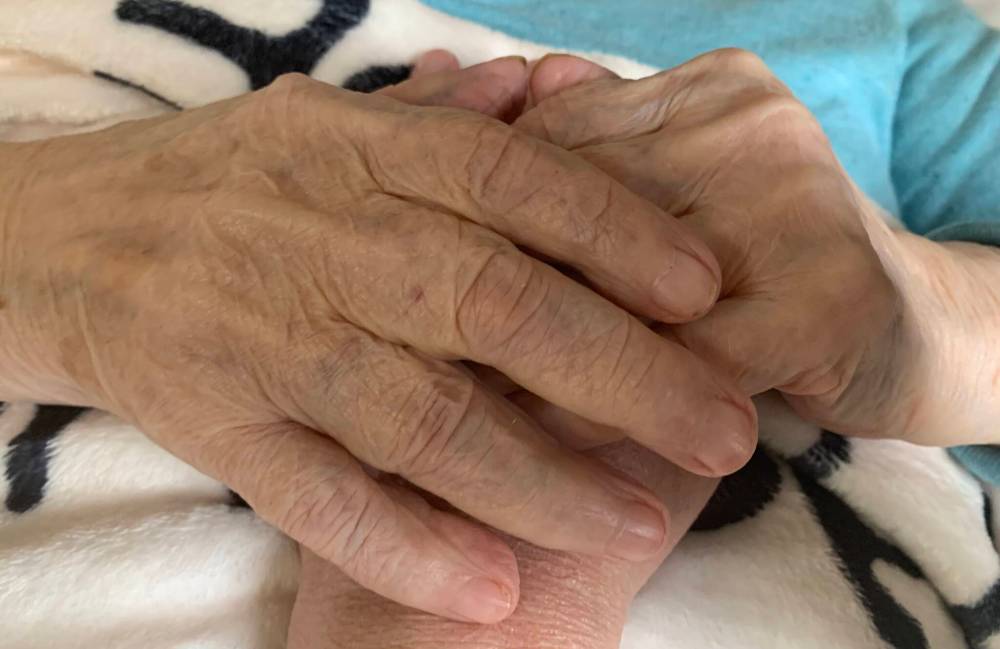
Pam Frampton photo
The author and her mom, Vera Frampton, hold hands.
“I’m glad you came. It’s nice to have someone to talk to,” she says, her eyes half-closed, oblivious to the presence of her roommate nearby.
“Well, I can certainly stay for a while.”
She reaches for my hand then, and I feel her baby-soft skin, notice the pronounced blue veins threading her fingers like strands of wool beneath the surface.
And then I notice something else.
Her rings are gone.
The four rings she always wore: wedding and engagement rings to mark 62 years of marriage. A family ring representing her offspring, and a sapphire and diamond ring my dad gave her once for no special occasion — which, in itself, rendered it a special occasion.
They were going to be family heirlooms — “one for each of my girls,” she used to say — precious keepsakes to pass down through generations.
To see them missing was a shock. I had never seen her take them off and, given the pronounced veining in her hands, imagined they would have been difficult to remove.
“Mom, what happened to your rings?” I asked, aware as soon as the words left my mouth that she would be unable to tell me.
“What?” she asked.
“Never mind.”
I poked through her jewelry box and nightstand, trying to tamp down my panic so it wouldn’t spread to her.
No rings.
On the way home, I called my two sisters. Neither could remember if she had been wearing the rings on Mother’s Day. None of the photos we had taken showed her hands.
Later, I went through all the photos on my cellphone and they did the same. The most definitive evidence we found were pictures from her birthday in September, when the rings were all there.
Eight months ago.
I knew then she’d never see them again.
That’s when the guilt kicked in.
Why hadn’t we noticed sooner? Why didn’t we check her hands at each visit? Why didn’t I take the rings for safekeeping before her Alzheimer’s advanced?
There are logical answers to all these questions, but they don’t quash the feelings of blame.
I didn’t take the rings from her because they were, quite simply — besides the clothes in her closet — all that she had; the last vestiges of her autonomy as an adult. They were hers, gifts given to her, symbols that would tie her to us and our late father to the end.
Or so we’d thought.
The thing about dementia is you can’t be held accountable for your actions. If Mom’s hearing aids weren’t working and she took them out and laid them down somewhere and they got lost, you can’t fault her for that.
Dentures, the same. Glasses, ditto.
And she has lost all those things over the past few years.
But she has never lost her rings, her pride and joy, tangible things that reminded her she was valued and loved, even if she didn’t always remember herself.
You sit and think about every possible scenario until it makes you heartsick — some so dark you don’t even want to consider them.
You mourn how vulnerable people like my sweet and gentle mother are. Memories stolen, robbed of dignity, rendered gullible by their affliction and reliant on the goodness of strangers.
I remember when I realized I’d have to take her credit card from her for her own financial protection. She was an easy target for phone scammers and slick sales pitches, and though it made me feel incredibly sad, I knew she didn’t have money to waste.
I had never wanted this role-reversal, the child trying to protect the mother.
But my siblings and I did try to protect her in every way we could.
It came as a blow, with the discovery of her missing jewelry, the knowledge that we can’t protect her from her failing memory, nor other human frailties.
She is at the mercy of the world now, weak as a kitten; unable to safeguard herself in any way.

As her adult child, I feel helpless.
On my father’s deathbed, we promised him we’d look after Mom.
I feel like I’ve let them both down.
Oh I know rings are just possessions, that they can’t compare to the strength of the love and blood that bind us. But there’s just something about seeing those soft and fragile bare hands that makes me want to weep.
Pam Frampton is a freelance writer and editor who lives in St. John’s. Email pamelajframpton@gmail.com X: pam_frampton
Pam Frampton is a columnist for the Free Press. She has worked in print media since 1990 and has been offering up her opinions for more than 20 years. Read more about Pam.
Pam’s columns are built on facts, but offer her personal views through arguments and analysis. Every column Pam produces is reviewed by an editing team before it is posted online or published in print — part of the Free Press‘s tradition, since 1872, of producing reliable independent journalism. Read more about Free Press’s history and mandate, and learn how our newsroom operates.
Our newsroom depends on a growing audience of readers to power our journalism. If you are not a paid reader, please consider becoming a subscriber.
Our newsroom depends on its audience of readers to power our journalism. Thank you for your support.
Advertisement Advertise With Us
Advertisement Advertise With Us