Biden administration old-growth forest proposal doesn’t ban logging, but still angers industry

Advertisement

Advertise with us

BILLINGS, Mont. (AP) — The Biden administration is advancing its plan to restrict logging within old-growth forests that are increasingly threatened by climate change, with exceptions that include cutting trees to make forests less susceptible to wildfires, according to a U.S. government analysis obtained by The Associated Press.

Read this article for free:


or

Already have an account? Log in here »

To continue reading, please subscribe:

Subscribe and receive a limited-edition Free Press branded hat or tote.

Digital Subscription

One year of digital access for only $205*

  • Enjoy unlimited reading on winnipegfreepress.com
  • Read the E-Edition, our digital replica newspaper
  • Access News Break, our award-winning app
  • Play interactive puzzles

*First annual payment billed as $205.00 + GST for one year. This annual subscription will automatically renew at $233.00 + GST every 52 weeks (10% off the regular annual price of $259.35). Offer available to new and qualified returning subscribers only. Cancel any time.

To continue reading, please subscribe:

Add Free Press access to your Brandon Sun subscription for only an additional

$1 for the first 4 weeks*

  • Enjoy unlimited reading on winnipegfreepress.com
  • Read the E-Edition, our digital replica newspaper
  • Access News Break, our award-winning app
  • Play interactive puzzles
Start now

*Your next Brandon Sun subscription payment will increase by $1.00 and you will be charged $17.95 plus GST for four weeks. After four weeks, your payment will increase to $24.95 plus GST every four weeks.

Hey there, time traveller!
This article was published 20/06/2024 (821 days ago), so information in it may no longer be current.

BILLINGS, Mont. (AP) — The Biden administration is advancing its plan to restrict logging within old-growth forests that are increasingly threatened by climate change, with exceptions that include cutting trees to make forests less susceptible to wildfires, according to a U.S. government analysis obtained by The Associated Press.

The analysis, which is expected to be published Friday, shows that officials intend to reject a blanket prohibition on old-growth logging that’s long been sought by some environmentalists. Officials concluded that such a sweeping ban would make it harder to thin forests to better protect communities against wildfires that have grown more severe as the planet has warmed.

“To ensure the longevity of old-growth forests, we’re going to have to take proactive management to protect against wildfire and insects and disease,” Forest Service Deputy Chief Chris French told the AP. Without some thinning allowed on these forests, he said there is a risk of losing more trees.

FILE - Climbing assistant Lawrence Schultz ascends the Three Sisters sequoia tree during an Archangel Ancient Tree Archive expedition to plant sequoia seedlings on Oct. 26, 2021, in Sequoia Crest, Calif. The Biden administration on Thursday, June 20, 2024 advanced its proposal to protect old growth trees that are increasingly threatened by insects, disease and wildfires as climate change worsens. (AP Photo/Noah Berger, File)

The exceptions under which logging would be allowed are unlikely to placate the timber industry and Republicans in Congress, who have pushed back against any new restrictions. French asserted that the impacts on timber companies would be minimal.

“There’s so little timber sales that occur right now in old-growth … that the overall effects are very small,” French said.

The U.S. timber industry employs about 860,000 people, which is about 30% fewer than in 2001, according to government data. Much of their work shifted in recent years to timber from private and state lands, after harvests from national forests dropped sharply beginning in the 1990s due to new policies, changing lumber markets and other factors.

The proposed changes on old-growth mark a shift for an agency that has historically promoted logging. They’re expected to be finalized before Democratic President Joe Biden’s term ends in January, and they come after he issued a 2022 executive order that directed the U.S. Department of Agriculture to identify old-growth forests across the nation and devise ways to conserve them.

That order touched off a flurry of disagreement over what fits under the definition of old-growth and how those trees should be managed.

Old-growth forests, such as the storied giant sequoia stands of Northern California, have layer upon layer of undisturbed trees and vegetation. There’s wide consensus on the importance of preserving them — both symbolically as marvels of nature, and more practically because their trunks and branches store large amounts of carbon that can be released when forests burn, adding to climate change.

Underlining the urgency of the issue are wildfires that killed thousands of giant sequoias in recent years.

Most old-growth forests across the U.S. were lost to logging as the nation developed over the past few centuries. Yet pockets of ancient trees remain, scattered across the U.S. including in California, the Pacific Northwest and areas of the Rocky Mountains. Larger expanses of old growth survive in Alaska, such as within the Tongass National Forest.

Old-growth timber harvests in the Tongass were limited in 2021 to small commercial sales. Those would no longer occur under the administration’s proposal.

The new analysis follows a separate report on threats to old-growth forests that was finalized last week. It concluded that wildfires, insects and disease have been the main killers of old-growth trees since 2000, accounting for almost 1,400 square miles (3,600 square kilometers) of losses.

By contrast, logging on federal lands cut down about 14 square miles (36 square kilometers) of old-growth forests. That figure has been seized on by timber industry representatives who argue that further restrictions aren’t needed.
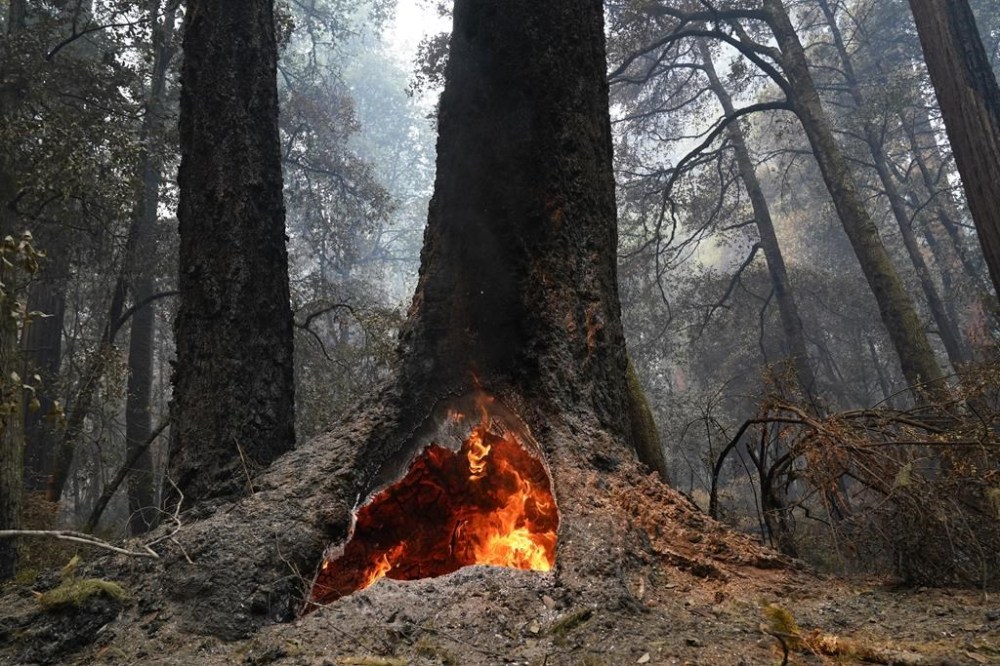
FILE - In this Aug. 24, 2020 photo, fire burns in the hollow of an old-growth redwood tree in Big Basin Redwoods State Park, Calif. The Biden administration is advancing its plan to restrict logging within old growth forests that are increasingly threatened by climate change, with an environmental review of the proposal expected to be publicized Friday. (AP Photo/Marcio Jose Sanchez, File)

“A binding restriction on timber harvest is not where their priority ought to be,” said Bill Imbergamo, of the Federal Forest Resource Coalition, an industry group. He added that exceptions by federal officials to allow some logging could be challenged in court, which could tie up even small logging projects that are focused on reducing wildfire risks.

Environmentalists have urged the administration to go even further as they seek to stop logging projects on federal lands in Oregon, South Dakota, Montana, Idaho and other states.

Jamie Williams, president of The Wilderness Society, said the proposal was “a step in the right direction.”

“But it must go further to protect and restore resilient old-growth forests in a way that meets the challenges of the changing climate,” he added.

Government inventories have identified about 50,000 square miles (130,000 square kilometers) of old-growth forests in federal lands across the U.S. and 125,000 square miles (320,000 square kilometers) of mature forests that haven’t yet reached old-growth status. That includes land overseen by the Forest Service and the Bureau of Land Management, which in April adopted a rule intended to put conservation on equal footing with extractive industries such as logging and energy development.

Environmentalists lobbied unsuccessfully for the Forest Service to extend its old-growth logging restrictions to mature forests. That means those forests remain exposed to potential commercial logging, said Blaine Miller McFeeley, of the environmental group EarthJustice.

“If you don’t have protections for mature trees, there will never be a new cohort of old-growth,” he said.

Under former President Donald Trump, federal officials sought to open up huge areas of West Coast forests to potential logging. Federal wildlife officials reversed the move in 2021 after determining that political appointees under Trump relied on faulty science to justify drastically shrinking areas of forest that are considered crucial habitats for the imperiled northern spotted owl.


Report Error Submit a Tip

More Stories

Desperate Poilievre wants Canadians to believe the sky is falling when it’s just cloudy outside

Tom Brodbeck 5 minute read Preview

Desperate Poilievre wants Canadians to believe the sky is falling when it’s just cloudy outside

Tom Brodbeck 5 minute read Yesterday at 12:47 PM CDT

Pierre Poilievre has a problem.

Canadians just don’t seem to be paying much attention to him anymore.

So, naturally, the Conservative Opposition leader has decided to turn up the volume.

At a recent party caucus retreat in Penticton, B.C., Poilievre delivered the familiar message: Canada is in trouble, Canadians are hurting and the Liberal government is making everything worse.

Read
Yesterday at 12:47 PM CDT

United Way, other charities fight for dollars as donor base shrinks

Scott Billeck 8 minute read Preview

United Way, other charities fight for dollars as donor base shrinks

Scott Billeck 8 minute read Yesterday at 2:00 AM CDT

Winnipeg’s charitable sector is being squeezed from both sides: demand for help is growing while the pool of donors to meet that need is shrinking.

The imbalance is increasingly being carried by a relatively small group of deep-pocketed donors. Last year, 600 people — about three per cent of United Way Winnipeg’s individual donors — accounted for roughly $8 million, or 55 per cent of individual donations.

The fundraising pitch isn’t getting any easier.

Homelessness and public drug use have become increasingly visible, household budgets remain strained and the problems charities are trying to address can seem so entrenched that donors may reasonably wonder what difference another contribution can make.

Read
Yesterday at 2:00 AM CDT

A life’s story: activist, educator, organizer knew the true meaning of community

Janine LeGal 7 minute read Preview

A life’s story: activist, educator, organizer knew the true meaning of community

Janine LeGal 7 minute read 3:00 AM CDT

Somewhere between a love for sharing stories and a love of community connections, Michael (Mike) Maunder lived his life. Giving voice to people and neighbourhoods was a passion for the natural-born community organizer.

An author, teacher and principal, Maunder lived in a one-bedroom apartment in West Broadway and devoted himself to community development, education and neighbourhood renewal.

He maintained a connection with Augustine United Church, whose commitment to social justice he appreciated, volunteered at the Sandy-Saulteaux Spiritual Centre, and found comfort in a Buddhist prayer community.

Maunder died on July 15 at the age of 80.

Read
3:00 AM CDT

‘She was looking to destroy me’: convicted harasser faces new charges

Dean Pritchard 6 minute read Preview

‘She was looking to destroy me’: convicted harasser faces new charges

Dean Pritchard 6 minute read Thursday, Sep. 17, 2026

When Agnieszka Ciochon-Newton moved into the 55-plus apartment building on Stradbrook Avenue last year, she came across as “timid, soft-spoken and sensitive,” said building manager Tanya Owen.

Little did Owen know the meek-looking 58-year-old woman would soon turn her life and the lives of many of her tenants upside down and threaten her career and family.

“She was looking to destroy me for a simple tenant disagreement,” Owen said Thursday.

Court records show Ciochon-Newton was arrested earlier this month and charged with seven counts of criminal harassment, two counts of uttering threats and one count each of fraud, breaking and entering, attempting to obstruct justice, intimidation of a justice official, mischief and defamatory libel.

Read
Thursday, Sep. 17, 2026

Family account spiced with magic realism, geopolitical intrigue and a ghost story

Reviewed by Zilla Jones 4 minute read Preview

Family account spiced with magic realism, geopolitical intrigue and a ghost story

Reviewed by Zilla Jones 4 minute read 2:01 AM CDT

Tom Lin’s second novel Babylon, South Dakota moves beyond a historical account of an immigrant family’s struggle, delightfully blending and bending genres.

Lin is a Chinese-born novelist whose family emigrated to the U.S. when he was four years old. His debut novel, The Thousand Crimes of Ming Tsu, won the 2022 Andrew Carnegie Medal for Excellence in Fiction, making him the youngest ever recipient of that award. He earned a PhD in English from the University of California Davis and is currently an assistant professor of English and creative writing at the University of Iowa.

Babylon, South Dakota takes place in an unspecified time period that can be understood to be during the Mao era — likely the 1950s or ’60s. A young Chinese couple, the Hsuis, immigrate to the rural community that gives the book its title. They take the names Saul and Mei and settle on a 160-acre homestead left to them by a distant relative.

Saul’s dream is to breed and sell chrysanthemums from seeds he brought from China, while Mei wants to raise livestock. They speak no English, know nothing of life in the United States, are unprepared for the harshness of winter and the isolation of the farm and bring nothing with them except some gold, which Mei hides around the house for emergencies. Their only link to the outside world is a discarded and marginally functioning TV set, which Saul rescues and rigs up.

Read
2:01 AM CDT

Gillingham in lead with decided voters

Nicole Buffie 6 minute read Preview

Gillingham in lead with decided voters

Nicole Buffie 6 minute read Yesterday at 6:55 PM CDT

A cloud of uncertainty is hanging over Winnipeg as October’s municipal election nears.

Three months after a poll showed more than 40 per cent of Winnipeggers wanted to see someone other than current mayor Scott Gillingham elected, a new Abacus Data poll indicates more than half of Winnipeg voters are undecided heading into next month’s civic election.

Of decided voters, 55 per cent favour Gillingham compared to 23 per cent for former councillor and provincial cabinet minister Kevin Klein and 11 per cent for funeral director Mike Vogiatzakis.

Of all respondents, just over 50 per cent said they were unsure while 13 per cent said they will not vote.

Read
Yesterday at 6:55 PM CDT