

Social media’s myriad risks for kids

Advertisement
Read this article for free:
or
Already have an account? Log in here »
To continue reading, please subscribe:

Digital Subscription
One year of digital access for only $205*
- Enjoy unlimited reading on winnipegfreepress.com
- Read the E-Edition, our digital replica newspaper
- Access News Break, our award-winning app
- Play interactive puzzles
*First annual payment billed as $205.00 + GST for one year. This annual subscription will automatically renew at $233.00 + GST every 52 weeks (10% off the regular annual price of $259.35). Offer available to new and qualified returning subscribers only. Cancel any time.
To continue reading, please subscribe:
Add Free Press access to your Brandon Sun subscription for only an additional
$1 for the first 4 weeks*
- Enjoy unlimited reading on winnipegfreepress.com
- Read the E-Edition, our digital replica newspaper
- Access News Break, our award-winning app
- Play interactive puzzles
*Your next Brandon Sun subscription payment will increase by $1.00 and you will be charged $17.95 plus GST for four weeks. After four weeks, your payment will increase to $24.95 plus GST every four weeks.
Read unlimited articles for free today:
or
Already have an account? Log in here »
Hey there, time traveller!
This article was published 26/06/2024 (808 days ago), so information in it may no longer be current.
On June 17, U.S. Surgeon General Dr. Vivek H. Murthy said social media platforms should come with warnings, in the style of those used on cigarette packages and alcohol labels, since social media apps have been deemed detrimental to children’s mental health.
The American Psychological Association and the Canadian Paediatric Society have also sounded the alarm, with the latter saying of the impacts of social media use: “We are in the midst of a youth mental health crisis that demands meaningful and conscientious mitigation measures.”
Many children, and most teens, use social media daily.
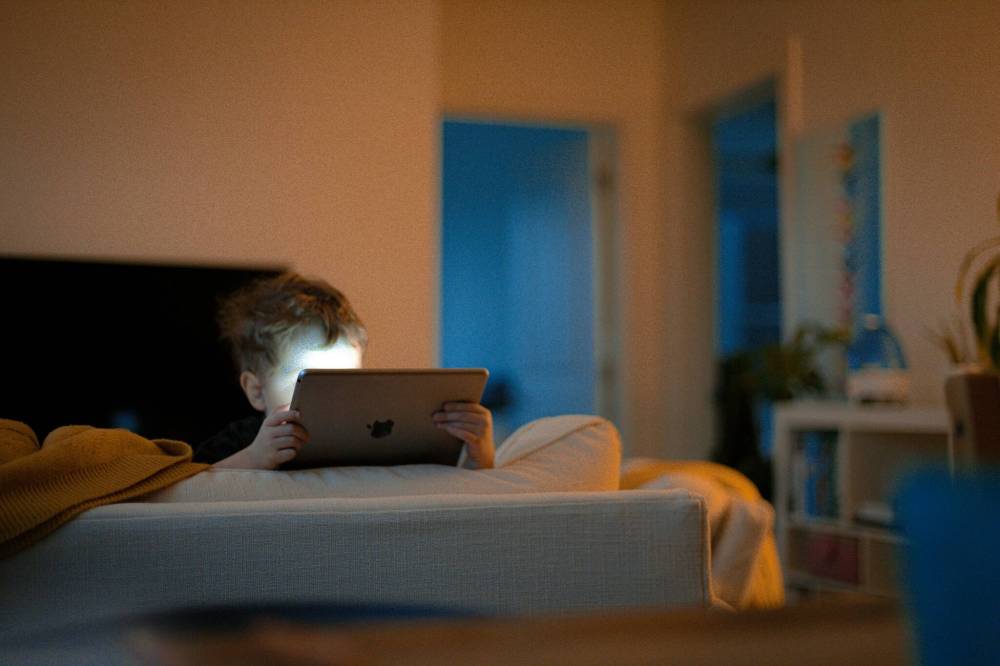
Platforms like TikTok, Snapchat, Instagram and WhatsApp may seem like a good way to explore interests and connect with friends, but research suggests they may be doing kids more harm than good.
If a warning label was adopted, it would have to be pretty extensive, since there is much to approach with caution.
It might go something like this:
WARNING: Hours spent daily on social media may lead to the following: lowered self-esteem; fear of missing out; poorer body image; shortened attention span; lack of confidence; loneliness, anxiety, depression; and high-risk behaviours.
Social media can subject children to a steady stream of idealized, highly sexualized, artificial intelligence-generated characters that kids will compare themselves to and likely find themselves lacking.
It’s bad enough that young people have been fed the message that any images of themselves shared online should be run through filters that erase any perceived “imperfections” of skin and muscle tone. Now there is a whole AI army of perfect bodies and faces streaming through their feeds 24 hours a day. Some of those images are pornographic.
Damage will be done and is being done.
WARNING: Social media regularly subjects children and youth to sexual stereotypes and misogyny, as if there weren’t enough exposure to that in real life.
Social media tells the world that some people only have value as sexual objects. Images of women and girls, in particular, are often publicly discussed and dissected in terms of their clothing and specific body parts — not for their points of view, skills, insights, discoveries, adventurous spirits, creative talents or generous hearts.
And not only that, there are adults with ill intent on social media who may use adolescents’ profile information to sext them or exploit their innocence to turn them into victims of sextortion — blackmailed for sex, sexually graphic photos or money.
Parents should also know that children’s images could be plucked from social media and used to create images of child sexual abuse that are then shared with others.
WARNING: Children who seem to have an active online “life,” may, in fact, be feeling isolated or alienated.
Their lives off-screen may become frightening and anxiety-ridden because of what is happening to them onscreen.
They may be the targets of cyberbullying, body shaming, peer pressure.
The U.S. Surgeon General advises that for adolescent girls in particular, social media use may “perpetuate body dissatisfaction, disordered eating behaviors, social comparison and low self-esteem.”
In a 2023 advisory, he warned that, “Extreme, inappropriate, and harmful content continues to be easily and widely accessible by children and adolescents. This can be spread through direct pushes, unwanted content exchanges, and algorithmic designs. In certain tragic cases, childhood deaths have been linked to suicide- and self-harm-related content and risk-taking challenges on social media platforms.”
And it’s not just themselves that social media can make kids feel bad about — as if that wasn’t concerning enough.
Social media also exposes them to a steady diet of hateful content — posts that vilify people for their race, religion, sexual orientation, physical appearance, political position, social status or perceived lack thereof, mental health, or just basic human vulnerabilities.
True, there can be pockets of community that are welcoming and inclusive, but there aren’t enough safeguards to filter out the vitriol.
WARNING: Children and teens need to feel safe. Social media opens them up to innumerable harms at a time in their lives when their brains are still developing and they are not equipped to recognize the dangers.
If this all sounds a bit bleak, well, quite frankly, it is.
The U.S. Surgeon General puts it bluntly: “Our children’s well-being is at stake.”
Parents, teachers, governments, researchers and big tech companies all have a role to play in protecting children and creating spaces where they can explore the digital world with more boundaries and less risk.

Responsible adults wouldn’t hand a child a loaded gun and let them play with it, or give them a package of cigarettes laced with carcinogens.
So why has society normalized the practice of putting smartphones and tablets and laptops in the hands of children, leaving them to explore the wonders and horrors of social media unaccompanied?
Pam Frampton is a freelance writer and editor who lives in St. John’s.
Email pamelajframpton@gmail.com
X: pam_frampton
Pam Frampton is a columnist for the Free Press. She has worked in print media since 1990 and has been offering up her opinions for more than 20 years. Read more about Pam.
Pam’s columns are built on facts, but offer her personal views through arguments and analysis. Every column Pam produces is reviewed by an editing team before it is posted online or published in print — part of the Free Press‘s tradition, since 1872, of producing reliable independent journalism. Read more about Free Press’s history and mandate, and learn how our newsroom operates.
Our newsroom depends on a growing audience of readers to power our journalism. If you are not a paid reader, please consider becoming a subscriber.
Our newsroom depends on its audience of readers to power our journalism. Thank you for your support.
Pam Frampton is a columnist for the Free Press. She has worked in print media since 1990 and has been offering up her opinions for more than 20 years. Read more about Pam.
Pam’s columns are built on facts, but offer her personal views through arguments and analysis. Every column Pam produces is reviewed by an editing team before it is posted online or published in print — part of the Free Press‘s tradition, since 1872, of producing reliable independent journalism. Read more about Free Press’s history and mandate, and learn how our newsroom operates.
Our newsroom depends on a growing audience of readers to power our journalism. If you are not a paid reader, please consider becoming a subscriber.
Our newsroom depends on its audience of readers to power our journalism. Thank you for your support.
Advertisement Advertise With Us
Advertisement Advertise With Us