Fish biomass loss possible in Atlantic Canada amid rising emissions, researcher says

Advertisement

Advertise with us

HALIFAX - A new study is predicting a steep decline in global fish populations — including species in Atlantic Canada — by the end of the century, if unchecked greenhouse gas emissions continue.

Read this article for free:


or

Already have an account? Log in here »

To continue reading, please subscribe:

Subscribe and receive a limited-edition Free Press branded hat or tote.

Digital Subscription

One year of digital access for only $205*

  • Enjoy unlimited reading on winnipegfreepress.com
  • Read the E-Edition, our digital replica newspaper
  • Access News Break, our award-winning app
  • Play interactive puzzles

*First annual payment billed as $205.00 + GST for one year. This annual subscription will automatically renew at $233.00 + GST every 52 weeks (10% off the regular annual price of $259.35). Offer available to new and qualified returning subscribers only. Cancel any time.

To continue reading, please subscribe:

Add Free Press access to your Brandon Sun subscription for only an additional

$1 for the first 4 weeks*

  • Enjoy unlimited reading on winnipegfreepress.com
  • Read the E-Edition, our digital replica newspaper
  • Access News Break, our award-winning app
  • Play interactive puzzles
Start now

*Your next Brandon Sun subscription payment will increase by $1.00 and you will be charged $17.95 plus GST for four weeks. After four weeks, your payment will increase to $24.95 plus GST every four weeks.

Hey there, time traveller!
This article was published 17/07/2024 (801 days ago), so information in it may no longer be current.

HALIFAX – A new study is predicting a steep decline in global fish populations — including species in Atlantic Canada — by the end of the century, if unchecked greenhouse gas emissions continue.

The 108-page report published last week by the Food and Agriculture Organization of the United Nations projects that with an average temperature increase of between 3 and 4 C, fish biomass would decline by more than 30 per cent by 2100 in 48 countries.

China, which is the world’s largest seafood consumer, is among the countries whose catches will see the sharpest declines in the world, with a 31 per cent loss.
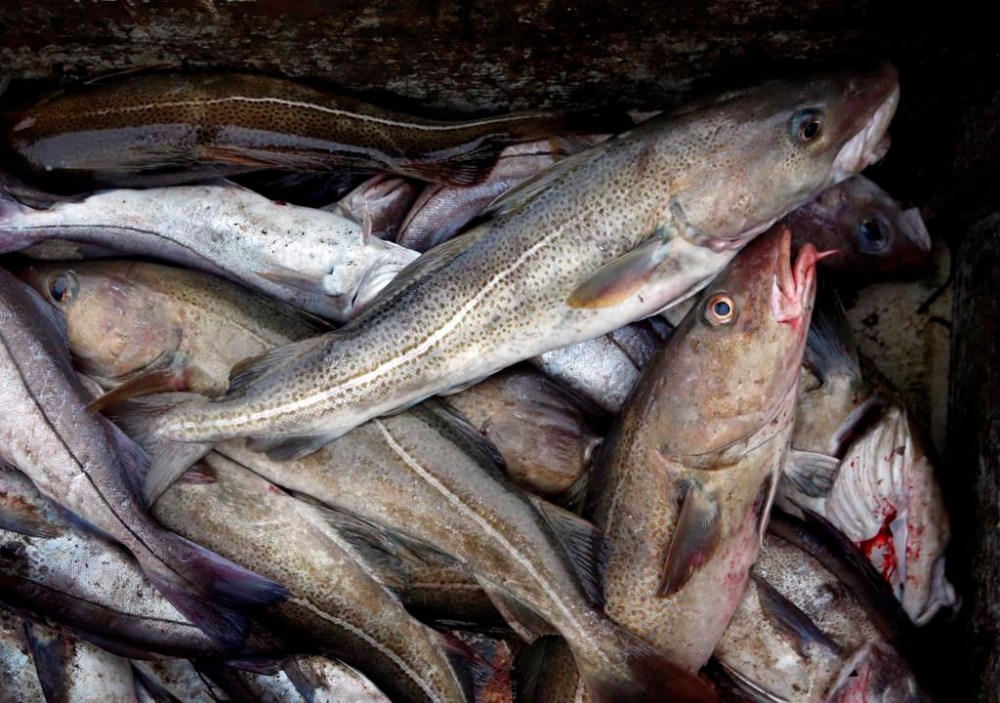
A new study published by the Food and Agriculture organization of the United Nations says new projections show a possible steep decline in global fish biomass by the end of the century under high greenhouse gas emissions, with several areas of Atlantic Canadian fishing areas affected. In this April 23, 2016, file photo, cod fill a box on a trawler off the coast of Hampton Beach, N.H. THE CANADIAN PRESS/AP/Robert F. Bukaty

A low carbon emissions scenario — or 1.5 to 2 C warming — by contrast, projects less than a 10 per cent loss of fish worldwide.

The study measures biomass as the total amount of fish counted in a specific body of water, using a measurement of grams of carbon per square metre of water.

Andrea Bryndum-Buchholz, a marine ecologist at Memorial University who is one of 41 contributors to the study, says in ninedifferent projection models anticipating fish declines,Canadian fisheries are found to be vulnerable as water temperatures rise in the northwest Atlantic.

“All these models agree that fish biomass is going to decline in certain areas because water temperature is increasing,” she said in an interview last week.

It shows three-quarters of the East Coast’s protected marine areas — regions that maintain the long-term conservation of marine species — fall within climate change hotspots, where waters are expected to warm at higher rates.

Bryndum-Buchholz said that has implications for the region’s fishers, who could face significant challenges in the worst case emission scenarios.

“The fishing industry is super important here. It needs to be sustainable,” Bryndum-Buchholz said.

She added that if climate change is allowed to continue at its current pace, it creates pressure for fishery closures that will harm a key part of the region’s economy.

“Fishing is integral to the Maritimes and other areas of the world, so we want to reduce moratoriums because the access (to fish) is important.”

Bryndum-Buchholz said governments managing fish populationscould adopt a risk-based approach that is appropriate to each region, carefully monitoring biomass, animal behaviour and water temperature in each area.

“We can’t have a global solution (to food security) even though we have these global projections. It’s not one cookie-cutter approach,” she said.

This approach involves a significantly higher investment and would lead governments to adjust allowable catches when there are early signs of decline, enforce catch restrictions to prevent fishing juvenile-aged fish, and adjust marine protected areas to respond more effectively as climate change continues.

Increased water temperatures can influence things like migration and breeding habits, Bryndum-Buchholz explained. Lobster migration is one example of migration habits changing, where more lobsters are moving away from waters in Maine as the Atlantic waters warm.

Areas in Atlantic Canada where there is expected warming and biomass declines include the Scotian Shelf, which follows the south shore of Nova Scotia, the Laurentian Channel, which is between Cape Breton Island and Newfoundland, and the Grand Banks, which follows the southeast corner of Newfoundland.

The Gulf of the St. Lawrence, which borders all four of the Atlantic provinces and Quebec, is the fastest warming area.

This report by The Canadian Press was first published July 17, 2024.

Report Error Submit a Tip

More Stories

Happy email debt forgiveness day

Tory McNally 8 minute read Preview

Happy email debt forgiveness day

Tory McNally 8 minute read 2:01 AM CDT

There are few things more capable of producing an immediate feeling of guilt than opening your inbox and seeing an email you have not answered.

You know the one. It has been sitting there for three days or three months or perhaps long enough that responding now feels less like answering an email and more like reopening a historical case. You read it, think, “I really need to deal with that,” and then close it again.

The next week you see it, feel slightly worse and tell yourself you will answer it when you have more time. A month later, you are considering whether it would be less embarrassing to change your name and move to another province.

Fortunately, there is a solution: Sept. 30 is Email Debt Forgiveness Day, and I think it may be one of the most compassionate holidays we have invented.

Read
2:01 AM CDT

Prost! Raise a glass to Oktoberfest

Ben Sigurdson 4 minute read Preview

Prost! Raise a glass to Oktoberfest

Ben Sigurdson 4 minute read 2:01 AM CDT

As September comes to a close, a pair of local breweries are bringing some serious gemütlichkeit.

For the uninitiated, gemütlichkeit’s a word that doesn’t translate neatly from German to English, but which roughly means friendliness and good cheer.

Both Devil May Care Brewing Co. (155 Fort St.) and Kilter Brewing Co. (450 Rue Deschambault) are hosting Oktoberfest parties this weekend featuring food, music, games and, of course, plenty of beer.

Both breweries are rolling out special releases to coincide with their respective Oktoberfests — expect malty festbiers, marzens, rauchbiers and other German-inspired brews, served up in hefty steins alongside Bavarian-inspired fare. Devil May Care’s festivities run through to Sunday and feature eats by Freebird Kitchen, while Kilter keeps the party going through to Saturday, Oct. 3, and is offering pretzels and Oktoberfest-themed hot dogs. Lederhosen is encouraged.

Read
2:01 AM CDT

The never-ending, continuing war in Ethiopia

Gwynne Dyer 5 minute read 2:01 AM CDT

Another October coming up, and still the Nobel Peace Prize Committee refuses to give Donald Trump his prize. They even gave one to Barak Obama, who was Black and a Democrat and had only been in office for 20 minutes. Meanwhile, they ignore a man truly worthy of the prize, a man who ended eight wars last year alone. (He said so himself.)

Unfortunately the prize committee has a long record of backing the wrong person.

They gave it to Aung Sang Suu Kyi of Myanmar, who defended the Rohingya genocide: “I don’t think there is ethnic cleansing going on,” she said.

They gave it to former U.S. secretary of state Henry Kissinger, who ordered the secret carpet-bombing of Cambodia: “The illegal we do immediately; the unconstitutional takes a little longer.”

Two U.S. presidents, and America’s decline

Editorial 4 minute read Preview

Two U.S. presidents, and America’s decline

Editorial 4 minute read Yesterday at 2:00 AM CDT

“Let us have faith that right makes might, and in that faith, let us, to the end, dare to do our duty as we understand it.” — Abraham Lincoln in his Cooper Union address, given in New York City in 1860.

Read
Yesterday at 2:00 AM CDT

Unhappy Dynacare staff refuse OT shifts; doors could be closed at clinics with Saturday hours

Carol Sanders 3 minute read Preview

Unhappy Dynacare staff refuse OT shifts; doors could be closed at clinics with Saturday hours

Carol Sanders 3 minute read Yesterday at 6:54 PM CDT

Some Winnipeg Dynacare sites normally open on Saturday were closed last week, and may continue to be because staff are refusing to pick up overtime shifts after they were forced back to work amid a labour dispute with the company.

Read
Yesterday at 6:54 PM CDT

Letters, Sept 26

7 minute read 2:01 AM CDT

Important lessons lostRe: Parents still in charge amid health curriculum overhaul: premier, Sept. 23

The premier’s assurance that parents could continue to “opt-out” their children from health education classes on the premise that specific topics clash with their “personal beliefs” is, at once, disappointing and concerning.

To be blunt, such an approach is Trumpian. It condones “othering.”

The new curriculum content is intended to provide students with factual information that will help keep them safe from myriad physical, emotional and mental harms while also providing opportunities to develop understanding, respect and compassion for their fellow humans.