Across the universe
Debut space saga’s familiar tropes offer readers plenty to chew on
Advertisement
Read this article for free:
or
Already have an account? Log in here »
To continue reading, please subscribe:

Digital Subscription
One year of digital access for only $205*
- Enjoy unlimited reading on winnipegfreepress.com
- Read the E-Edition, our digital replica newspaper
- Access News Break, our award-winning app
- Play interactive puzzles
*First annual payment billed as $205.00 + GST for one year. This annual subscription will automatically renew at $233.00 + GST every 52 weeks (10% off the regular annual price of $259.35). Offer available to new and qualified returning subscribers only. Cancel any time.
To continue reading, please subscribe:
Add Free Press access to your Brandon Sun subscription for only an additional
$1 for the first 4 weeks*
- Enjoy unlimited reading on winnipegfreepress.com
- Read the E-Edition, our digital replica newspaper
- Access News Break, our award-winning app
- Play interactive puzzles
*Your next Brandon Sun subscription payment will increase by $1.00 and you will be charged $17.95 plus GST for four weeks. After four weeks, your payment will increase to $24.95 plus GST every four weeks.
Read unlimited articles for free today:
or
Already have an account? Log in here »
Hey there, time traveller!
This article was published 27/07/2024 (805 days ago), so information in it may no longer be current.
It is not a long time ago, nor is it in a galaxy far, far away.
It is instead early in the 26th century. And it is not only in our very own solar system, but that system is dominated, rather ruinously, by the lingering overlords of our Earth.
So, this book is definitively — and probably detrimentally — familiar.
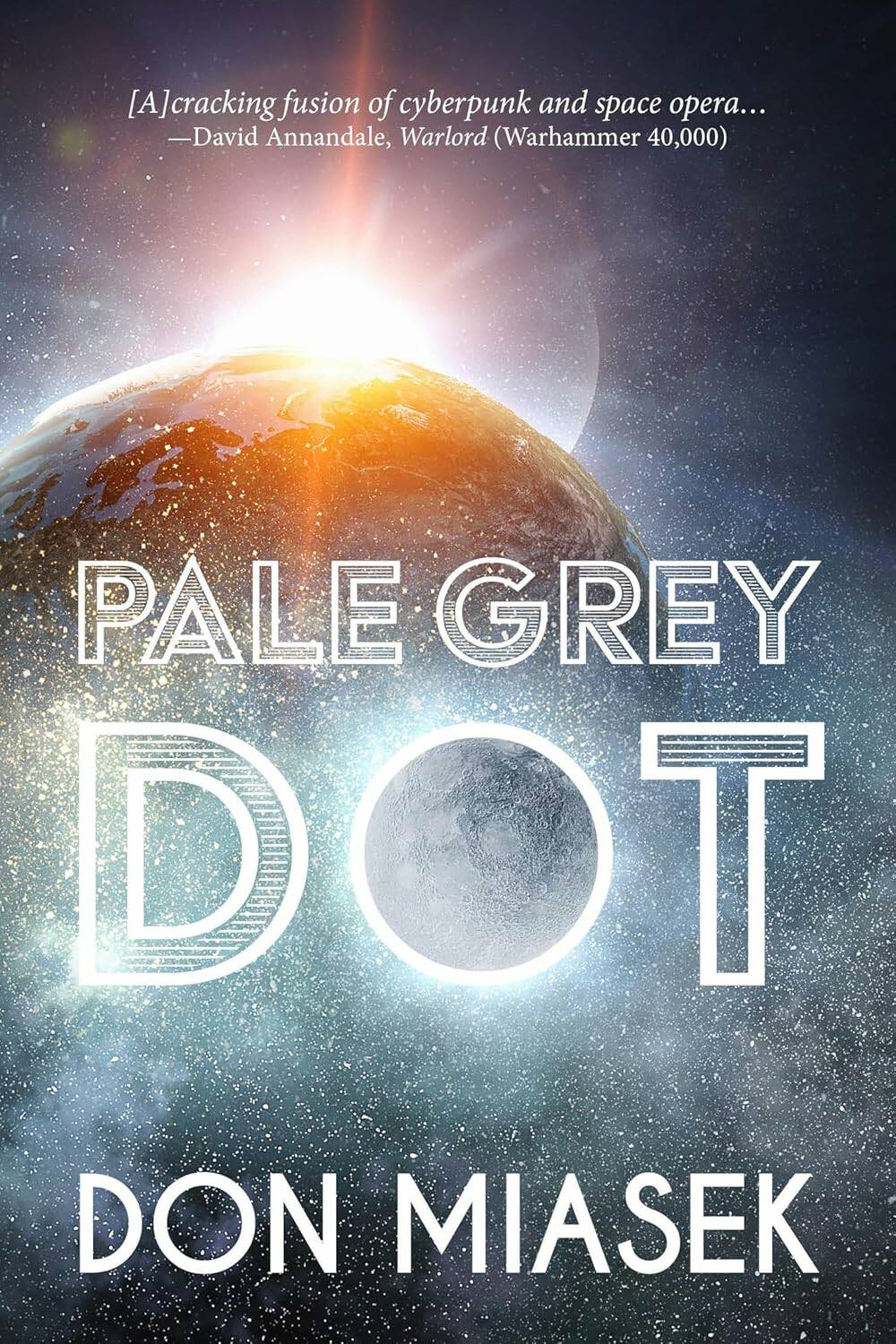
Pale Grey Dot
Don Miasek’s debut novel could only have been science fiction. A principal editor of tdotSpec, “a team of writers and editors from Toronto, dedicated to publishing awesome speculative fiction that reflects diverse and vibrant voices from around the world,” Miasek here attempts for his first time a full-blown sci-fi bonanza. It is deliberately epic, but here it is in capsule: he assembles a gaggle of former establishment operatives, chucks them out into the solar system and contrives to have them realize they must adopt a concerted path back to their Terran home to commit tyrannicide. Or matricide. Or deicide. It depends on how you look at it.
So, sci-fi saga it is.
There are spaceships big and small, missiles, lasers and old-school fistfights, full-on robots and cybernetically enhanced humans as well as interplanetary questing and ship-corridor dashing. There is that massive, nasty, distantly-central, almost-omniscient, nigh-omnipotent, certainly totalitarian and downright icky over-arching governing thing. There is our cluster of extra-special rebels with some extra-special powers who are united in newfound loathing for that oppressive, grand entity. And there is the unwavering movement of everyone and everything, first away from and then toward that gravitational, central heartbeat where that gargantuan evil encamps.
So, familiar it is, as well.
There is also a No. 2 baddie whose physiology is intricately machined, one who is quite fond of holds metaphoric and literal: he dines out on a galactic reputation that grips any naysayers in abject fear and, in a fateful penultimate act that yields full sway to his mammoth hubris, deploys one of his mechanized limbs to choke the throat of a particularly rude dissenter.
There are also anonymous, impersonal, antagonistic droid drones zipping all over the place with their spidery legs and penchant for plurality and shooting first.
There are also wickedly restraining chips (called “the Athenian protocol”) pre-emptively embedded in any useful being that might contemplate revolt, chips that need to be surgically removed.
There is also a hologram message those now-lovable rebels serendipitously intercept, making all the difference. And a brawl between one dubious rebel and an irrelevant baddie-on-the-spot — in a canteen.
So, it is too familiar — which is too bad, as there is some lovely stuff here.
Miasek’s title is an obvious but potent riff on Carl Sagan’s wondrous 1990 book Pale Blue Dot. But the allusion is not just a pretty face; what Miasek is fundamentally doing is initially crafting a handful of co-protagonists (there are a half dozen who are banded and important), then fragmenting and expelling that wayward coterie from a gasping Earth, and finally forcing them to pull a Lot’s Wife and gaze back at that fatally industrialized grey orb, washing his creatures in a come-hither wave of horror and nostalgia.
At one point Miasek gracefully sends a money Sagan quote blipping through one of our flawed rebels’ minds (he is contemplating that pale dot, “the aggregate of all joy and suffering…”), but Miasek trusts his reader to understand our century’s resonances in his faux-remote epic without being heavy-handed, resisting uttering the name “Sagan.” And so, we have some elegant writing here.
Miasek’s inter-textual manoeuvres are, in many ways, quite complex and often most satisfying. There are bits here of the Wachowskis (The Matrix), of Gene Roddenberry’s writing heirs (especially The Borg and its Collective Cube), of anything Philip K. Dick (especially Blade Runner and Minority Report), of Josh Whedon (Firefly) and, if you’d like, even of Quentin Tarantino (Kill Bill) and John Frankenheimer (Ronin). There is also singularly and inevitably Arthur C. Clarke (2001: A Space Odyssey). This is the early 21st century projected on a surprisingly proximate 26th, through and through.
Miasek takes his science quite seriously. So devoted is he to a scrupulous depiction of the incomprehensible vastness of spatial distances and the crushing breadths of time required to traverse them that his novel very nearly grinds to a halt in mimicry.
Finally, Miasek’s explorations of the intrusion of the digital and the mechanical on the lives of human beings are often quite thought-provoking. His book is at its strongest as it makes its reader see the computer ports on the protagonists’ limbs, hear the clicking as drives and who-knows-whats are merged with their bodies, and wonder in a Ship-of-Theseus manner just when the human is shuffled off and the robot has become. That said, Pale Grey Dot does force one to conclude that if our present is not already at Miasek’s future, it will be beyond it so very soon.
This charmingly enthusiastic sci-fi offering is ultimately an ambitious attempt at co-opting the (near) future in service of proclaiming discomfiting, creeping commentary on our depressing, blinded now. Miasek certainly achieves orbit on that and unquestionably proffers an ironically humbling, grand snapshot of a once-magnificent Earth that now seems irreparably sullied.
Laurence Broadhurst teaches English and religion at St. Paul’s High School in Winnipeg.